Optical Crosstalk in CMOS Image Sensors
Chris Fesenmaier and Benjamin Sheahan
Psych 221 - Winter 2006-2007
| Welcome | ||
| Introduction | ||
| Methods | ||
| Pixel Scaling | ||
| Methods | ||
| Results | ||
| Conclusions | ||
| References | ||
| Crosstalk Reduction | ||
| Methods | ||
| Air Gaps | ||
| Light Guide | ||
| Metal Mirrors | ||
| Results | ||
| Reference | ||
| Air Gaps | ||
| Light Guide | ||
| Metal Mirrors | ||
| Conclusions | ||
| References | ||
| Appendices | ||
Crosstalk Reduction - Results
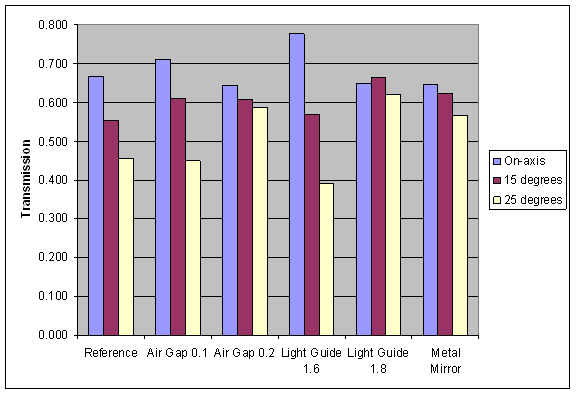
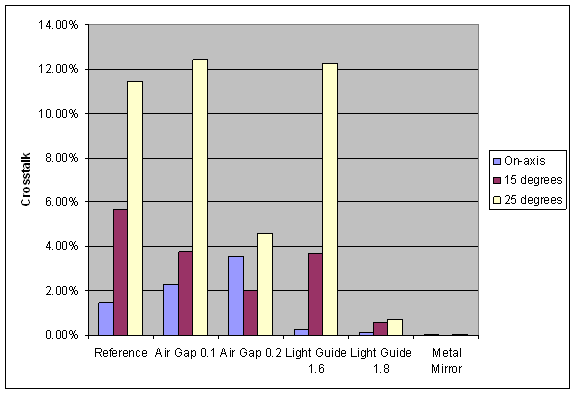
It is evident that the best solution for the on-axis case, the n = 1.6 light guide design, was among the worst performers at high angles of incidence. The most robust crosstalk prevention methods, meaning those that performed well regardless of angle, were the high-index light guide and metal mirror designs. Note that there is a wide range of transmission and crosstalk values among the different tests, especially for the 25 degree case. It is also important to observe that some designs performed worse than the baseline in certain situations.
|
(a) |
|
(b) |
Fig. 19. Plots of the transmission (a) and crosstalk (b) for all tested designs. |
As a further comment on the methods tested, it is important to note that they were all based on reflection and not absorption. While it would be feasible to deposit absorbing material to prevent crosstalk, the amount of light lost would be too great. By pursuing methods which instead attempt to redirect the light, both transmission and crosstalk can be improved.