Optical Crosstalk in CMOS Image Sensors
Chris Fesenmaier and Benjamin Sheahan
Psych 221 - Winter 2006-2007
| Welcome | ||
| Introduction | ||
| Methods | ||
| Pixel Scaling | ||
| Methods | ||
| Results | ||
| Conclusions | ||
| References | ||
| Crosstalk Reduction | ||
| Methods | ||
| Air Gaps | ||
| Light Guide | ||
| Metal Mirrors | ||
| Results | ||
| Reference | ||
| Air Gaps | ||
| Light Guide | ||
| Metal Mirrors | ||
| Conclusions | ||
| References | ||
| Appendices | ||
Methods - Air Gaps
This technique to confine the incident light relies on TIR at the boundary between the ILD, in this case silicon dioxide, and an air void that is formed at the edge of the active pixel area. This method has been recently demonstrated in literature [3-6] by engineers at the Taiwan Semiconductor Manufacturing Company (TSMC), who found that it could significantly increase light transmission and reduce crosstalk. A SEM image of one of their test structures is shown in Figure 5(a) and an illustration of the air gap concept is shown in Figure 5(b).
|
|
(a) |
(b) |
Fig. 5. SEM image (a) and illustration (b) of the air gap concept, courtesy of Hsu et al. [3]. Note the space in between the air gaps to allow the metal interconnects to run through the structure. AGGR stands for Air Gap Guard Ring. |
|
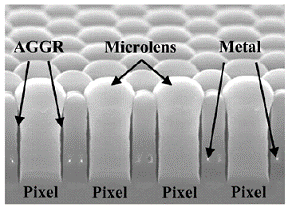
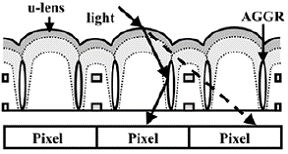
The benefit of such a design is two-fold. First, light inside the pixel light tunnel at an angle less than the critical angle of the oxide-air interface should be reflected and land on the photodiode. Second, any light that does not undergo TIR at the oxide-air interface is refracted at a more vertical angle, meaning that it will travel less distance laterally and have less likelihood of reaching the active area of the adjacent pixel. Given an index contrast between silicon dioxide and air of 1.46, we would expect a critical angle of over 46°, more than sufficient for most sensors. In real situations, this air gap would have a rounded shape, but was approximated as rectangular for simplicity.
The air gaps are formed by selectively etching away a nearly vertical line of oxide where the air gaps should be. Then a film is deposited on top that pinches off the hole and seals the air gap. While this seems simple, the process is quite difficult and care must be taken to ensure that other materials do not reside in the voids.
Other than the spacing of the air gaps, which was preset for this study to keep the comparison between the techniques fair, there is the additional degree of freedom of the width of the gaps. For very narrow air gaps, it is possible that light may "leak" through the gap even when it should be reflected. To test this effect, two air gap widths of 0.1 µm and 0.2 µm were simulated.