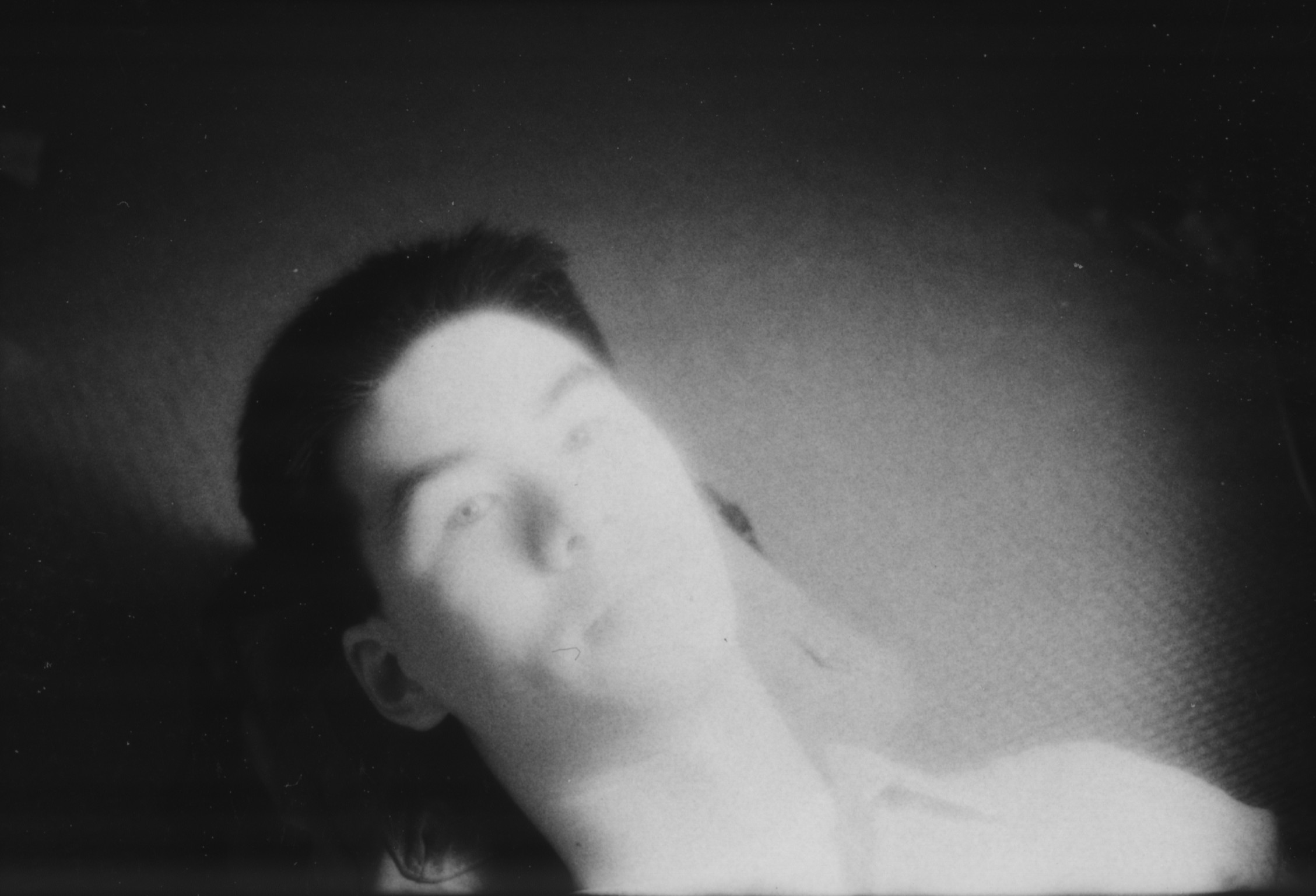
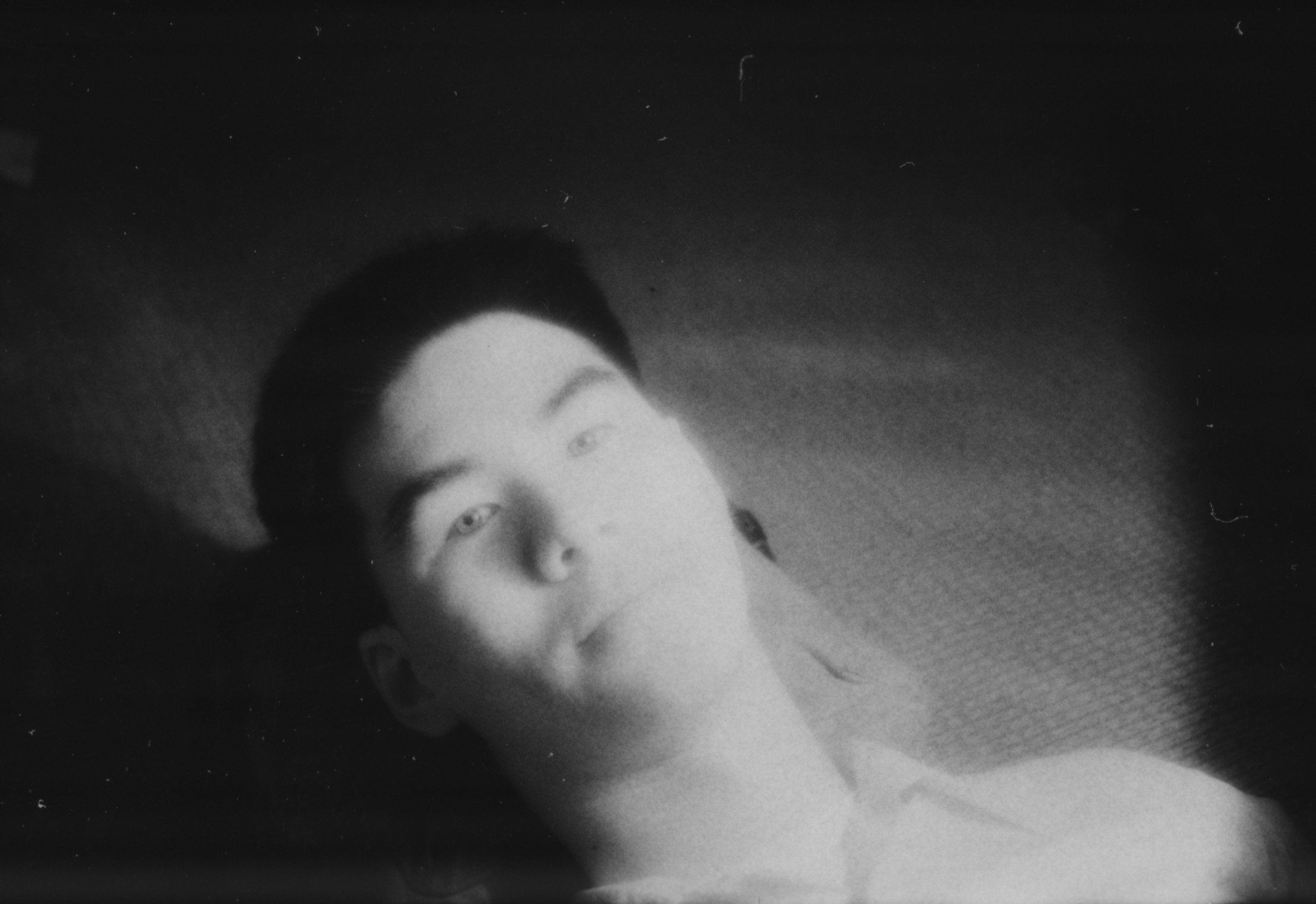
While we did not follow as rigorous a calibration procedure for these photographs, we nonetheless include them for their striking appearance. Both images below were taken with the red filter and under the same exposure settings. The image at left was taken under Reveal light illumination, whereas the image at right was taken under Halogen light illumination. Note that, as expected, the Reveal image is brighter; this coincides with our results from an inspection of the light sources.
Of particular interest in these photographs is the color of the iris. The subject is a young Asian male and has the expected dark brown eyes under normal conditions. However, with the red filter and infrared film, the iris appears much lighter. The effect is seen with both Reveal and Halogen illuminants. It suggests that the iris is reflecting a large amount of infrared light, particularly striking since the nominal dark brown of the iris suggests that it absorbs a large amount of visible light. The sharpness of the division between visible and near infrared is highlighted. An attempt was made to also image a blue iris to see if the effect is eye pigmentation dependent. Unfortunately, those images came out too overexposed.
In general, infrared imaging of the human eye seems to find especial popularity in eye tracking algorithms, wherein the reflection direction of the incident infrared beam is used to determine eye location. Naturally, the fact that the human eye does not perceive infrared light prevents the tracking system from distracting the user. This paper gives a good introduction to the field, including a history of attempted techniques. It is also interesting in that it addresses the interesting design problem of using eye movements as an input mechanism to a machine. The paper has a goodly list of references, however, one it lacks is found here. In this paper, seemingly oft-cited in the literature, two near infrared LEDs operating at 880nm and an infrared sensitive camera are used to measure light reflecting off the eye. This particular method exploits the fact that when the light source is coaxial with the camera the pupil appears bright, whereas when the camera is not coaxial, the pupil appears dark. Contrasting the derived bright and dark eye images then allows more accurate tracking of the pupil than either technique in isolation. Finally, more information on different eye tracking algorithms can be found in the reference list found here.
Home Introduction Applications Methodology Modeling Results Conclusion References Appendix I Appendix II