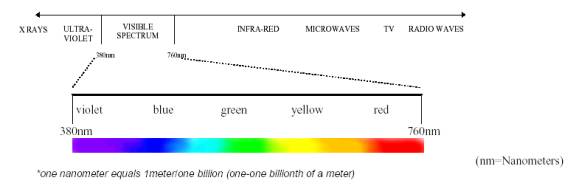
Human vision is sensitive to visible light, that part of the electromagnetic spectrum with wavelengths from about 400 to 700 nm. Correspondingly, most photographic film is sensitive to this same range. This project focuses on the use of near infrared film, which is sensitive from about 400 to 900 nm. The range of wavelengths from 700 to 900nm is termed the near infrared regime. This project will present some common uses of infrared photography, develop a methodology to analyze the process of infrared photography, and then apply this methodology to a variety of pictures we acquired under controlled conditions. The goal of the project is to gain a general understanding of infrared photography through the acquisition of photos and a simple qualitative analysis.
This report is split into six main sections. This Introduction gives a brief overview of near infrared photography, and describes how the report is laid out. This is followed by an Applications section that discusses two common uses of infrared photography. The Methodology section includes a description of the experimental setup, a simple model of the photographic process used, and a description of how the film was processed. This is followed by the Modeling section, which describes the models created in Matlab of the imaging device and different sources, and derives a transfer function for each system. The fifth section is Results, which discusses the correlation between the transfer functions and a number of pictures of flowers, fruits, circuit boards, and a forest. Each picture is explained in terms of the transfer function of the system that took the image. Finally, the last section is the Conclusion, which sums up the material presented on the site. This is followed by the References, which contains links for more information on infrared photography; Appendix I, which contains the source codes used in Matlab as well as some other photos taken that are not included in the results; and Appendix II, which describes the contributions of both of the members of the group. Enjoy!!
Home Introduction Applications Methodology Modeling Results Conclusion References Appendix I Appendix II