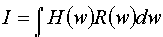
The image intensity of a photograph depends on the source lighting, the reflectance of the object, and the optics of the camera. Each of these not only depends on geometry, but also varies with wavelength. In this project, we focus on the later. In terms of the wavelength w, the intensity of the photograph is modeled (very simply) by:
R(w) is the reflectance of the object and is the quantity we are attempting to capture in taking the image. H(w) is an effective transfer function. It is a combination of the spectrum emitted by the light source S(w), the transmission characteristics of the camera filter Cfilter(w),and the film sensitivity Cfilm(w). We assume that the rest of the camera optics is constant, and hence effectively unity, with respect to wavelength. Expanding out the intensity:

There is also a transmission model of photography wherein the object is characterized by its transmission X(w) (or conversely absorption A(w)) of the source spectrum instead of its reflectance. This mode is often used in biomedical applications for noninvasive infrared imaging. Since in our setup the objects are front lit, the reflectance model is more appropriate. However, the mathematics of transmission is similar to that of reflectance: the reflectance R(w) can just be replaced by the transmission X(w).
For our project, we attempted to assess the reflectance of objects in the near infrared regime. To this end, photographs were taken in a controlled environment and the effective transfer function H(w) was varied in hopes of highlighting different aspects of the near infrared spectrum. To do this, one of three different light sources was used to illuminate the object. Pictures were then taken either with or without a red filter applied to the camera lens; six different transfer functions were thus achieved. For all photographs, Packard 036 was used as a darkroom. The source lights were alternately mounted in the same torchiere lamp and the camera was fastened to a tripod so that the geometry (e.g. distance from source light to object, distance from object to camera) was kept constant for all shots. Similarly, the same infrared film was used for all shots. The components were:
Invariant Components |
Varying Components |
|
Camera: Nikon AF N6006 |
Filter: Promaster R2 Red Filter |
|
Lens: Nikkor AF 35-80mm |
Light Sources: |
|
Film: Kodak HIE 135-36 B&W |
GE Reveal 100W Lightbulb |
|
(High Speed Infrared Film) |
GE Halogen Ultra 60W Lightbulb |
|
|
Strobe-Incandescent Light |
The spectral characteristics of these components are detailed in the modeling section. Three sets of objects were imaged. These were 1) a bouquet of flowers in water, 2) a table of fruits and vegetables containing a bunch of grapes, banana, apple (in background), tomato (in foreground), and leaf of lettuce, and 3) a collection of printed circuit boards. Objects were chosen to emphasize a diversity of materials.
Due to our inexperience with infrared film, shots were taken with a variety of focuses, exposure times, and film speeds. As the automatic settings for the camera were designed for visible light, all settings for the camera were performed manually. As infrared light will have a longer focal length with the camera optics than visible light, the image was brought slightly out of focus, moving the lens out for these pictures. As this study is not considering spatial resolution, the degree the shots are in focus will not have a significant impact on the results. There are a variety of web sites detailing practical aspects of working taking infrared pictures. Jeremy McCreary's site and also the Infrared Photography FAQ by Clive Warren come highly recommended. In our case we tended to overexpose the infrared photos, but still managed to see some interesting effects, and have included only the clearer shots.
In addition to these controlled photos, outdoor photographs were acquired both with and without the red filter. The same camera and infrared film as in the controlled shots were used for these outdoor shots as well. Sunlight provides a strong source of near infrared radiation and deciduous foliage, it turns out, is particularly striking in the near infrared. Images were also taken of the human face, to emphasize an interesting appearance of the pupil under near infrared imaging.
Finally, we took some photographs with a digital camera equipped with a Tiffen 87 58mm infrared filter. The camera was generously leant to us by Ulrich Barnhoefer. The Tiffen filter is a true infrared filter, but was not compatible with our Nikkon camera due to the different lens size. While this project did not attempt to model the digital system, we nonetheless discuss some salient features of the images in the Results section.
The infrared film was developed by Keeble and Shuchat Photography down California Avenue here in Palo Alto. Negatives and contact sheets of the infrared photographs were acquired; unfortunately, time constraints prevented us from getting prints of the photographs. While we were able to digitize the negatives themselves, the resulting images either contained line artifacts or poor dynamic range (negative scanners at both the ISE Lab and Meyer Library were tried). It was found that digitizing the contact sheets directly prevented line artifacts and permitted higher dynamic range. Thus, the analog images seen here are contact sheet images scanned by an Epson 1600 Expression scanner operating at 1600 dpi (available at Meyer Library). This accounts for the occasional dust and fingerprints in the images. Care was taken to turn off as much of the scanner image post-processing as possible. Corel Photo-Paint 8 was then used to both crop the raw images and convert them to standard JPEG under 10% compression and 10% smoothing.
The color photographs shown here were acquired using the same camera and filters with standard Kodak Gold 200 film. Film was developed and photographs printed at Keeble and Shuchat Photography. The final prints were digitized by the HP ScanJet 4C available in the ISE Lab.
Home Introduction Applications Methodology Modeling Results Conclusion References Appendix I Appendix II