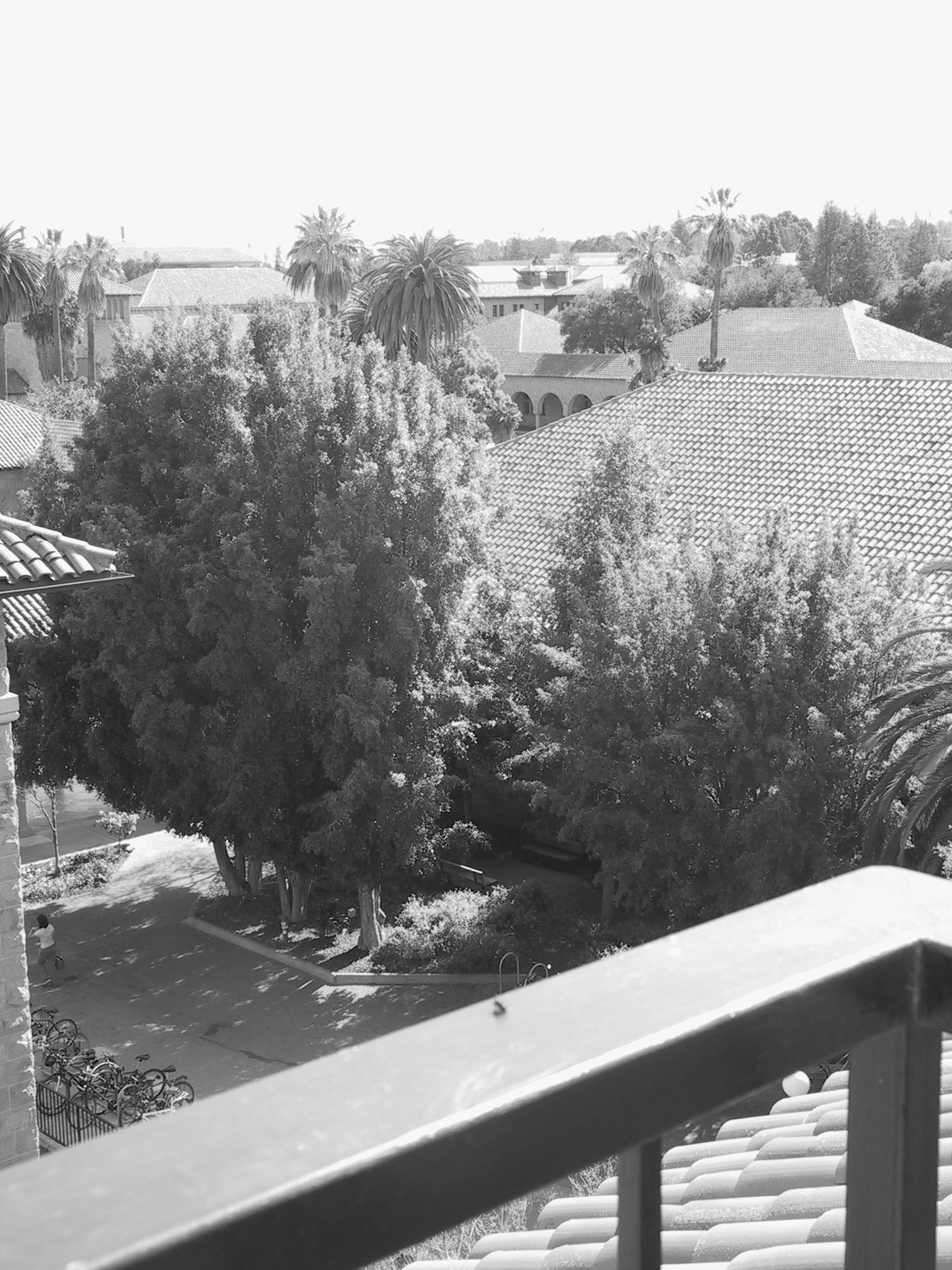
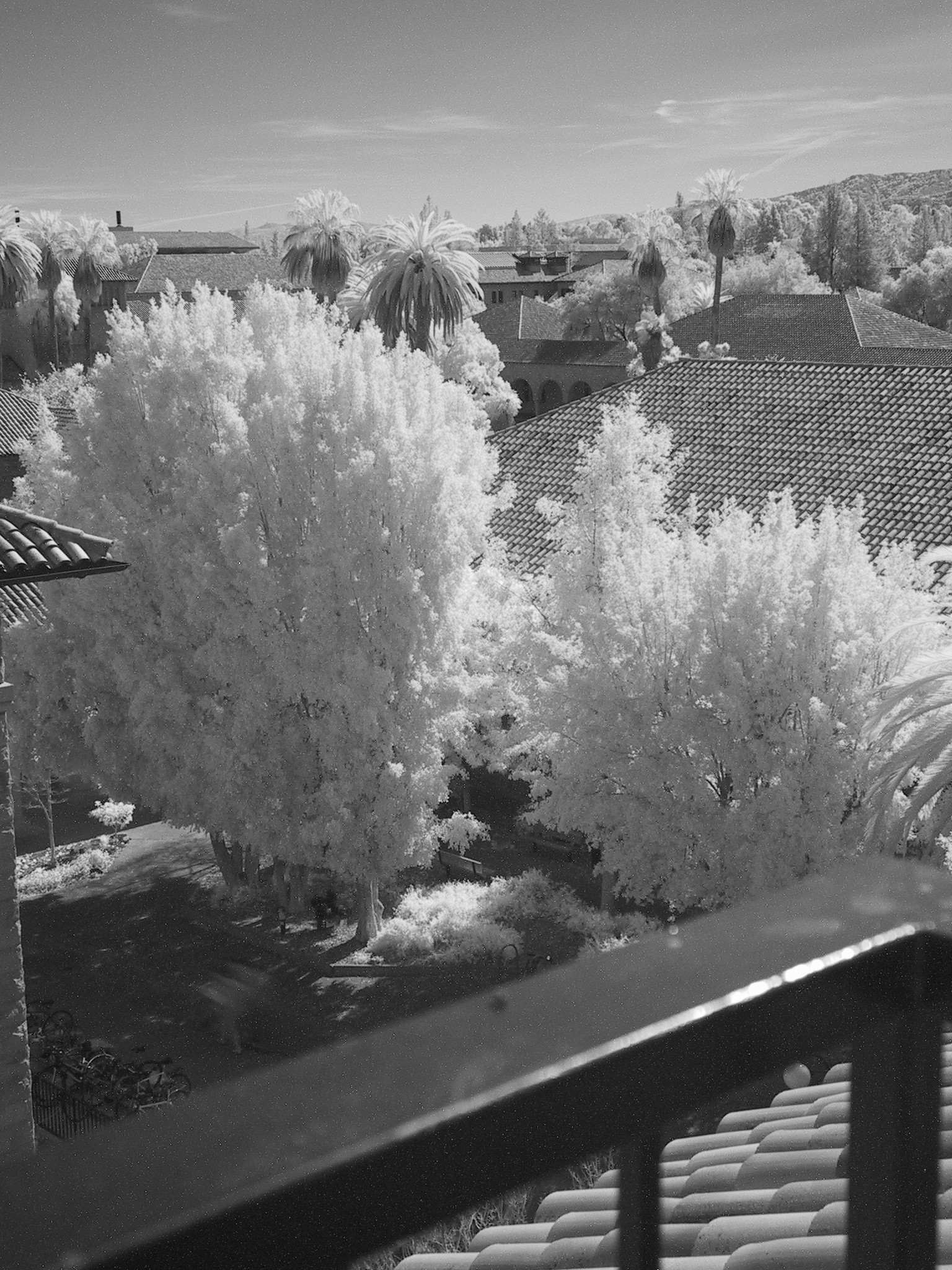
Below are shown two photos taken with the digital camera generously loaned us by Ulrich Barnhoefer. The pictures were taken from the roof of the psychology department here at Stanford University overlooking the quad. Again taken under strong daylight conditions, these images utilized a Tiffen 87 58mm true infrared filter. While most pictures taken came out too underexposed to be of use, the two below came out nicely. The picture on the left is the standard black and white digital image taken without the filter, and the image on the right is the one with the infrared filter attached. Although we did not attempt to model this system, there are still some notable features worth a look.
First notice the sky at the top of the images. Without the filter, the sky is very bright, as it was a sunny day. No clouds are discernible. When the filter is added, the near infrared image now has the sky dark, as the blue light coming from the sky has been filtered out. Further, some clouds are clearly visible. The ability of near infrared to image clouds is a common application of the film. Next, notice the dramatic difference in the brightness of the trees between the two images. Both the trees in the center of the picture, and the palm trees in the background are significantly brighter in the near infrared image. Plants reflect near infrared strongly, and this is often termed the Woods effect. This ability to image foliage is another common usage of near infrared photography, and is discussed in the Applications section. Finally, notice the bicycles in the lower left corner of the image. Without the filter, the bicycles look dramatically different, due to their different colors. However, with the filter, the bicycles are not as bright, and what is more all look to be the same hue, indicating that, despite their different colors, they all similarly reflect near infrared light.
Home Introduction Applications Methodology Modeling Results Conclusion References Appendix I Appendix II