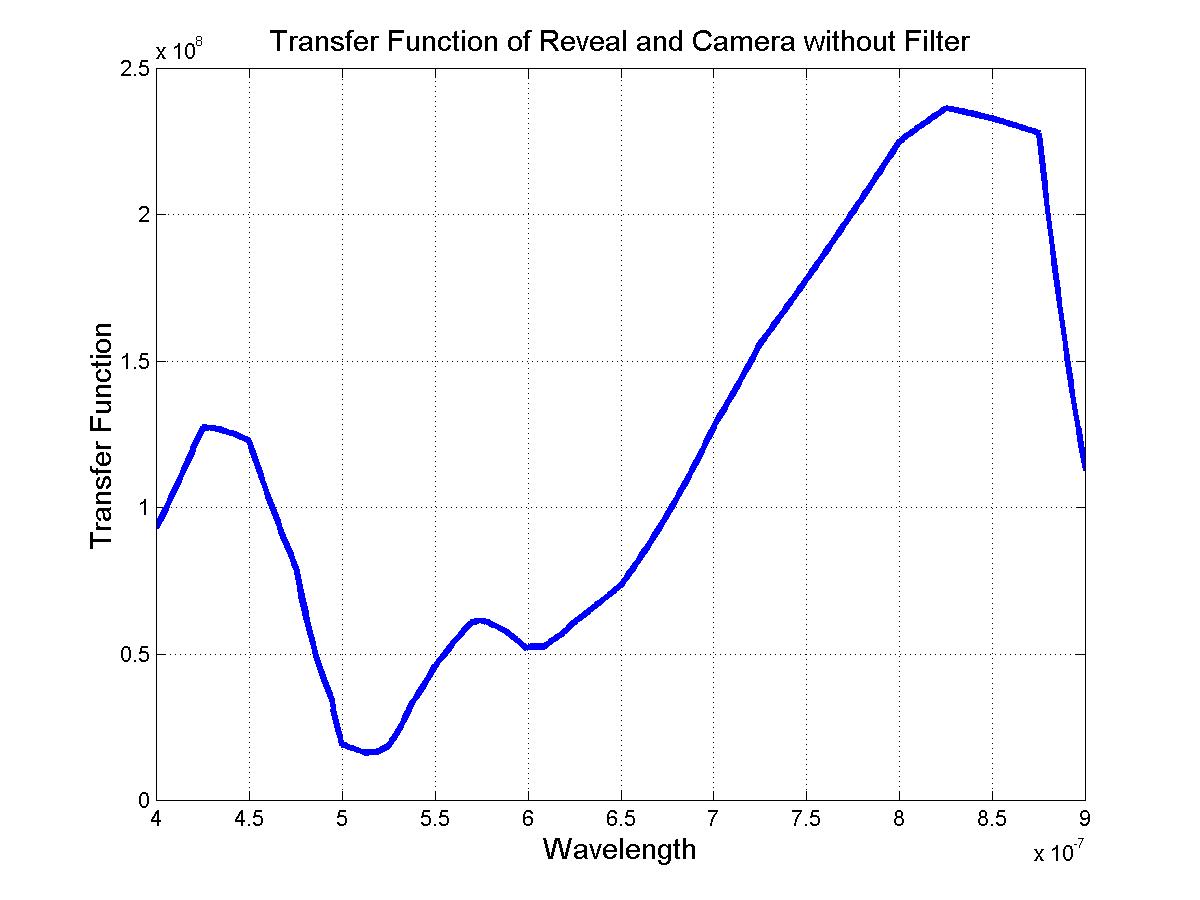
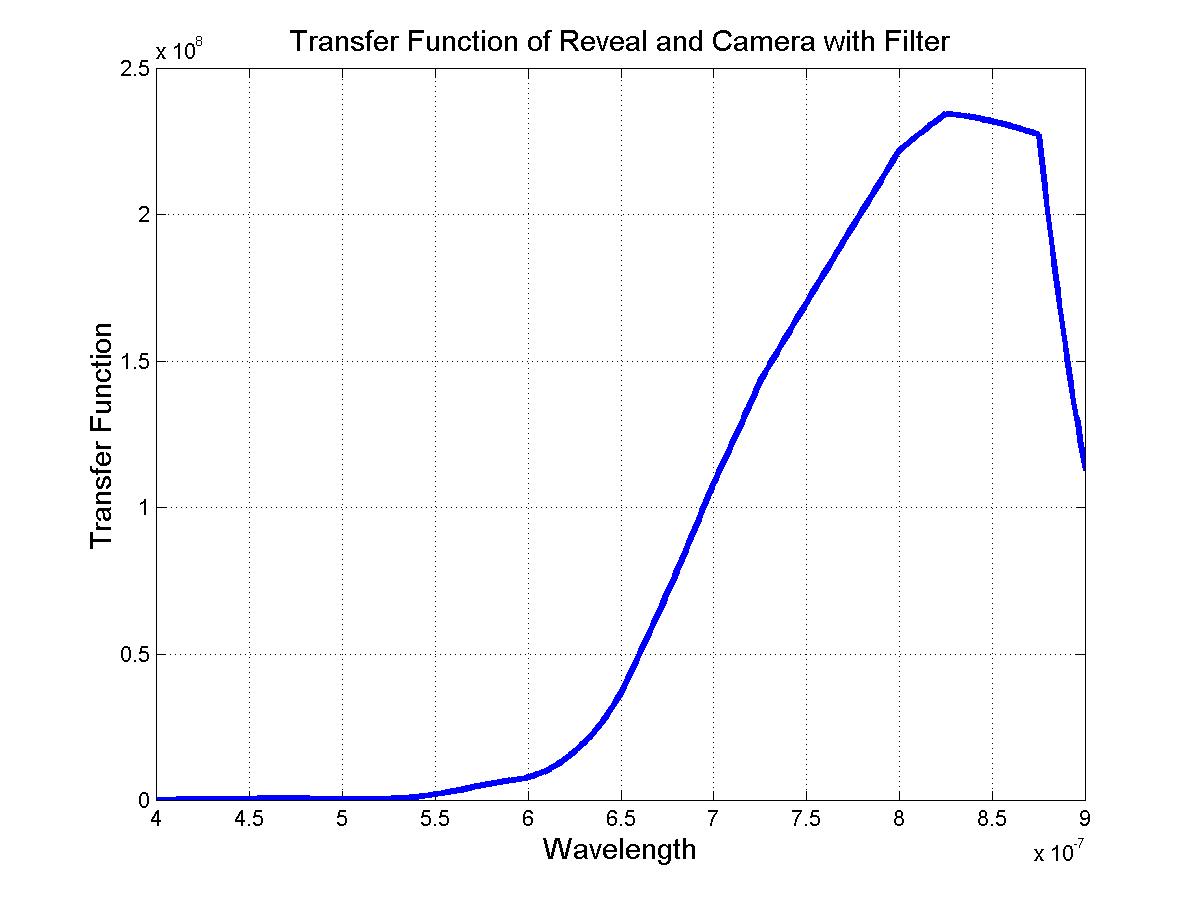
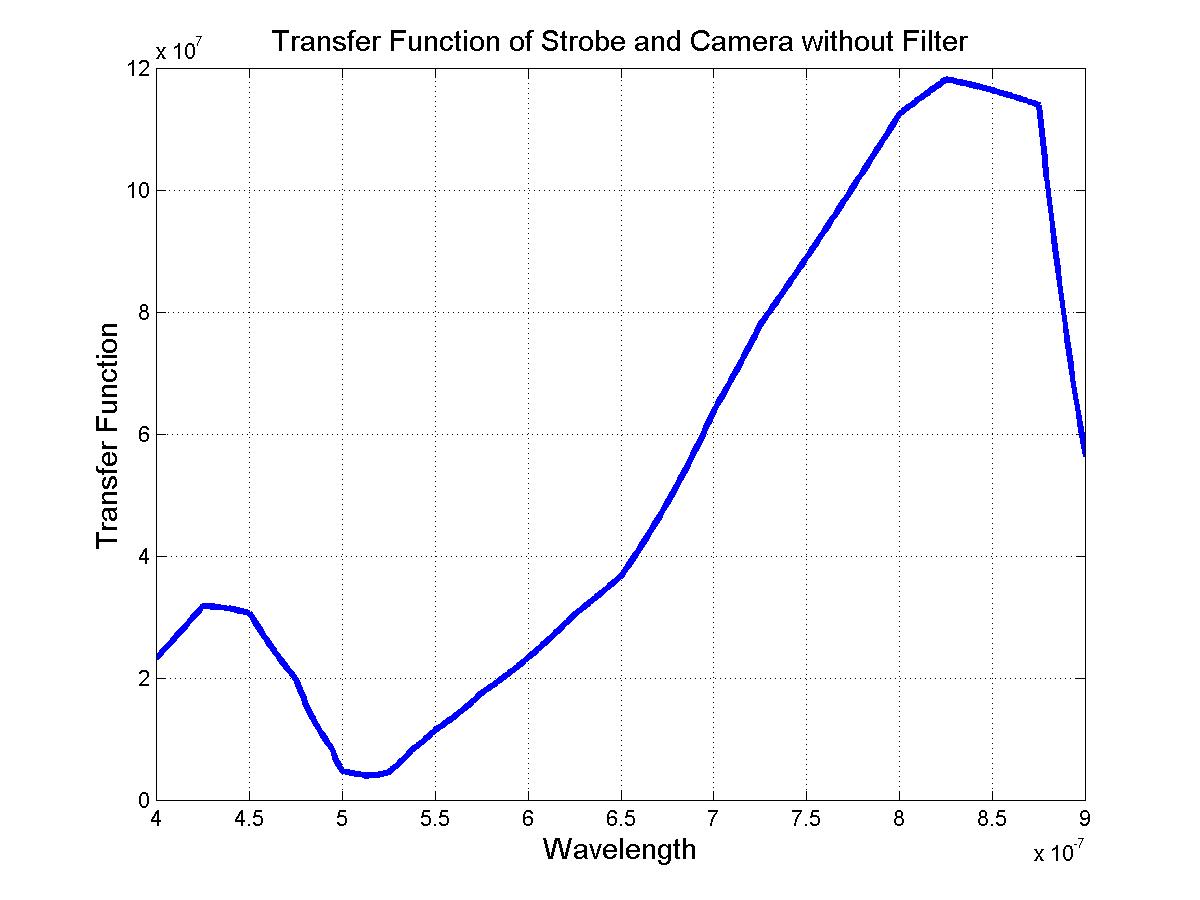
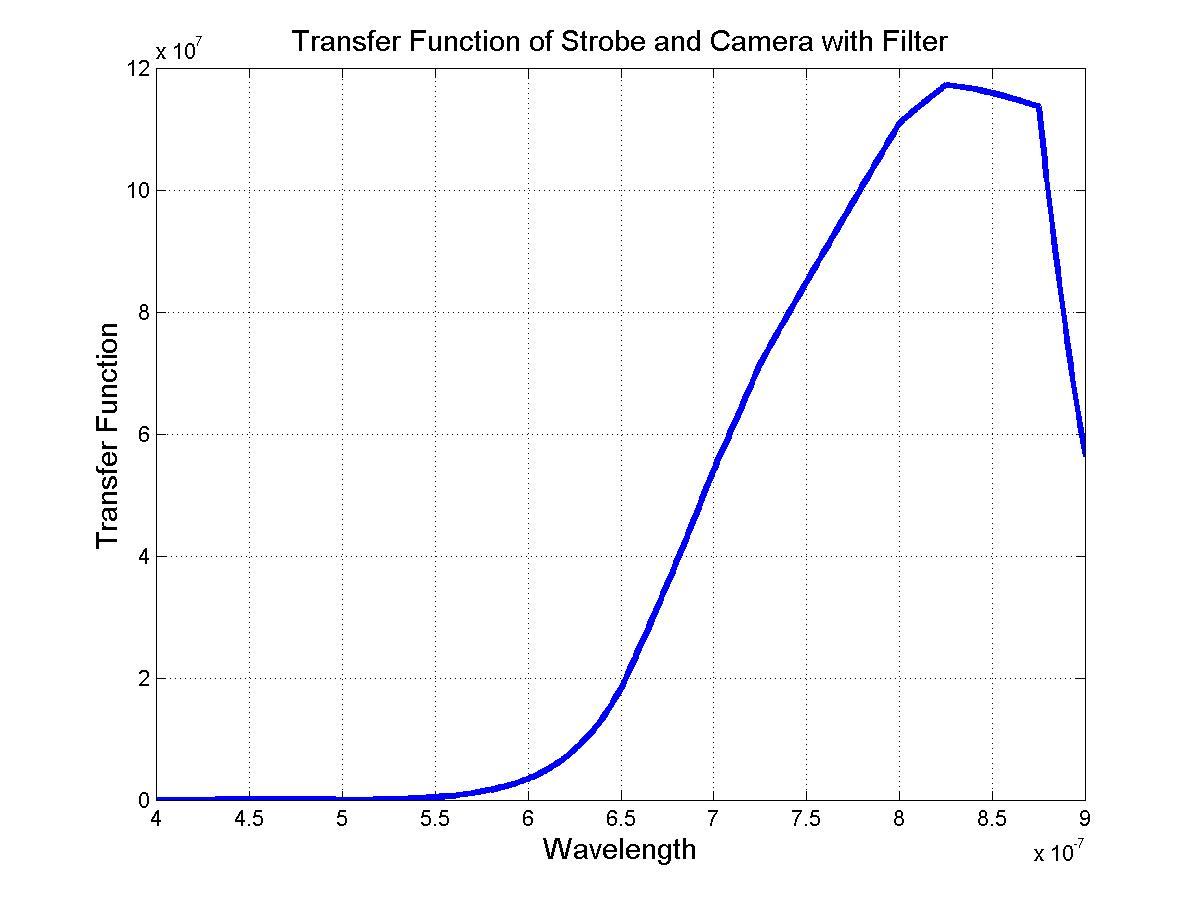
The final transfer functions incorporate the effects of the source, film, camera, and filter. The corresponding spectral plots are multiplied together one wavelength at a time to get a transfer function for the system. These transfer functions, when multiplied by the reflectance characteristics of the different objects and integrated over the whole frequency range, will give the amount of exposure on the negative. Note that these values are only relative. The numbers are exceedingly large, mostly because the geometry of the source, object and camera are not taken into account. Therefore, the functions are only useful in making relative comparisons. The transfer function has no units, as it is a scale factor.
Without Filter: The transfer function shows that the image will be strongly sensitive to the near infrared region of the spectrum. Violet light will also show up clearly in the image. The film largely filters out blue and green light. The notch visible is the attenuation of the yellow light by the glass of the reveal bulb and the film, and will have a minimal impact on the exposure.
With Filter: Adding the filter depresses the effect of violet light on the exposure. The exposure will be mostly determined the by the near infrared component of the reflectance as desired.
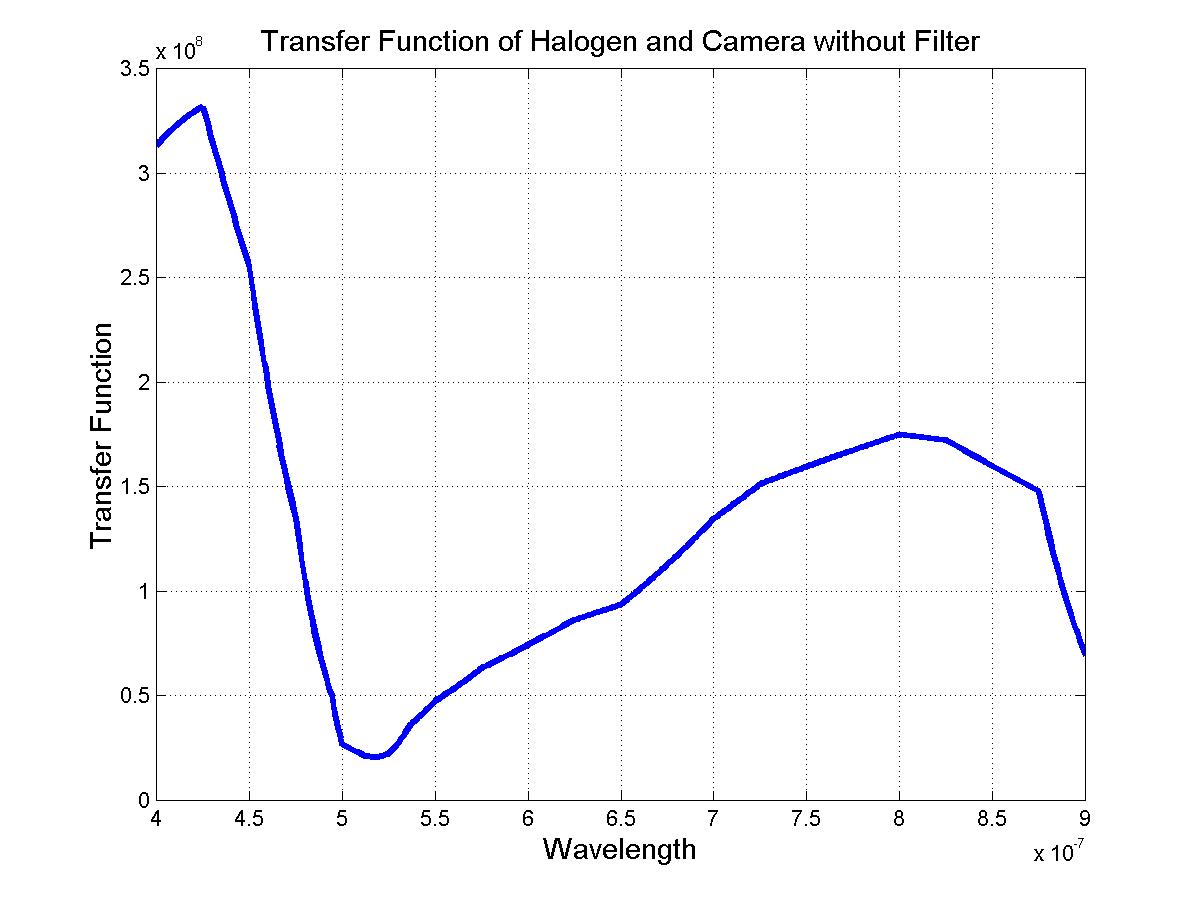
Without Filter: The transfer function shows that the exposure will be strongly sensitive to both the near infrared (700-900nm) and violet (400-450nm) portions of the spectrum. The film attenuates the yellow and green (500-600nm) wavelengths. The violet light has a strong component in the spectra of the Halogen bulb, and without a filter will come through strongly. When compared to the reveal bulb, it can be seen that this strong component from 400 to 470nm is the most significant difference.
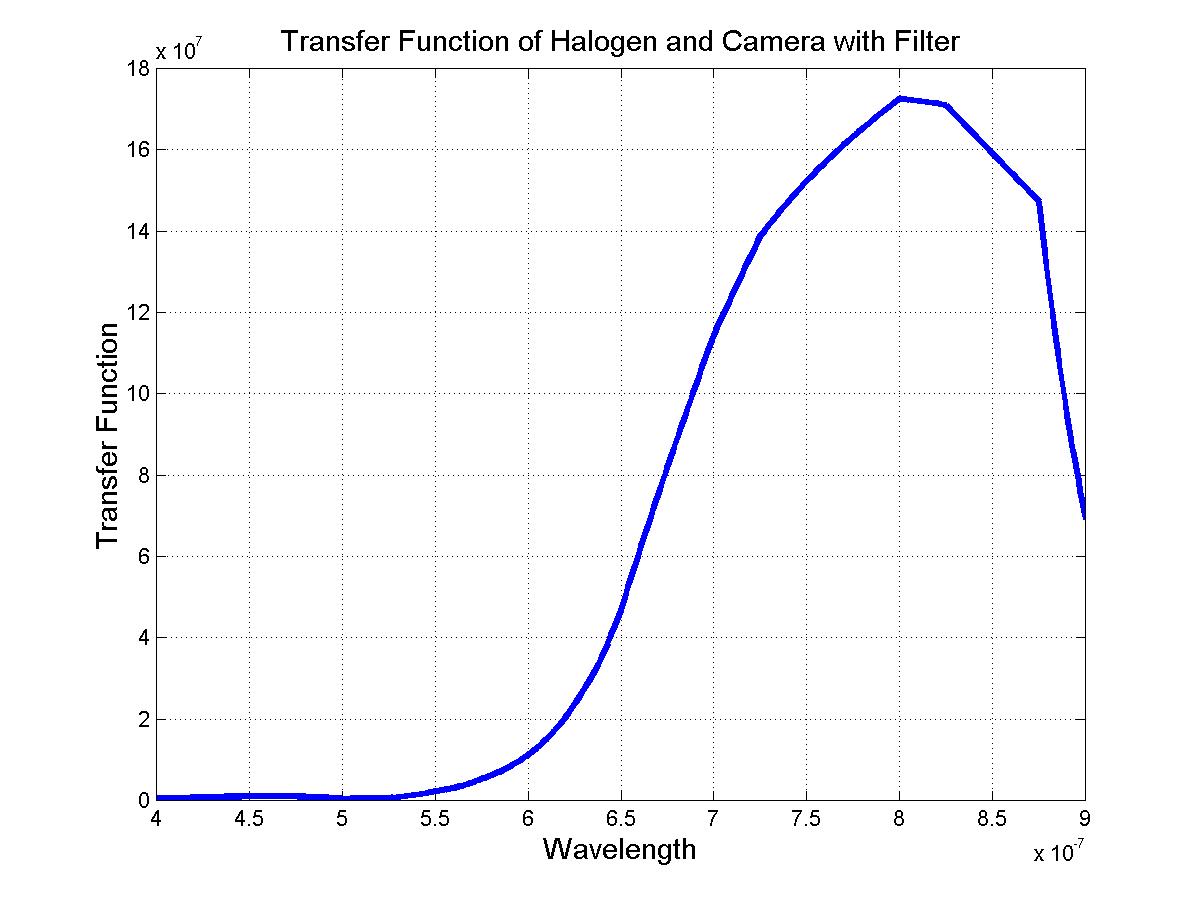
With Filter: Adding the filter to the Halogen bulb attenuates the violet portion of the spectrum, resulting in an exposure dominated by the red and near infrared wavelengths. The curve now looks similar to that of the Reveal bulb with a filter on the camera, except that the exposure is more sensitive to visible red light, down to about 650nm wavelengths.
Without Filter: Similar to the Reveal bulb, the transfer function shows that the image will be strongly sensitive to the near infrared region of the spectrum. However, even without the filter, there is a minimal component from the violet, blue, yellow and green light wavelengths. The exposure will be dominated by the red and infrared components, from 650 to 900nm.
With Filter: Adding the filter reduces the contribution of the visible components of the light, resulting in a transfer function very similar to that of the reveal bulb with a filter. The exposure will be dominated by the near infrared wavelengths, as desired.
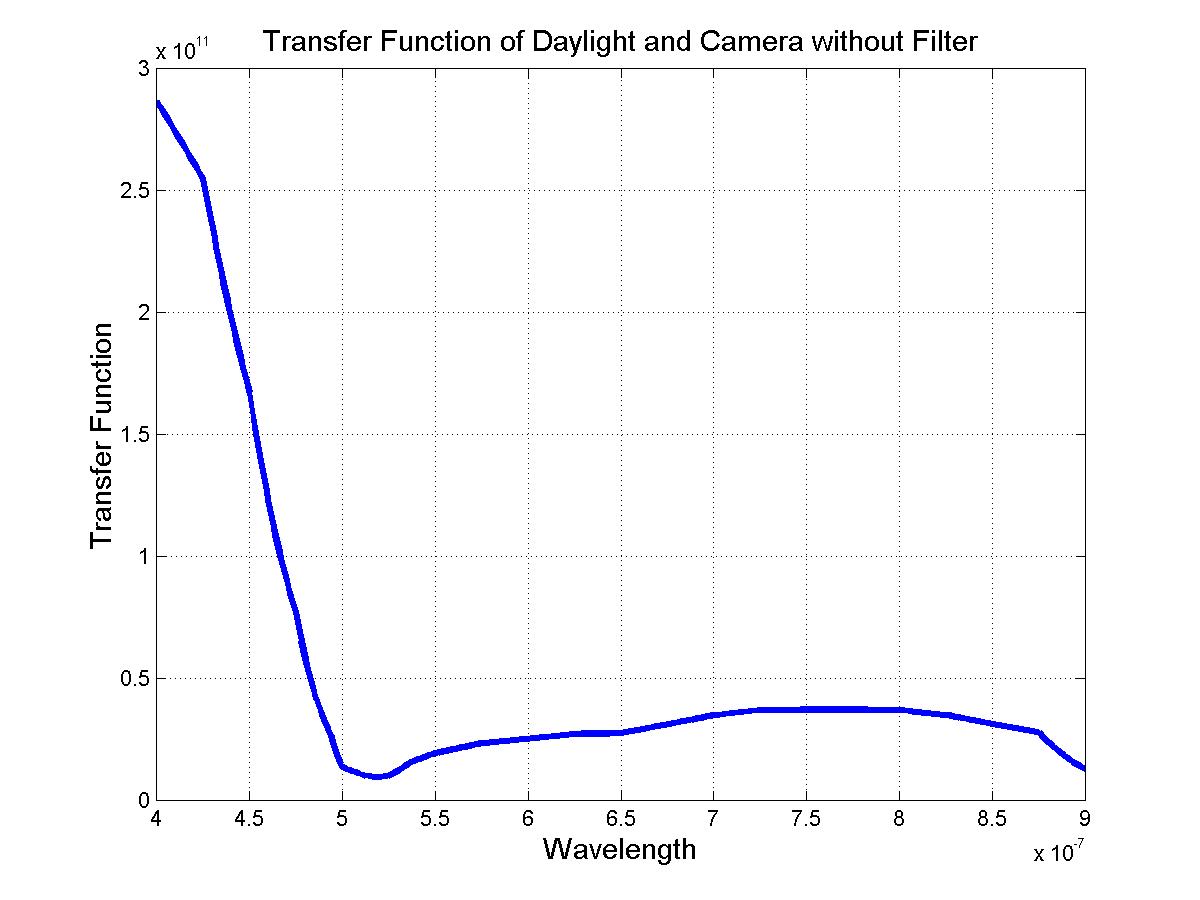
Without Filter: Without the filter, the exposure in daylight is dominated by the component of spectrum from 400 to 470nm, or visible violet light. Although daylight has a strong yellow component, the film is not very sensitive to these wavelengths. There is a relatively equal component from 600 to 900nm. The scale of these numbers cannot be compared to the other plots, as the conditions used for daylight were not controlled.
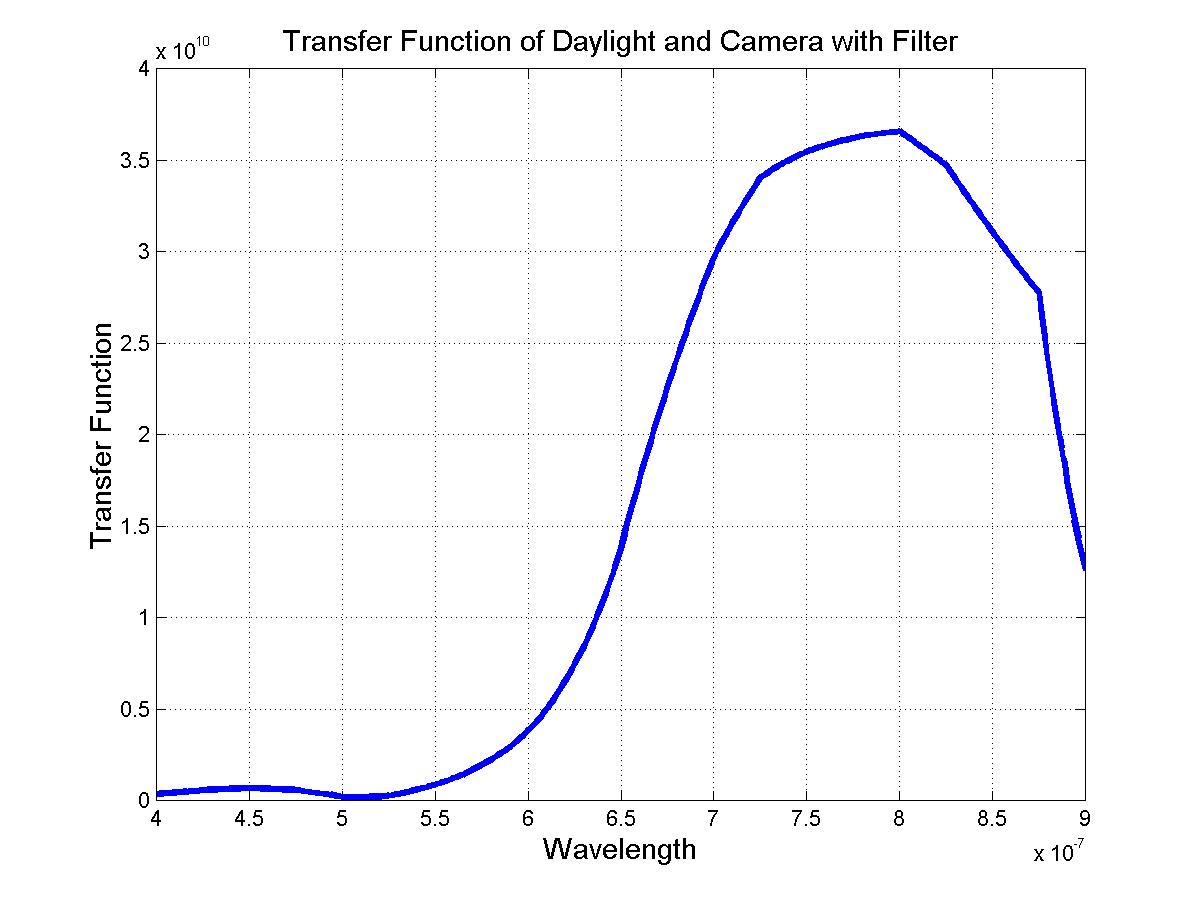
With Filter: Adding the filter attenuates the high spectral component of daylight below 500nm. This means that the exposure is now dominated by light in the near infrared and red range, from 650 to 900nm. There is a significantly larger component of red visible light in the transfer function than from the other sources.
Home Introduction Applications Methodology Modeling Results Conclusion References Appendix I Appendix II