
The camera consists of three different components: the camera optics, the film, and the filter. Since the project is not considering the different focusing of the light, the optics of the camera are taken as being equivalent for all wavelengths. This will be a source of error in our measurement, but should be minimal as we are not concerned with spatial resolution. This leaves the film and filter. Pictures were taken with the same film, with or without the red filter.
The spectral sensitivity of the camera was approximated as being equal to the spectral sensitivity of the film inside of it. The spectral sensitivity was obtained from Kodak. The spectral sensitivity is shown below with units of the reciprocal of exposure (m2/erg) required to produce a specificed density (D=3).
Notice that there is a high sensitivity of the film all the way to 900nm, which is why the film captures near infrared well. The film is also relatively insensitive to light with wavelengths from 500 to 600nm, corresponding to green and yellow light. This works well for infrared photography, as daylight and many other light sources have large spectral components in this range. Finally, the film is again sensitive to lower wavelengths, below 500nm. This is where the use of a filter will become important.
The Filter was used to reduce the visible light component of the image, and bring out the infrared component. The red filter was modeled by a high-pass transfer function. We used an exponential falloff, with a cutoff frequency of 650nm. The transfer function of the filter used was modeled as follows:
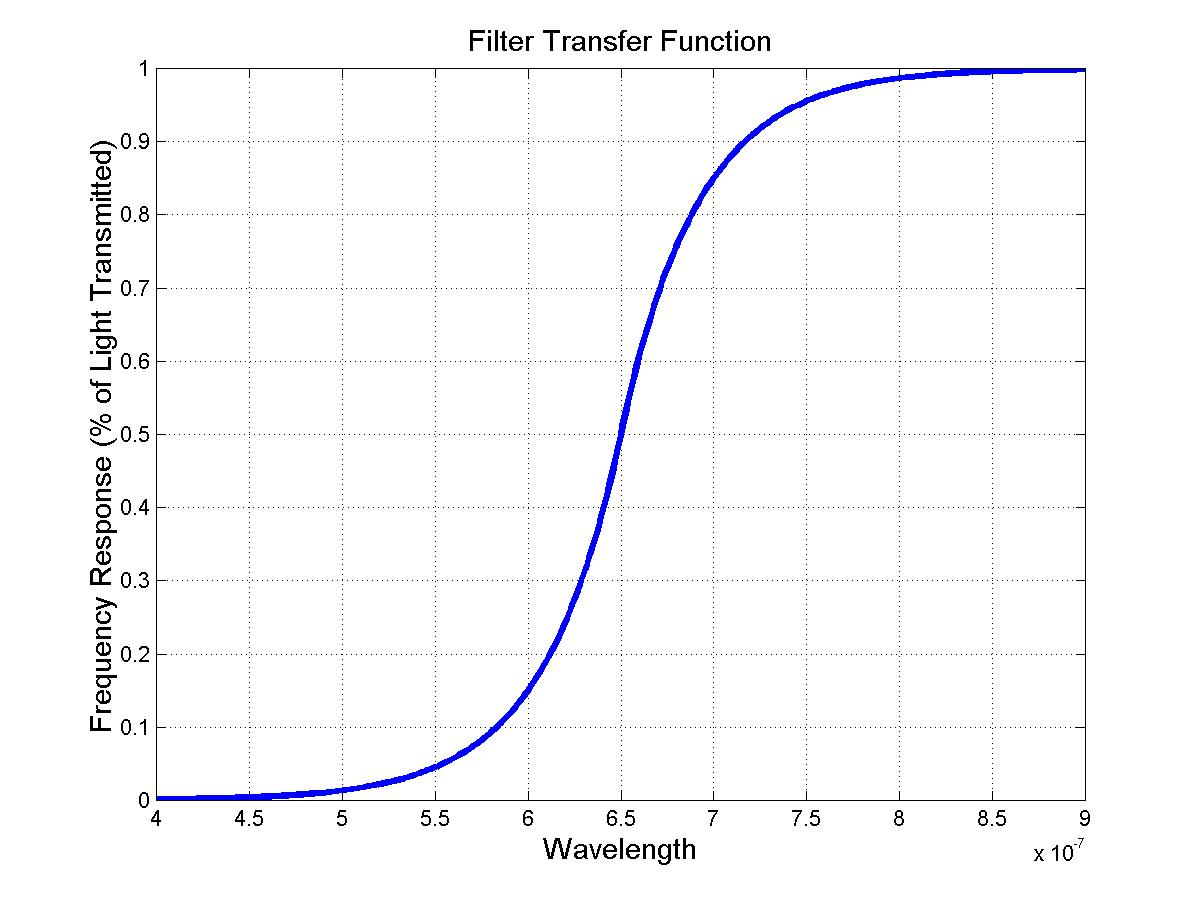
The transfer function of the filter was then multiplied by the spectral sensitivity of the film at each wavelength, to get the spectral sensitivity of the camera with a filter. The result is shown below. Note that, whereas before the camera was very sensitive to wavelengths below 500nm due to the properties of the film, the filter effectively blocks out these lower frequencies.
Home Introduction Applications Methodology Modeling Results Conclusion References Appendix I Appendix II