PSYCH221: A survey of digital watermarking techniques
|
Introduction: Methods: Conclusion: Contacts: |
Introduction
Background
The past decade has seen an information explosion of unprecedented magnitude. The internet and high-density storage media have made data transfer fast and often anonymous. These developments make it difficult to track how data is distributed. Watermarks embedded within an image enable one to trace an image back to its source despite having a minimal impact on the end user. Watermarks have a number of applications:
LSB insertion LSB insertion is one of the simplest techniques and has been known since antiquity (~1980s). Given an 8-bit image, the least signicant bits are replaced with meaningful data. Since only the lower-order bits are altered, the resulting color shifts are typically imperceptible. [4] Masking Luminance values are modified so as to make a visible pattern on the image. Since the watermark is plainly visible, this is often used in stock photography to discourage unauthorized commercial use of an image. [4]  A conspicuous mask watermark [3]
Palette Sorting Some image formats, such as GIF, have each pixel index into a color palette, which is a small subset of the total number of viewable colors. By intelligently reordering the palette, one can arrange like colors to be near each other in index value. Data is then embedded in a similar manner as LSB insertion. This method is efficient for grayscale images, which have a narrow range of colors. 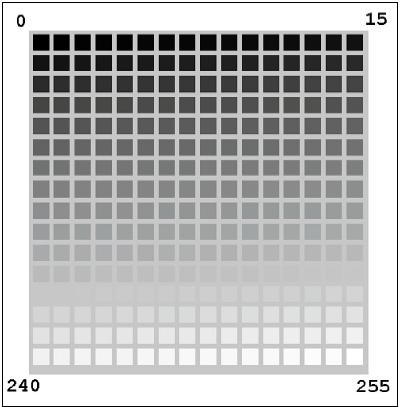 A grayscale palette sorted by luminance [4]
Bit-Plane Complexity Segmentation (BPCS) BPCS embeds watermark data only in "complex" regions of an image. The resulting watermark is localized on less conspicuous edges and noise-like regions while avoiding regions of flat color. [6] A Block Complexity based Data Embedding (ABCDE) ABCDE extends BPCS by adopting a more sophisticated metric for determining the complexity in an image region. [5] Spread Spectrum Spread spectrum is a frequency-domain method that takes the DCT transform of the image and adds a series of random values to the high-energy coefficients. These random values form a unique fingerprint that can be used to identify an image. Unlike the previously mentioned methods, spread spectrum does not allow insertion of arbitrary data. [2] Image Adaptive Discrete Cosine Transform (IA-DCT) IA-DCT extends spread spectrum by accounting for locally varying image features. Instead of a global DCT, as in spread spectrum, IA-DCT separates the image into 8x8 tiles and inserts watermark data with a power proportional to the "complexity" of the tile. [9] Steganography is a related field which attempts to attach information covertly such that hidden messages are not only encrypted, but undetected. Steganography differs from watermarking in several key ways. Watermarking only demands that the hidden data is undetectable to the eye; statistical analysis should reveal the presence of a watermark. Steganography assumes the end user is an adversary who may attempt to modify or remove the hidden message, should it be detected. In most applications, the end user can be aware of the presence of a watermark without compromising its usefulness. |