
PSYCH221: A survey of digital watermarking techniques
|
Introduction: Methods: Conclusion: Contacts: |
Methods
A Block Complexity based Data Embedding (ABCDE)
ABCDE works in a very similar method as BPCS, but employs a more sophisticated complexity metric. BPCS merely counts the number of bit-flips in each row and column of a given tile, with the assumption that a large number of bit flips indicates a lack of structure. ABCDE instead uses a pair of metrics that look for irregularity in a tile rather than high spatial frequencies. The authors' justification is that certain patterns, while high frequency, would produce unacceptable distortion if a watermark were embedded in them. 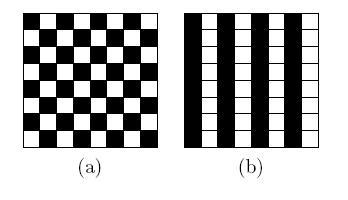
Patterns that are high frequency, but regular [5]
ABCDE replaces BPCS' &alpha-complexity with two metrics: run-length irregularity and border noisiness. Run-length irregularity searches for patterns amongst a tile's rows and columns. The checkerboard pattern above, for example, would be rejected by this metric. Border noisiness attempts to find edges in an image between two relatively flat regions of color. Rejecting tiles that lie on boundaries avoids the apparent blurring of edges that can occur with BPCS. [5] The results shown in the images below are particularly impressive. Despite the watermarked image having more than 60% of its image data overwritten, the differences between it and the original image are nearly imperceptible.
|