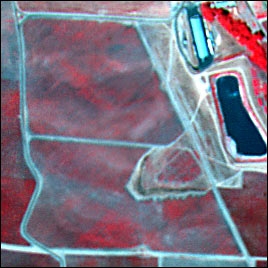
As previously mentioned, reflective near infrared imaging is popular in foliage studies. In such studies, the range of near infrared is usually expanded to 400-2500nm. An interesting foliage study is documented here. A multi-spectral digital camera was flown over vineyards to determine grapevine vigor. A fake color sample image is shown below, where the red, green, and blue channels are occupied by near infrared, red, and green, respectively. The bright red swath at the upper right is a line of healthy trees, the straight blue-white lines are roads, and the dark blue patch is a pond. Throughout the large vineyard sections, healthy grapevines are indicated by strong near infrared reflection, whereas weaker grapevines reflect more strongly in spectral green. Thus, while the majority of the fields are red, representing good grapevine vigor, in the lower field, the diagonal stretch of blue indicates poor grapevine health.
On a smaller scale, near infrared imaging can be used in a variety of plant studies. Since many organic functional groups (such as -CH, -OH, and -NH bonds) prevalent in leaves exhibit absorption signatures in the near infrared regime, biochemical composition as well as metrics like leaf tissue thickness and stage of decay can be determined. For example, this paper explains measurements of foliage moisture content from dried, ground leaf samples. This is useful for determining forest health and possible threat of forest fires. Another application is detailed in this paper. Here the near infrared spectra of leaves are correlated with litter (defined as the uppermost layer of the forest floor consisting chiefly of fallen leaves and other decaying organic matter) and soil composition. Again, this is useful for determining plant health, and can be used to assess soil regeneration cycles and mineral uptake.
Overall, though, near infrared imaging is just one of many imaging bands used to monitor vegetation and predict its growth. An example of this is the Multi-Divisional Program on Forest Productivity (MDP), launched in 1993 to investigate forests around Batemans Bay in Australia. Images were taken over many wavelength bands including near infrared, and the results used in combination to derive useful metrics. For example, a metric especially pointed out by the study is greenness, found from contrasts in the sum of the visible versus the sum of the near infrared bands, which can be used to predict canopy coverage, leaf area index (LAI), and fresh biomass.
Home Introduction Applications Methodology Modeling Results Conclusion References Appendix I Appendix II