| Home |
|---|
| Introduction |
| Approach |
| Methodology |
|
Verification of Sensor Linearity |
|
Spectral
Sensitivity |
| Resolution |
|
Chromatic Aberration |
| Summary |
| Acknowledgments |
| References |
| Appendix I: Code |
Spectral Sensitivity
The spectral sensitivity of a digital camera's sensor is the key factor that determines what colors it can capture and how richly they are portrayed in the image. It was thus highly valuable to characterize the sensors of the Nikon D70 and Canon EOS 300D from this perspective.
Because of the time-consuming nature of collecting the data required to derive spectral sensitivity information (and particularly the process of finding the best exposure for optimal SNR), it was decided to conduct these measurements with relatively low granularity. An image was taken with the Nikon D70 every 15nm, and an image was taken with the Canon 300D every 10nm, both in the range of 400nm to 740nm. The data was then processed as described in the Methodology section.
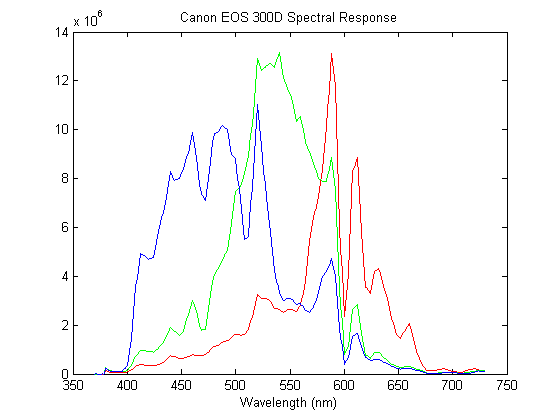
The results of applying the singular value decomposition algorithm to the measured data are shown below in Figure 2 and Figure 3.
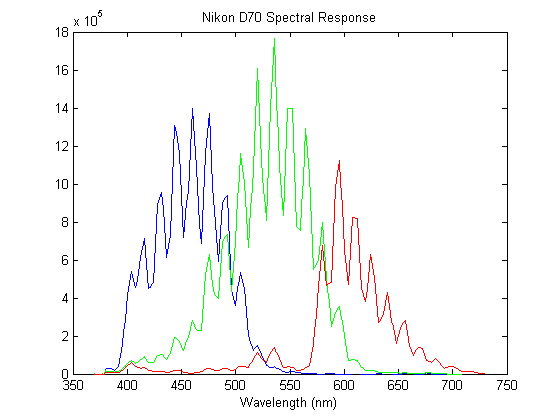
The extreme jaggedness of the first graph is due to the coarseness of the measurements; the overall shape of the curves closely matches those found by Moh, et al., in their earlier characterization of the D70.
The data for the Canon also appears rather erratic, which makes drawing specific conclusions somewhat challenging. It appears that the attempt to find the 'best exposure' manually was not entirely successful; with more time, this technique could be refined, and it is likely that the resulting spectral response plots would be more regular in their appearance.
However, it is possible that some high-level messages can be extracted from this data. For example, it appears from this plot that perhaps the Canon's sensor spectral responses overlap significantly more than those of the D70. This would mean that cross-talk between the different pixel types would be higher, perhaps due to an inherent difference in the sensor's design or due to the nature of the pixels' color filters. It also appears that, while for the D70 the red pixel's peak intensity is higher than the blue pixel's, for the Rebel this relationship is reversed, indicating a shift in the natural color balance of the sensor. (Of course, all this data gets color balanced by the camera in postprocessing anyway, but it is nevertheless interesting to note.)
Overall, however, it would be better to refine this experimental technique before attemping to draw any such conclusions definitively. More study is needed.