| Home |
|---|
| Introduction |
| Approach |
| Methodology |
|
Verification of Sensor Linearity |
|
Spectral Sensitivity |
| Resolution |
|
Chromatic
Aberration |
| Summary |
| Acknowledgments |
| References |
| Appendix I: Code |
Chromatic Aberration
The images used to calculate MTFs for red, green, and blue wavelengths were identical to Figures 4 and 5 (in the Resolution section) except for the lamp with which they were illuminated. Four of those images (the red and blue for each camera) appear in Figures 8-11 below.
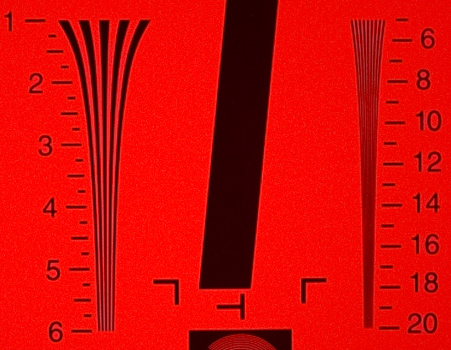
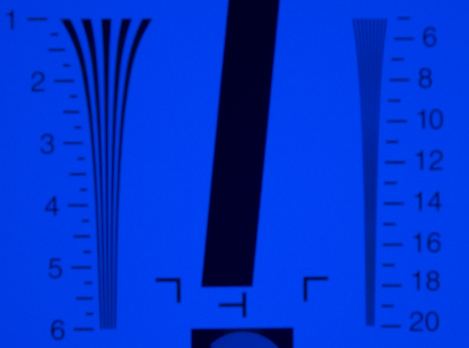
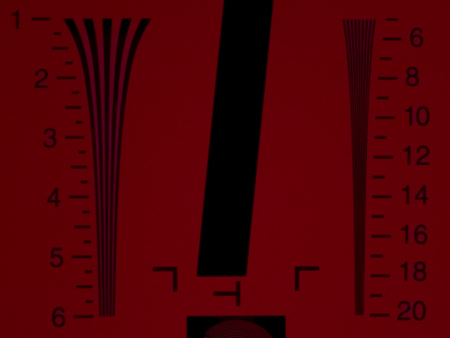
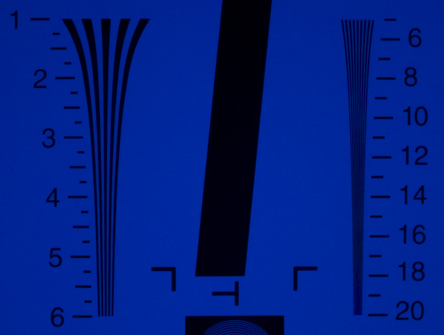
The results appear in Figure 8 and Figure 9 below.
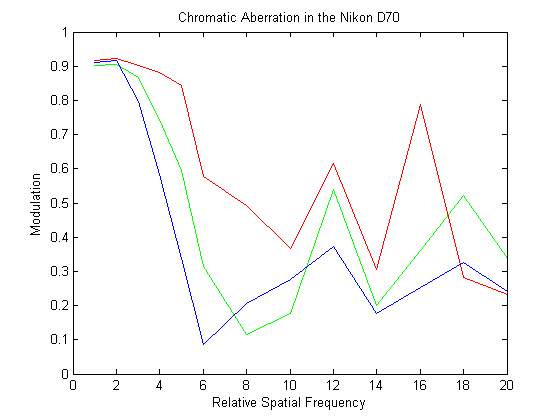
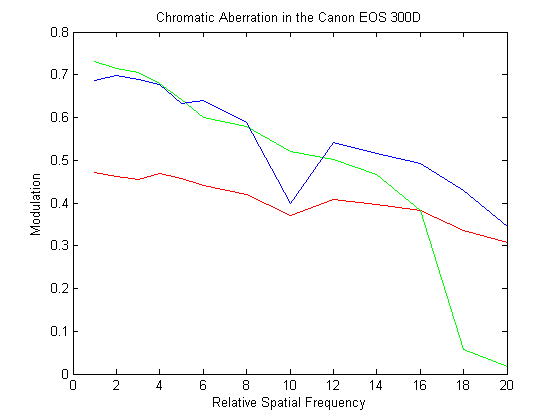
As explained in the previous section, the data for the Nikon D70 is not valid because the target was imaged significantly out of focus. Consequently, it is difficult to make good conclusions from this data. Note that we typically expect, for lenses that have some correction for chromatic aberration (as these lenses probably do), that the MTF for blue light should be better than that for red, because shorter wavelengths can image smaller spots (based on diffraction-limited spot size).
This is indeed what we see with the Rebel, but the data shows the opposite for the D70. It is extremely clear from Figures 8 and 9 that the Nikon was in the right focus for red light and not for blue. We already know that, for these measurements as well as those in the previous section, the D70 was too close to the target. This caused focus problems with the resolution measurement, but that focus problem corrected itself for the red image and worsened for the blue image, because the red light was focused behind the image plane, and blue light in front of it.
Beyond this, it is hard to say much about this data, except that collecting it once more with a careful eye to such considerations would be a valuable exercise in the effort to assess which lens has superior chromatic characteristics.