PART 2. Expanding the scene radiance captured by the camera.
Recall that previously we were able to “compress” the scene radiance data from the spectrophotometer to 6 or 5 basis functions. However, the camera itself will only generate 3 RBG values per each pixel. And, based on Figure (…from Jessica’s part…), and several research papers [2], we know that 5 to 6 basis functions will do the best job. Therefore we needed to come up with a way to “expand” the camera data (i.e. expand the scene radiance captured by the camera). We accomplished this by using color filters.
The camera that we used is Nikon D70. We already have the Sensor Spectral Sensitivities of this camera from a group of students who did their project on examining the camera’s properties[1]. Figure 2.1 shows the plot of the camera’s sensor spectral sensitivities of Nikon D70 that they calculated.
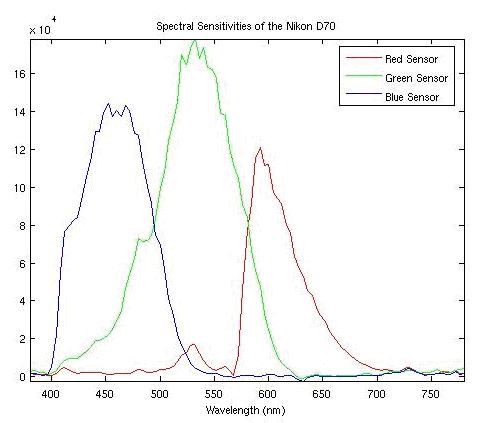
Figure 2.1 Nikon D70 Sensor Spectral Sensitivity
The filters that we used were acquired from Edmund Scientific. We were looking for filters which would cover the most area of wavelength spectrum, and we decided to use Pale Blue and Yellow filters. Figure 2.2 and 2.3 show the two filters that we used and their transmittivity plot from spectrophotometer measurement in the lab. From their transmittivity plot we can see that the combination of the two filters would cover a reasonable width of wavelength spectrum.
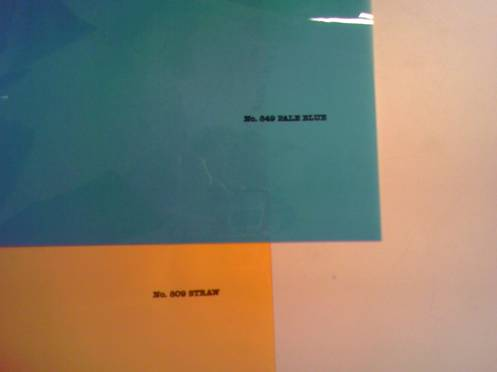
Figure 2.2 Pale blue and yellow sensor from Edmund Scientific Co.
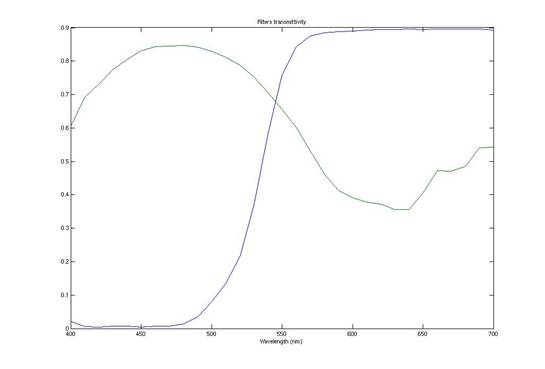
Figure 2.3 Filters transmittivity
Having decided which filters to use, we calculated the approximate 9-channel camera response and the result is plotted in Figure 2.4. From this figure, we can see that now the camera would yield more varied coverage along 400-700nm wavelength spectrum. However, based on the peak-center of each of the 9 channels, we can sort of predict that although they might cover more than 3 channels, they fall short of forming somewhat mutually exclusive coverage of 9 channels. Since some of the peaks overlap with each other, it would still be reasonable to assume that our camera now at least has 5 distinct channels instead of 3. And, we have reached our goal of expanding the spectral radiance response of the camera.
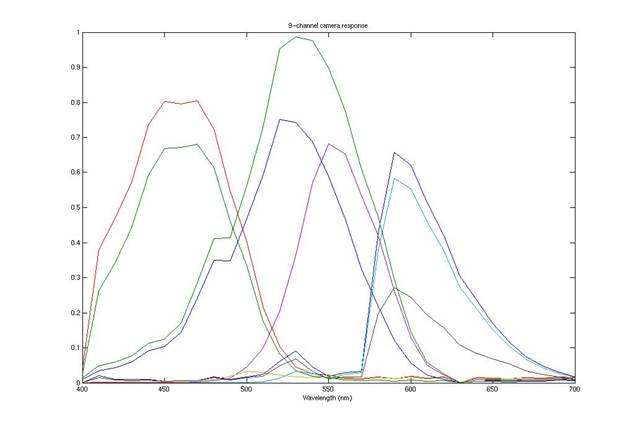
Figure 2.4 Nikon D70 9-channel response