Home | Introduction | Background | Schemes | Conclusion | References | Appendix
Introduction
Foveation in the Human Visual System
Under typical viewing conditions, human visual acuity diminishes gradually away from the direction of gaze, giving rise to the familiar notions of central and peripheral vision. At 2.3 degrees away from the point of fixation, the limit of spatial resolution is halved; at 20 degrees, it is only about 10% of the maximum possible spatial resolution.
This phenomenon arises from the unequal distribution of cone photoreceptors (cones) in the retina. Note that at photopic (or normal) light levels, the visual response due to cones dominates that due to rod photoreceptors (rods). The region of the retina most dense in cones is called the fovea and is responsible for central vision. Figure 1 illustrates the distribution of photoreceptors with respect to deflection from the fovea.
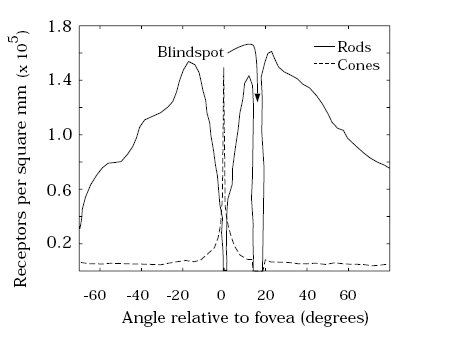
Figure 1: Density distributions of cones and rods with respect to angle relative to fovea (from Wandell [1]).
Applications to Video Compression
Applying our knowledge about foveation in the human visual system to video compression is, in principle, straightforward. Substantial compression can be achieved by degrading video quality spatially to match the viewer's acuity with respect to the point of fixation. Notice, however, that encoders for such schemes require feedback about the viewer's direction of gaze and distance from screen, possibly through eye-tracking. In the Background section of this report, we review an effective strategy for foveated video compression and verify its performance.
In the Schemes section of this report, we define the problem of foveated video broadcast to multiple viewers. This turns out to be a more sophisticated problem than the single user case. We propose three alternative schemes and compare them in terms of required receiver bandwidth and encoder complexity. Simulation results indicate that there is a trade-off in minimizing these two quantities.