Motivation
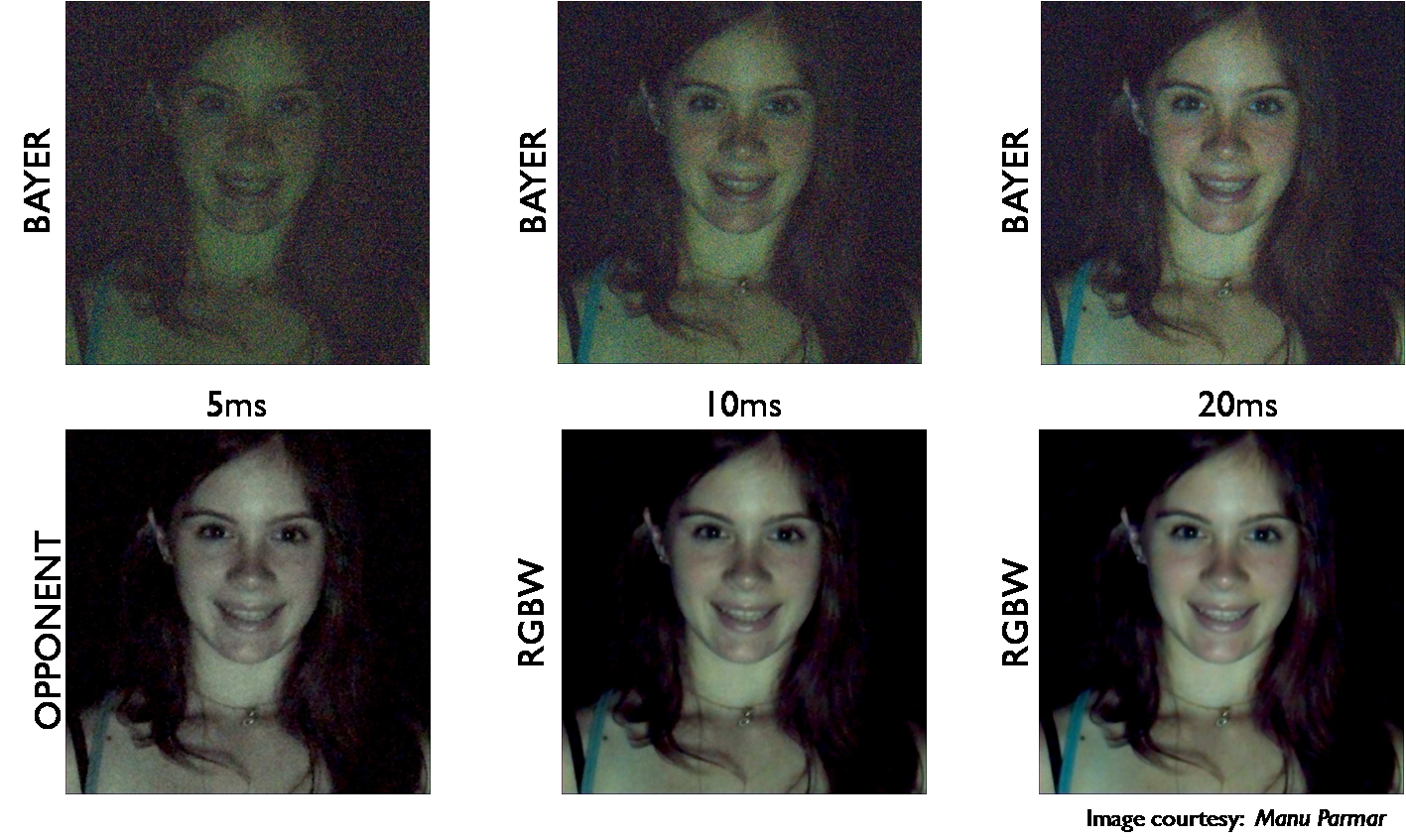
The motivation behind the study was to see if Bayer CFA can be replaced with RGBW CFA. While it is true that under poor lighting, W-channel from RGBW can help reduce noise, under good lighting, the same W-channel is saturated and hence cannot be used[a]. In this case, the RGBW CFA has only half the resolution in green channel as the Bayer CFA. So, the purpose of this study was to analyse the merits and de-merits of RGBW compared to Bayer and to see if RGBW can in fact replace Bayer.
Noise vs. Resolution
Any noisy image needs to be de-noised before it can be used. But, de-noising also reduces the resolution.
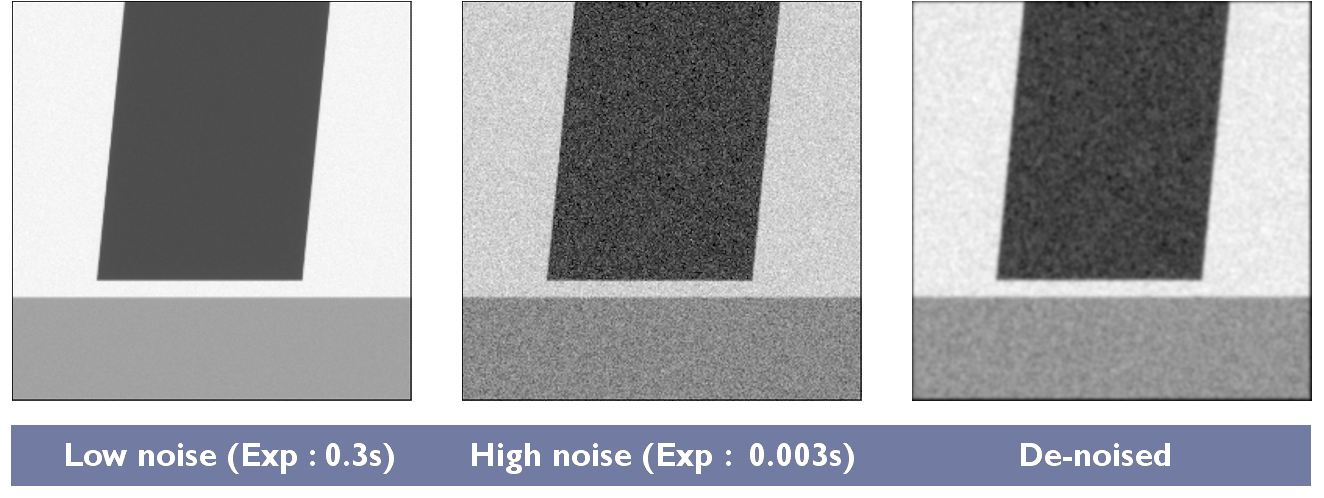
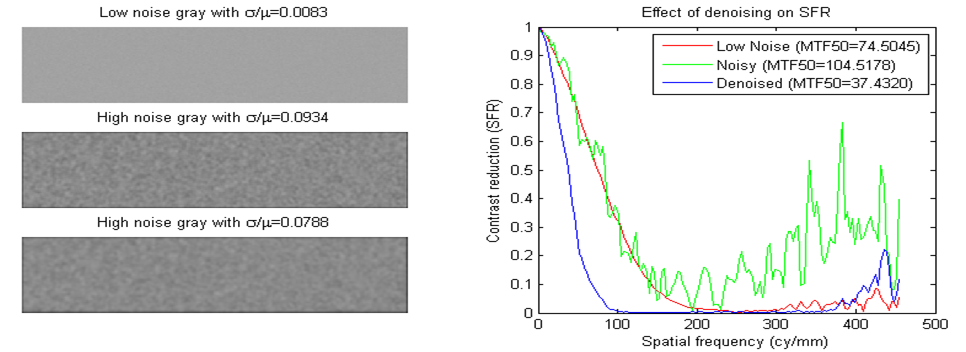
Shown above are a low noise image, a noisy image and a denoised image. The MTF50 for the low noise image was around 74 and that for noisy image was around 104. But the MTF50 for the noisy image is not meaningful because of the error in calculating ESF which also results in a lot of harmonics in the MTF (as shown below). The MTF50 of the de-noised image was around 37, almost half that of the low noise image. This shows that de-noising results in loss of resolution. As is shown later, images created using RGBW CFA has less noise to start with and hence has lesser loss in resolution when de-noised compared to the Bayer CFA images
W-Band Saturation
Under low lighting conditions, using W-band can result in better images
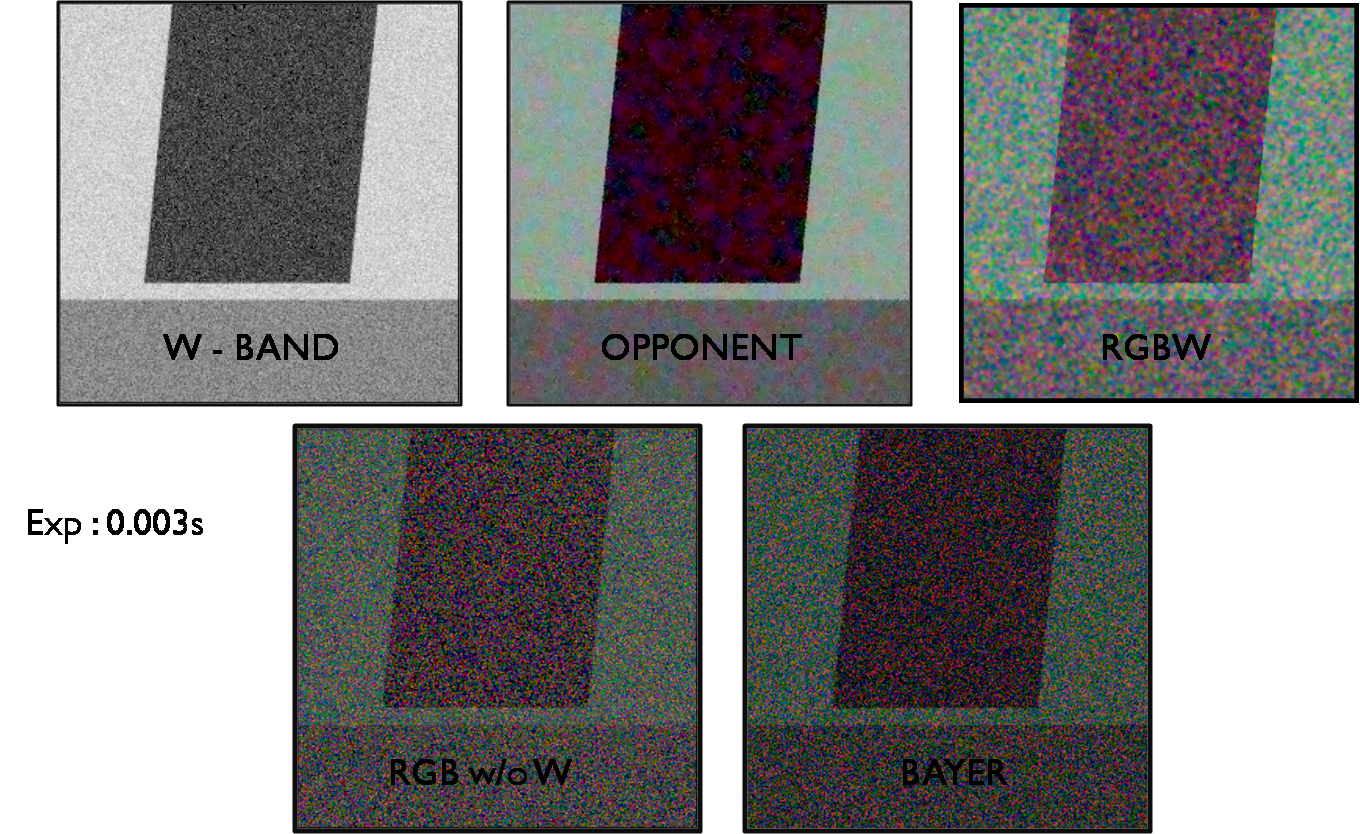
However, under bright conditions, W-band saturates and cannot be used as illustrated below
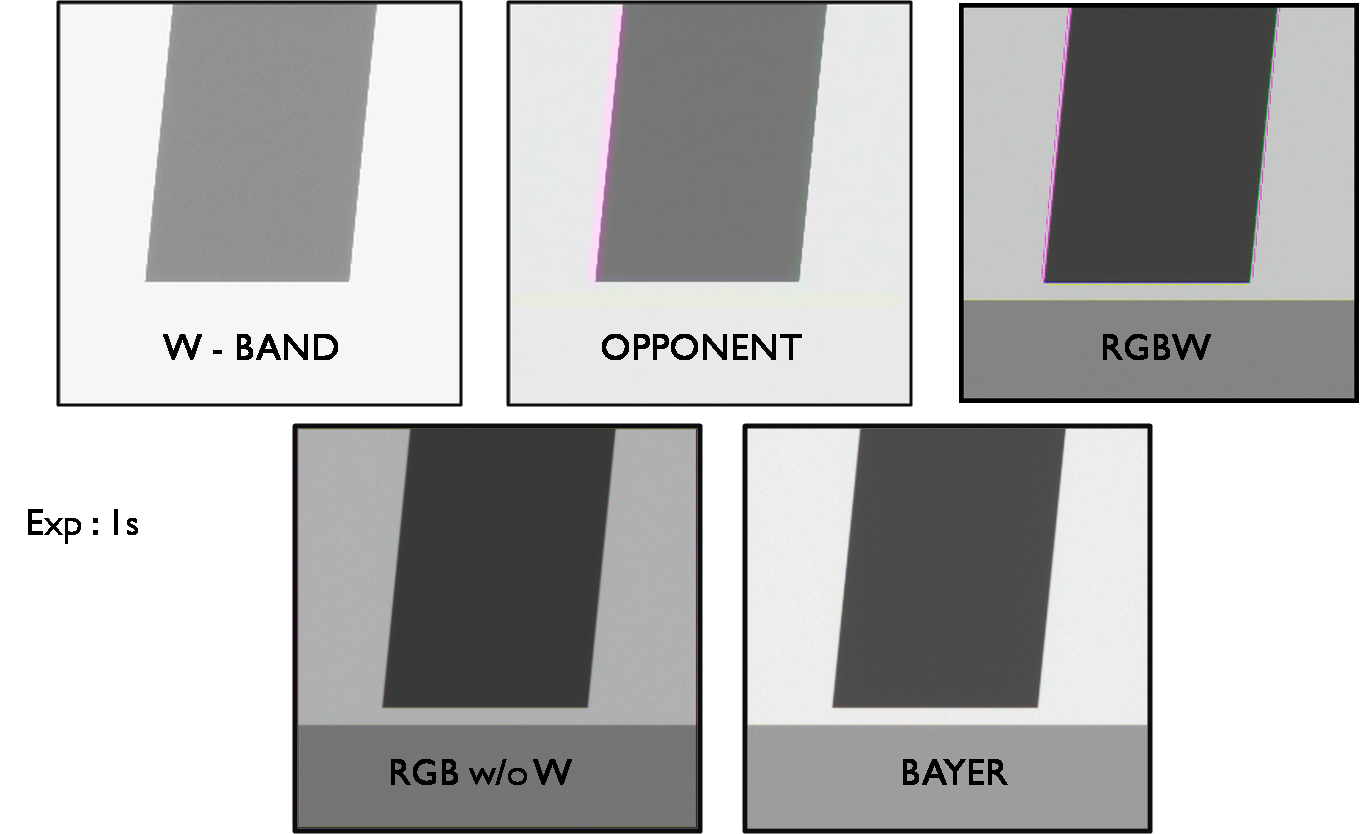
Thus under bright conditions, green channel resolution is half that of Bayer which affects luminance channel calculation and consequently, the RGB image has lesser MTF50 than Bayer.
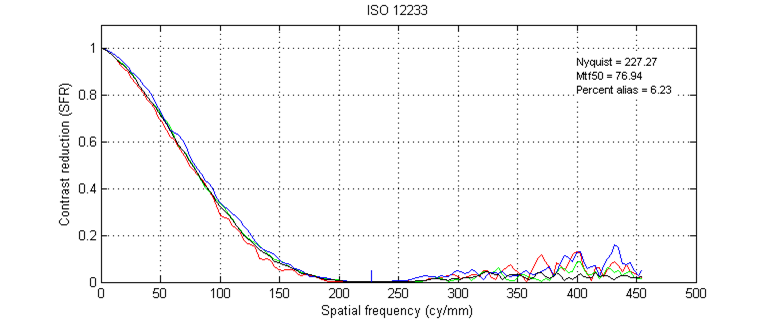
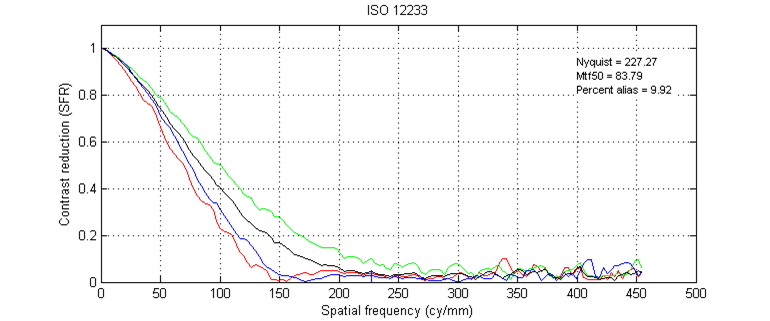
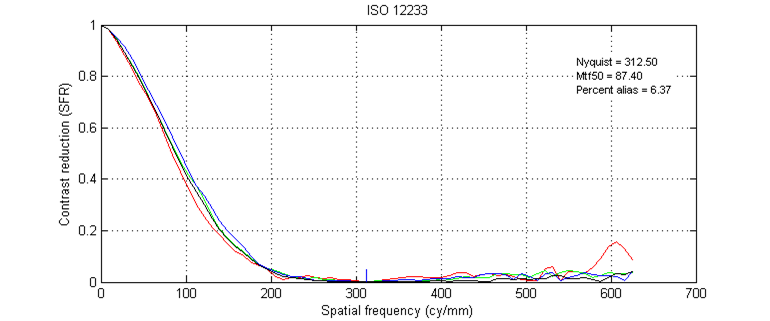
But, as the sensor pixel size is reduced, the MTF50 of the RGB becomes better than that of the Bayer with bigger size. This is a major motivating factor for using RGBW inspite of the problem with W-band. The figures below illustrate this comparison
Examples
Following are a couple of figures from "Interleaved Imaging: An Imaging System Design Inspired by Rod-Cone Vision" by Manu Parmar and Brian A. Wandell, which show the effect of using W-Band on real scenes
The first one shows the saturation of W-Band and how the RGBW image discards information from W-Band under bright conditions (200 cd/m^2 and 66ms exposure time)[a]
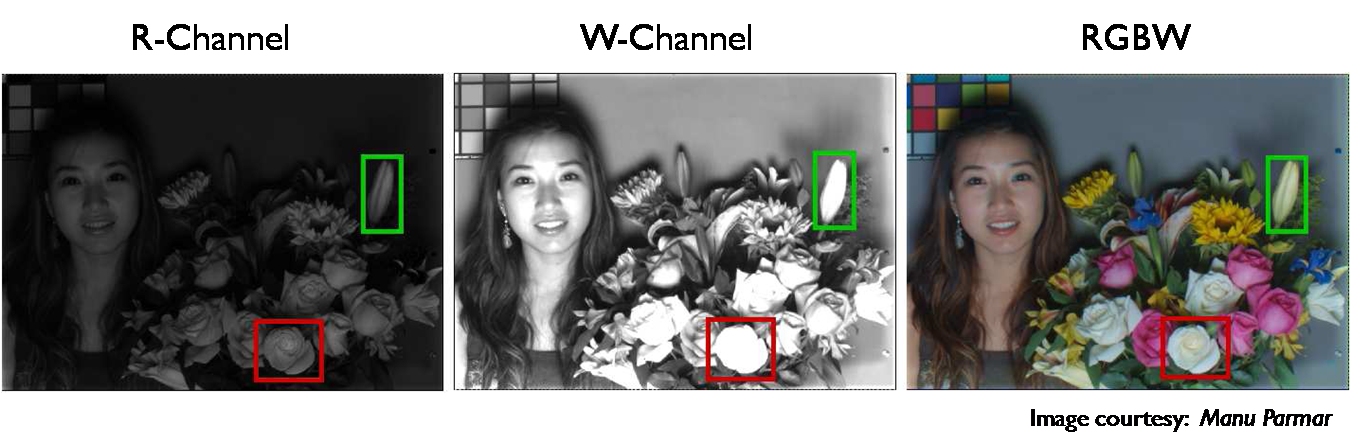
The second one shows how using W-band improves picture quality under low lighting conditions (25 cd/m^2)[a]