Introduction
What is an FPA?
an FPA or Focal Plane Array is the sensor array that collects the information in the digital camera. This plane is typically fabricated from a semiconductor wafer. As shown in the image there is typicaly a series of optical lenses then filter and microlens placed over the FPA. The FPA absorbs photons from different colors through the filters and that signal is ultimately what ends up being recorded as the captured optical image.
Typical FPA inside a digital camera [1][2]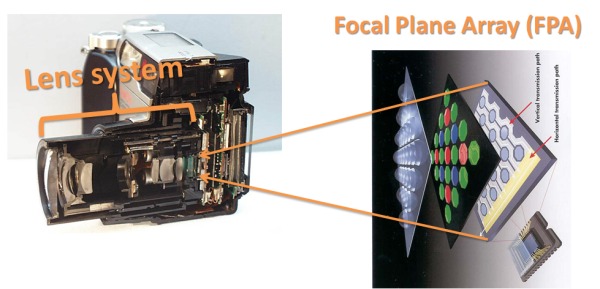
Planar FPA
Planar FPA are the industry standard and infact is the only option available to industry at all. There has been a great deal of research and development placed in this industry and currently types of arrays include CCD as well as CMOS based. Because the of the planar geometric feature of the array there is a great deal of optimization required for the optics of the system. Therefore it is common to find even in the simplest camera up to..... lenses. In addition to the number of lenses required it is often required that these lenses not be spherical. Non spherical lenses are more expensive to manufacture and the quality of images often depends on the quality of the lenses.
Curved FPA
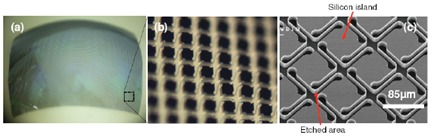
Curved FPA is a technique that has been recently proposed but is based on very fundamental optics theories. Manufacturing thin-film materials such as photo sensors have always been restricted to planar surfaces but this is no longer true with the advent of MEMS (Microelectromechanical Systems). NASA first proposed using a curved FPA for improving panoramic imagers for mars rovers [3]. While NASA used a highly costly fabrication technique to increase the FPA field of view (FOV) researchers at Stanford University have developed a cheaper technique. The Peuman's group have been working on flexible arrayed substrates a technology that is prime for use in the imaging applications. The fabrication of the sensors would be done on a planar wafer and as a last step the array can be etched into a mechanically flexible substrate [4].
Previous Work
The previous work done by the Peuman group have demonstrated an overview of the advantages of the CFPA. While the group used CodeV, it is desirable to reproduce the same results in Zemax as to confirm their results. In addition to reproducing CodeV results with Zemax this project aims to investigate and quantify the advantages of CFPA beyond what the previous paper has demonstrated.