In
addition to the undesirable “echo” effect we discussed earlier, our
algorithm introduces other limitations, some of which can be fixed, but others
are just inevitable. These
limitations are geometrical distortion and artifacts.
The
formula for calculating the stereo separation is an estimation. This
approximation is what causes a slight effect called geometrical
distortion. Examine the previous two figures carefully.
In our code, let “a” be the point that represents the x value that
has been reached (the horizontal point, i.e. the points that we scan across for
each y). The
formula uses the distance aA to calculate the stereoseparation.
However, this is just an estimation, since the stereo separation should
be dependent on the point A’ instead. Luckily,
at normal viewing distance, geometrical distortion is only a small, if at all
noticeable problem. At far viewing distances, A and A' coincides and
geometrical distortion disapears. There is also vertical distortion,
similar to horizontal distortion, but again this distortion is usually
unnoticeable.
Some
algorithms interpolate the z-values linearly into the space between the near and
far planes. This creates a small
depth distortion, since stereo separation is not a linear function of z.
The depth planes are not spaced the same distance apart, and our program
correctly estimates this by using a non-linear separation function:
function r = separation(z)
DPI = 72;
E = 2.5*DPI;
mju = 1/3;
r =
round((1-mju*z)*E/(2-mju*z));
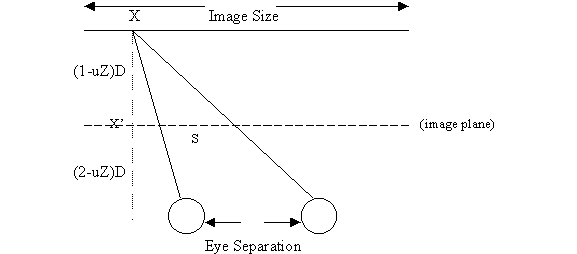
In order to keep the geometrical distortion to a minimum, we modified the algorithm to calculate the separation distance for a viewing distance of 12 inches and a image size of 5 inches. By using similar triangles and geometrical properties, we are able to break up the viewing plane into two locations: points that lie left/right of the eyes and points that lie between the eyes. The figure below illustrates a point x would usually be determined to have a separation distance by dropping a perpendicular to the image plane (x').
This separation value will not be exact for extremely large images; therefore, we arrive at a more exact derivation for the separation distance where the "-/+" sign depends upon whether the location is to the left or right of the eyes, respectively.

The derivation assumes the eyes are located exactly in the middle of the image and they are separated by 2.5 inches.
There
may be an occurrence that two points, although not constrained to be the same,
do occur to have the same color by chance.
This visual artifact may distract the eye when viewing the image. If we
take a look at the part of the code that assigns the random colors:
for x = fliplr(1:MaxX)
if
(Same(x) == x)
pix(x)
= (rand(1)>0.5);
else
pix(x)
= pix(Same(x));
end;
im(y,x) = pix(x);
end;
One
possible solution is to use several levels of gray instead of just black and
white to reduce the probability of producing an artifact. .

