
The inventor of stereography was the physicist Sir Charles Wheatstone. He held a conference on the 21st of June in 1833, where he revealed to the Royal Society in London about his discovery of stereoscopic phenomena. By validating his theory with drawn stereo pictures and viewing them through a contraption that later became the first stereoscopic viewing apparatus, he started the study of 3-D images. The earliest accounts validating the theory of how depth perception can be discerned solely through binocular disparity was provided by Wheatstone. In 1832, he constructed the first stereoviewer for the purpose of using line drawings as targets to create 3-D impressions. Consisting of two viewing tubes that allow the right and left eye to view to separate stereo images. The overall functionality is that a stereoscope is composed of two pictures mounted next to each other, and a set of lenses to view the pictures through. Each picture is taken from a slightly different viewpoint that corresponds closely to the spacing of the eyes (~ two inches). The left picture represents what the left eye would see, and likewise for the right picture. When observing the pictures through a special viewer, the pair of two-dimensional pictures appears to come together into a 3-D picture.
We can see a 3D picture through a stereoscope for the same reason a building appears three-dimensional. The right and left eyes see a slightly different version of the same scene, and taken together, we get an illusion of depth. This phenomenon had been known for quite some time, ever since the ancient Greek mathematician Euclid discovered the principles of binocular vision.
Early stereo photographs were taken with a camera mounted on a tripod with a sliding bar. Once the first picture was taken and a new photographic plate was inserted, the camera was moved about 7 cm along the bar (approximately adult eye spacing). Then, the second picture was taken.
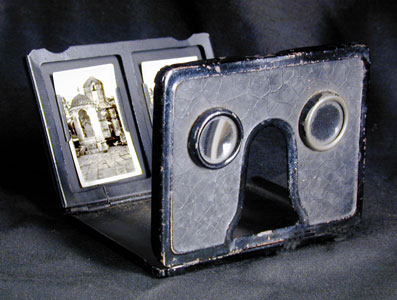
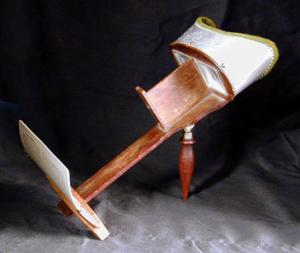
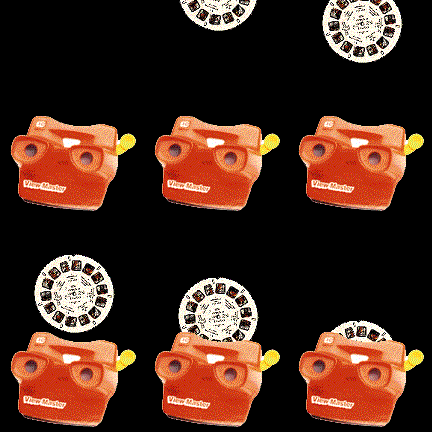
In August 1839, Daguerre published his method on the production of durable photographs. These pictures were taken with the camera obscura who Niepce built in 1822. This brought about the advent of photography and the ability to take three-dimensional pictures.
Sir David Brewster discovered that in repeated patterns with small differences a three-dimensional effect can be observed. He built the first stereo camera in 1849.
The first stereo adaptor for one-eyed cameras was invented in 1855 by the Frenchman Barnard.
With the introduction of miniature cameras and color film, better and better instruments for stereo photography were developed, but all soon disappeared from the market. In photography, two pictures are used, melting them to one leads to the three-dimensional effect. In this case you can mostly imagine the spatial appearance when seeing only one of the pictures.
One of the earlier experimenters was Bela Julesz who demonstrated that the brain is able to perceive 3-D information without any true perceptual depth cues. He invented the first random dot stereogram in 1959 in attempts to test stereopsis. The experiment he performed was with the random dot image and by shifting it slightly to produce a second image. When viewed in a stereoscope, the pattern appeared as a 3-D image. By surrounding the images with an identical random dot pattern they appear identical when viewed separately, but when viewed stereoscopically, the central square pattern (or whatever shape is created) will appear to float in space.
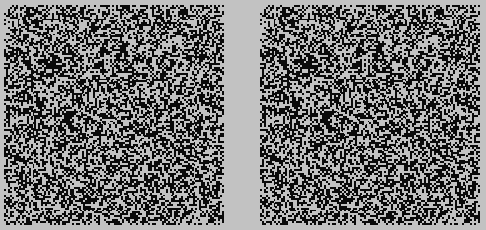
The original random dot stereogram created by Julesz discovering the 3D perception of the brain
1971
Julesz writes "Foundations of Cyclopean Perception", describing photographic techniques to produce random dot stereograms.
1979
Marr and Poggio describe computational models of the visual processes that are involved in interpreting random dot stereograms in the article "A computational theory of human stereo vision", which became the foundation in creating autostereograms.
Christopher Tyler designed the first single image random dot stereogram (SIRDS), which the unaided eye could view.
Stereography is now employed in a variety of applications such as aerial photography, virtual reality, 3-D televisions, and numerous medical applications.

