What is stereo or 3-D?
The word stereo originates from the Greek meaning spatial or three-dimensional. When stereo is referenced in today’s time, it usually refers to spatial audio, but originally it described three-dimensional pictures that created by painters. In order to differentiate between the two, when 3-D pictures are discussed, it is in reference to three-dimensional.
The fascination with creating 3-D images has dated back to early man and artistic drawings. Even cave paintings have been shown to take advantage of depth in the canvas of walls in attempts to recreate three-dimensional life. Arts throughout the early eras also developed methods to create depth within their paintings. Some of the techniques employed by artists are interposition, relative height, and linear perspective. Each of these is a depth cue that can be used to enhance the effect of a painting.
In today’s time, three-dimensional viewing has regained some popularity through the 90s craze of autostereograms. Single image autostereograms have become possible with the computational power of computers and their ability to render images. Furthermore technology has developed so rapidly that we see 3-D in various forms of entertainment ranging from virtual reality simulators to holography.
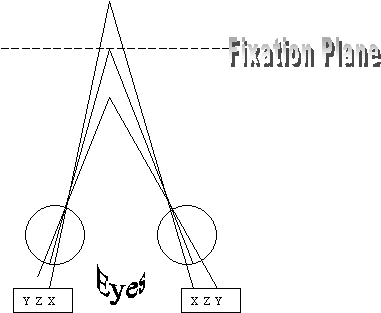
The ability to create such 3-D images in 2-D planes is based on the inherent nature of how our eyes view the world from slightly different, offset perspectives. Stereopsis is the ability of our brain to perceive depth from two images presented to each eye. Light enters the eye and impacts the foveas of both retinas. As displayed in the diagram below, images that are at the same location on each eye lie in what is named the fixation plane. Images that are further (X), on (Z), or closer (Y) to the fixation plane will cast disparate images on the foveas, which are interpreted by the brain as depth. This type of depth cue falls under the category of a binocular depth cue, which requires both eyes.
Images that do not lie on the fixation plane are swapped in location on the two foveas, thus allowing the brain to perceive depth.
As exemplified above in the figure, objects that are closer than the fixation point, contain a disparity that is called “crossed” due to the fact that the lines of sight cross each other between the eyes and the surface on where the eyes are focused. For objects that lie further away than the fixation plane have a disparity conversely called uncrossed. In order to perceive depth, the visual cortex contains cells that are solely stimulated by crossed disparity points, while other specialized cells are only responsive to uncrossed disparity locations. Amazingly, the brain is quite adept at discerning a disparity of a few seconds of arc, which is developed at quite an early age of around 16 weeks old.
A perk of stereopsis is the ability to measure stereoscopic acuity. One type of measurement can be done through random dot stereograms. For example, the same edge pattern appears in both images that are displayed to the right and left eyes. The center dots of the two patterns of dots are similar, but contain either a crossed or uncrossed displacement. The effect of this pattern will cause the center to appear to stand out or fall behind the edge pattern depending upon the orientation of the center dots. Through this type of experimentation, data has been collected to verify that stereopsis begins development at the age of only a few months.
The ability to create stereograms is achieved by drawing upon the fact that our brain is capable of obtaining depth from a flat image. Solely by presenting shifted versions of two images, the brain is able to process the illusion that a three dimensional image is present. This becomes the fundamental theory behind the creation of all types of stereograms.

