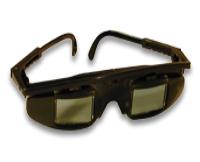
Stereo shutter glasses
Some of the new technology behind current stereogram displays employ LCD displays to create the illusion of a 3-D object. The more recent technology involves LCD shutter glasses, which is termed a tachistoscopic devices.
The
liquid crystal shutter glasses function by allowing the wearer to look through
the lenses at a normal color display while the lenses shutter alternately
showing each eye its respective image. The
“shuttering” effect is so fast that the brain perceives the two images into
a single image and if the design is correct, a 3-D image should result.
The displays can be broken up into two main categories:
liquid crystal shutter glasses and head mounted displays, both of which
are for personal viewing. The head
mounted displays are mainly employed in virtual reality systems where the right
and left eyes are receiving two discrete images and no overlap will occur.
Liquid crystal shutter glasses are usually designed to work with NTSC video or stereo viewing on computer monitors. By source is attached to the glasses, thus allowing sychronization of which image will be displayed and which eye will be obscured at the same moment in time. Better results are obtained on computer monitors due to higher refresh rates of current monitors, while NTSC standards are much lower (~30 fps), thus causing flicker noise to appear, degrading the overall effect.
There exists three main types of shutter glasses: frame flipping, interleaving, and synch doubling. Frame flipping functions by using all available pixels to render each eye's image. The drawback is that it requires graphics hardware with enough memory to store both images at once. Interleaving displays each image view alternately. The drawback of this approach is the lower resolution of the overall image. Synch doubling employs a computer to create the left eye view on the one half of the screen and the right eye view on the other half. A synch doubler spreads out the top half image to fill the entire screen and does the same with the bottom half image. By alternately displaying it at half the original refresh rate of the monitor. The perk is that it requires no special graphics hardware within the computer itself, but again results in a lower resolution image.
A second technique involves projecting polarized images (different polarization for left eye versus right eye) on a polarization-preserving screen. Passive polarized glasses are then used for stereo viewing. Unlike anaglyphs, this allows full color images. New techniques involving dual, commodity-type DLP projectors (one for each eye's view) have made this approach very affordable.
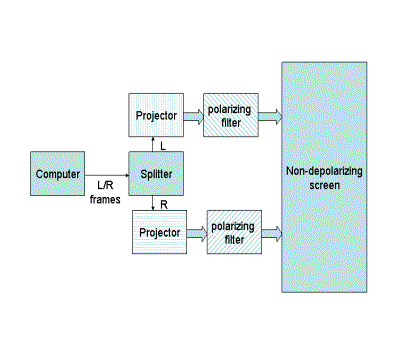
Schematic of passive, dual-projector stereo display system. Components include host computer (commodity PC or workstation), splitter/converter, DLP projectors, polarizing filters, and polarization-preserving projection screen. Passive polarized glasses are worn by the viewer to view the image correctly.
Current/Future
The following displays an overview of the types of current research being conducted throughout the world.
Stereoscopic display technologies include autostereoscopic
displays, virtual window displays, and methods for transmitting stereoscopic
video
One of the main areas that innovative designs have been researched are stereoscopic displays. These include displays for medical applications such as teleoperation and telesurgery. Other applications of displays are being created for television and entertainment. User interfaces have been looked into to create a more adept control environment for workers. Overall, viewed from the most recent stereoscopic display conferences, there remains a broad range of applications to apply stereography to ranging from imaging to entertainment.