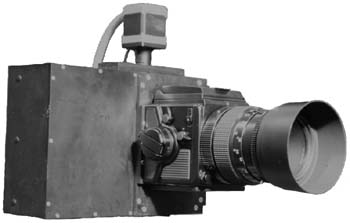
One obvious difference between the two procedures is the actual camera.
The MARC camera is much more portable than the Kontron, and had much more
resolution capabilities. Also, the MARC camera was much more portable,
as stated before. The capabilities of the MARC camera were such that the
pixel ability varied depending on position. The original project had a
more fixed pixel per area ratio because the camera was in a fixed position.
Also, the lighting environment produced different results. In the MARC
procedure, the lighting looks the same as the photograph, that is the light
is adjusted based on the photograph. In the original VASARI project, the
light illumination is maximized; however the objects must be mostly planar.
This is because of the requirement that the image lie in the same plane
as the calibration chart. The process with the MARC camera seems to be
much quicker as well.
The camera
itself
is one that has self-positioning hardware inside, which allows for the
portability of the camera. The output data of the camera is in CIElab,
i.e. it is colormetric. Uncompressed images can take up to 1.6Gbytes. This
is due to the high resolution of the images.