Camera Information
For
this project, we have used a Hewlett-Packard PhotoSmart C30 digital camera.
This camera provides 1 megapixel resolution (1152 x 872) and 24 bit color.
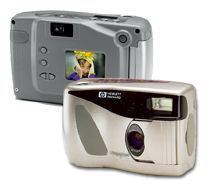
Briefly, a digital camera works in the following way: The light reflecting
from the source is focused by the camera lens onto a charge coupled display
(CCD). The CCD passes along an analog electrical signal that gets sampled
by an analog-to-digital converter. This digital signal is then passed through
a processor that creates a digital photographic image. In doing so, the
processor adjusts image properties such as contrast according to the requirements
of the anticipated user, compressing the digital information. The camera
output is in units of RGB for each pixel.
Camera Limitations:
Since our requirements of the camera output are more rigorous than those
expected for a typical consumer, we must correct for the adjustments made
by the digital signal processor. The camera output has already been "corrected"
for brightness to appear best on a standard computer monitor. Weber's Law
states that the minimal discernible difference between the brightnesses
of two images increases as their absolute brightnesses increase. Since
monitor brightness levels follow a gamma function according to Weber's
Law, the digital image from the camera has also passed through a nonlinear
gamma function. Before we deal with the digital image for our archival
purposes, we must "uncorrect" the nonlinearity of the RGB values. Further,
the RGB values are device dependent, based on the color sensitivities of
the camera CCD. In order to remove this dependency, we must also convert
our RGB values to XYZ coordinates. XYZ coordinates refer to the properties
of the the incident light on the CCD, unaffected by the specifications
of the hardware. There is a linear transformation from XYZ to RGB, which
we will find.
start
next