On this page:
Experimental Results
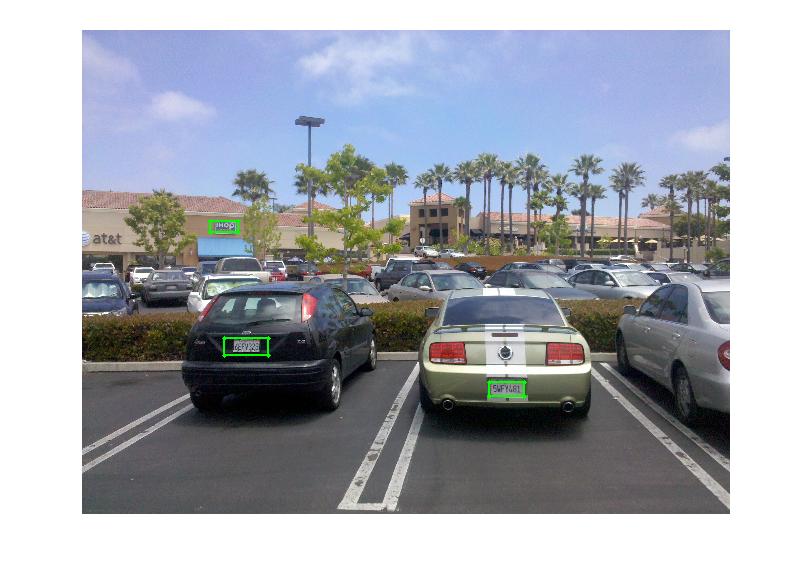
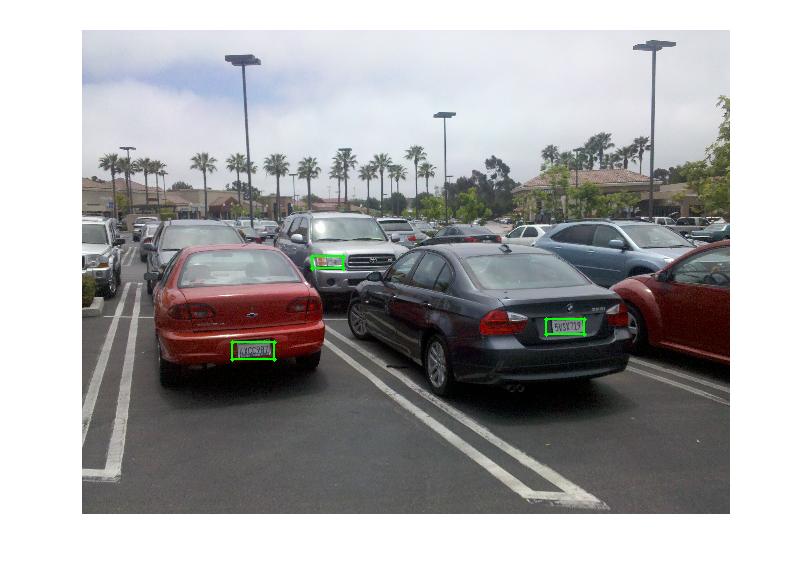
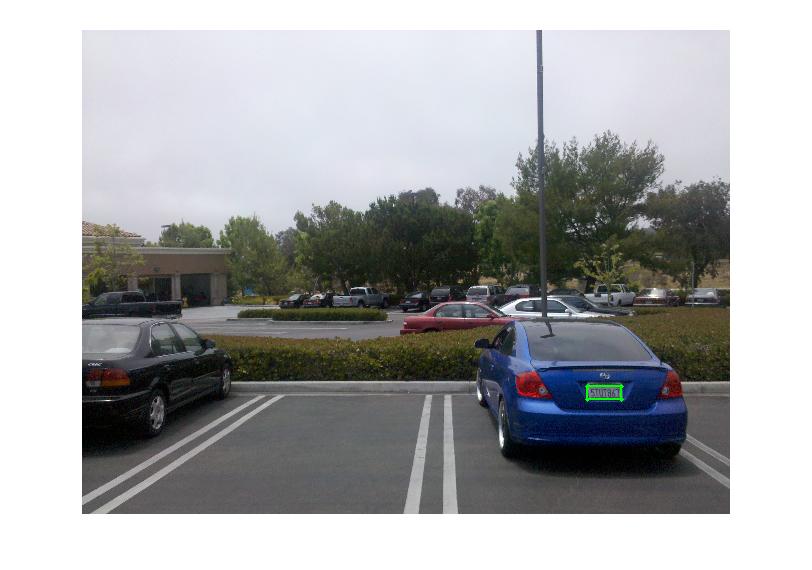
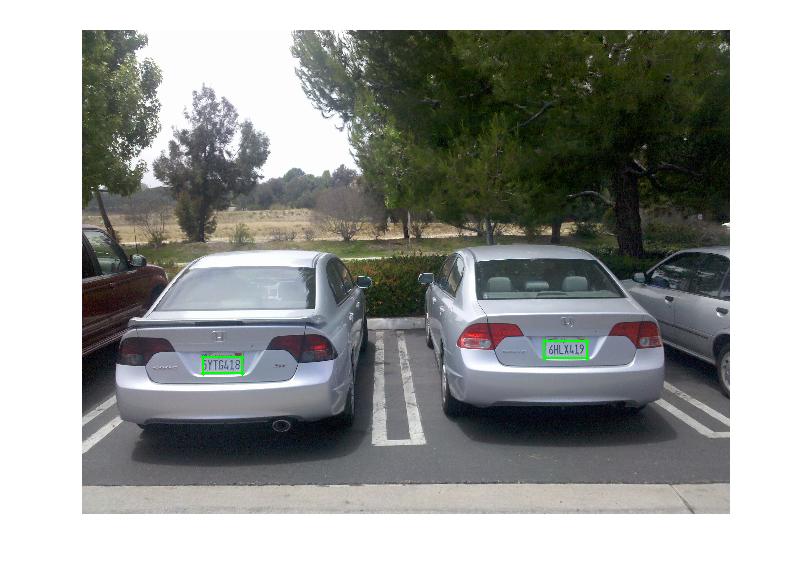
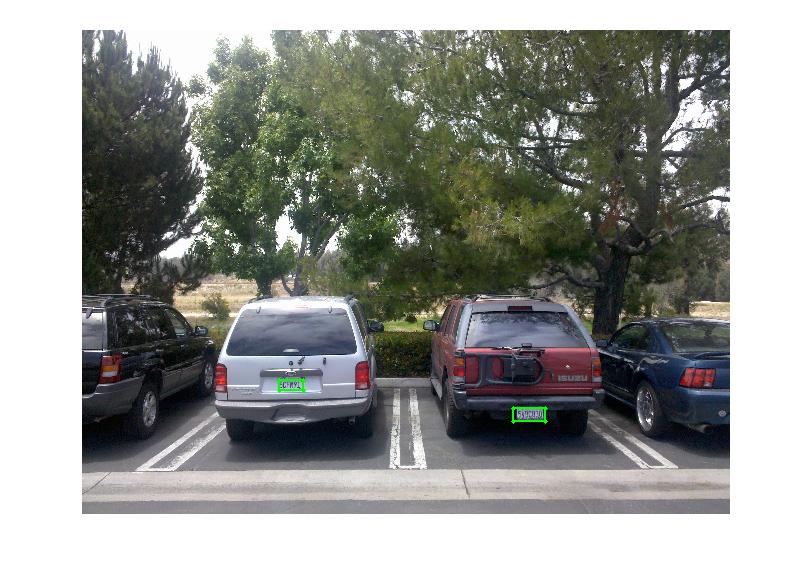
The recognition rate for plates whose original width is 100 pixels or larger was 91.7% on our dataset, although it should be noted that the false positive ratio was an excessive 30% in this case. This latter fact is due to the addition to the dataset of a number of images that contained business signs in the background (taken in the parking lot of a large outdoor mall area). For images without signs in the background, approximately 5% of the detected windows were false positives. When smaller plates were included, the overall recognition rate dropped to 67.6%.
Conclusions
Blind, edge-based license plate detection is a difficult problem that requires specific imaging conditions to perform accurately and reliably. The presence of background clutter must be mitigated with some form of false positive rejection. The proposed methods are not stringent enough, seeing as the false positive rate is far higher than would be acceptable in any practical application. Although the horizontal-line search method worked well in parts of our image set, mean-shift segmentation seems most promising as a robust rejection stage. However, the implementation details of this latter method are a major area for potential improvement; proper analysis of the regions as in [6] could result in elimination of the horizontal-line-based false positive rejection stage.
Additionally, the scale-invariance of the proposed methods could be improved. Though we are not particularly interested in plates that are too small to perform reliable optical character recognition (OCR), there is nonetheless significant room for improvement in the scale-invariance of the proposed method for plates well within the reach of OCR.
More importantly, however, is the detector’s susceptibility to affine distortions of the plates. Distortions resulting in less than an approximately 20° rotation of the top and bottom edges of the plate do not seem to interfere with the proposed method, but it seems that any greater distortion results in a 0% detection rate. Future work might experiment with rotated edge detection and filters, although an implementation faster than Matlab would likely be desirable at that point.
Another attempt at building the detector would likely focus more on the capabilities of the mean-shift algorithm and perhaps initially using clues from the image to choose appropriate segmentation parameters. Such a second attempt at the overall process of improving detector performance would most definitely be done in a more systematic fashion to alleviate the difficulties that come with the problem.
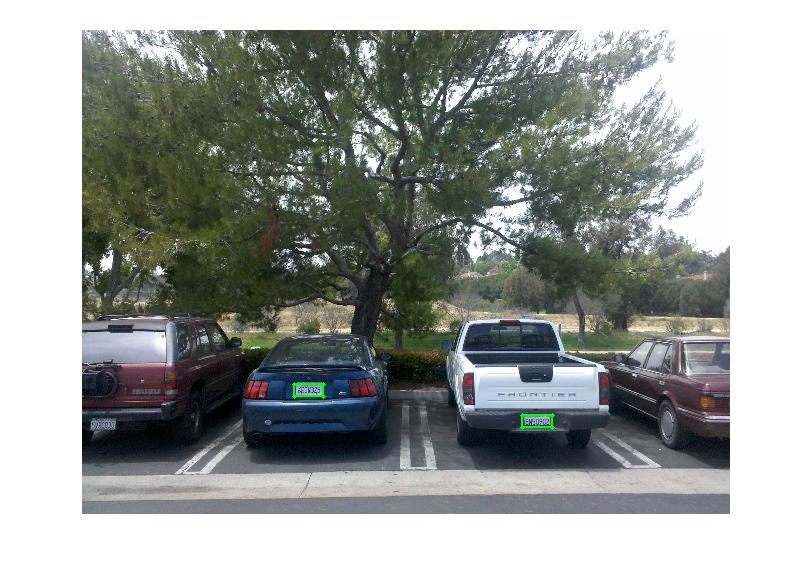
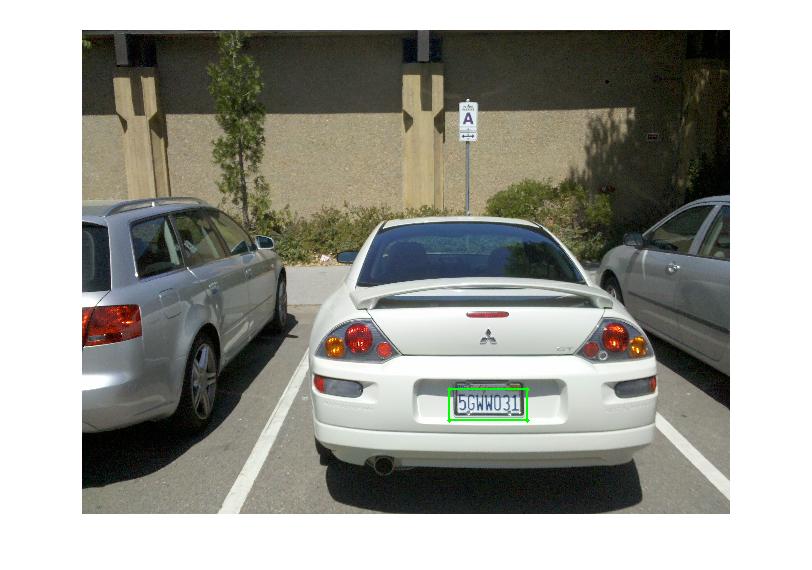
Sample Images