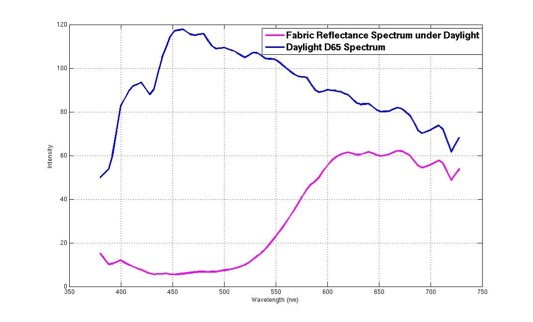
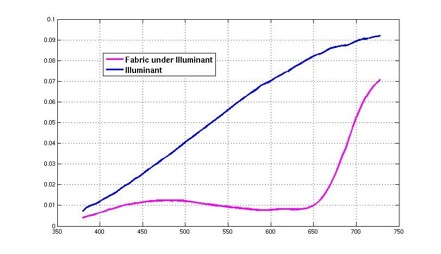
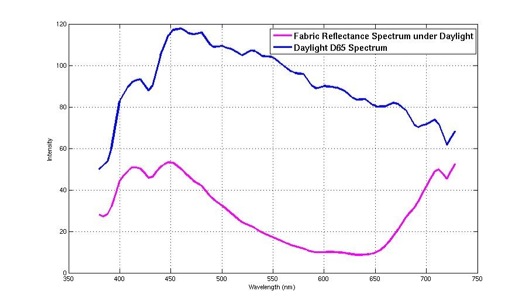
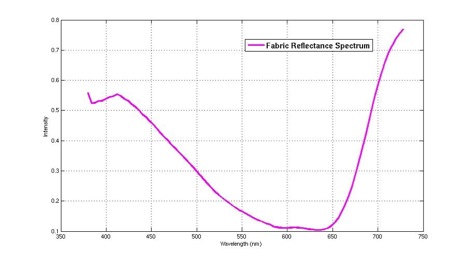
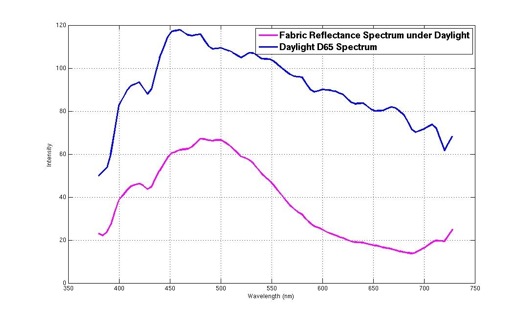
The spectrophotometer measurements are spectral power distributions of the reflectance of the material under certain illumination. The SPD is thus the multiplication of the fabric SPD and the illuminant SPD.
Measurements of the illuminant as well as the fabric under that illuminant were taken. The illuminant's SPD was found by taking a spectrophotometer measurement of a white surface.
In order to extract the actual SPD of the fabric, the spectrophotometer measurements were each divided by the SPD of the illuminant.
Next, we wanted to find what the material would've looked like under direct sunlight, so we multiplied the resulting fabric SPD by the SPD of D65 daylight and obtain the reflectance spectrum of the fabric under daylight.
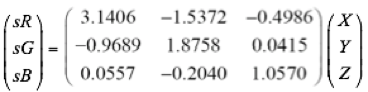
The next step was to find the XYZ values of this resulting spectrum, which can be used to then find RGB values.
The XYZ values are easily obtained by matrix multiplication - the standard CIE XYZ functions learned in class.
Since we are dealing with a reflectance spectrum under D65 light, and since our final goal is to display the color on an sRGB monitor, the ideal matrix to use now is XYX2sRGB (also learned in class).
In order to scale the resulting sRGB values to a suitable range, we used the following rationale:
If the input SPD to our conversion algorithm was white light (D65), the RGB values would have to be at their maximum (or as close as possible to maximum). This is consistent with assuming that the brightest sample we'd get is that of daylight. Under this premise, the solution we chose was to determine the sRGB values of D65 light and normalize this set of values such that the max of R, G or B is 1 (maximum intensity). It turns out that G had the highest sRGB value after the conversion (2641) and so that became our normalization factor. As expected, all fabric measurements had sRGB values below 1 after this scaling.

Spectrophotometer measurements of the different fabrics were taken in the lab, and processed in order to obtain the proper R, G and B values of each fabric sample.


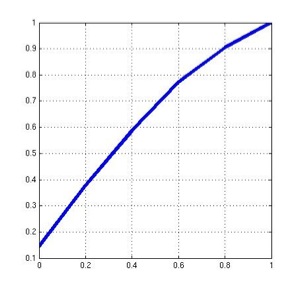
The final step was to do gamma correction with a gamma of 2.2, such that gamma are displayed accurately on an sRGB monitor.
We are essentially converting from linear sRGB space to appropriate digital frame buffer values.


And now, the color can be displayed on an sRGB monitor!



Going through the above steps gives an accurate representation of the fabric color, as we were able to verify by comparing the sRGB monitor display with the fabric samples.
We include 2 illustrations of our end result: “true” colors derived from the spectral measurements. The first sample is orange fleece and the second is blue linen.