Why Digital Archiving? An Introduction
Digital Archiving is the process of recording natural color images in the
digital domain. The general process involves taking photos of an image
(or as this presentation will focus on, a painting). Many sub-images are
taken of the picture in which a small rectangular fraction of the picture
is recorded. When these pictures are taken, readings are actually recorded
by some digital camera. After this is done and the entire subject has been
photographed with the digital camera, the information is processed. Since
the image is not being placed on film, there is no concern about the film
aging. After these sub-images are photographed, they are mosaiced together.
This part of the process involves many complex algorithms. As long as there
is a way to keep the information in a form that can be re-produced, the
process would be valuable. Image engineers discuss the number of pixels
per unit area. This is a measure of resolution since the more amount of
information used to describe a given area of painting, the more detail
that will be available to describe the area.
One of the two projects that this presentation will investigate is the
Visual Art System for Archiving and Retrieval of Images (VASARI) project.
This project was instituted by the European Community. One of it's goals
was to replace photography as a recording material. Photographs age, and
may not have the same high-resolution capabilities as digital medium.
Below is a piece of art from the VIDEOMUSEUM, a gallery that is using the
results of the VASARI project.
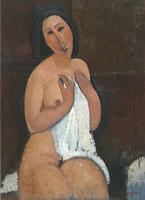
Amedeo Modigliani
One of the current roles of VASARI is the promotion of EVA (Electronic
Imaging & the Visual Arts), an organization that applies visual art
techniques. Below are two pictures taken from EVA conferences.
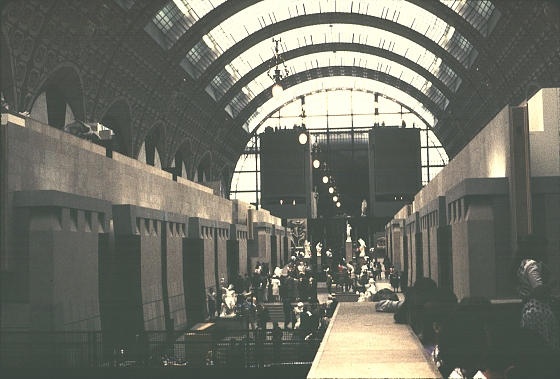
Musée d'Orsay
Palazzo dei Congressi
As the previous images show, as well as many more on file also, digital
archiving is an important part of the art industry, and its impact is very
well felt throughout the world.
Digital archiving is not limited to the VASARI and MARC (a project linked
to the VASARI project) projects. In fact, before either of the two projects
got started, The Musee d'Orsay, Paris, France had digital images on record;
however, they were created from replicas. The Open University of The Netherlands
was making extensive use of interactive electronic media. Malibu's J. Paul
Getty museum had produced a touch-screen videodisc for its ancient Greek
vase collection. All of these systems, however, had not combined the arts
of high resolution and colorimetry as the VASARI and MARC projects did.
start
next