The methods do not perform equally in the presence of
rotation. In the data shown below, unshifted phantoms (tx=ty=0) were rotated over a
range of small angles and the results of the rigid body and affine
registrations were compared in the same manner as the previous
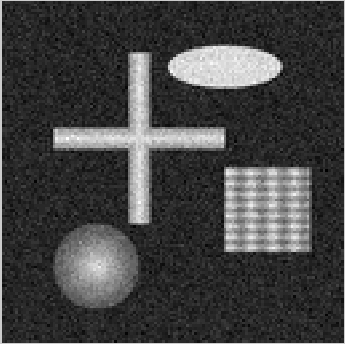
figure. First, we'll consider the results from the shapes phantom,
shown in the figure below.
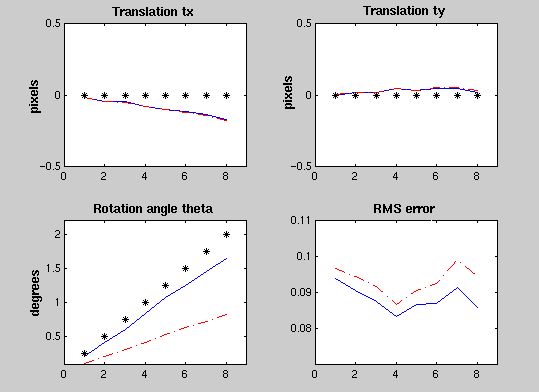
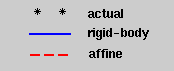
Algorithm performance on small rotations applied to the shape phantom (theta<=2 degrees). The
format is the same as the previous figure. The theta shown
for the affine registration is estimated from Sx and Sy. Note that the
error is consistently higher for the affine registration.
Interestingly, the affine registration scheme consistently has higher
error than the rigid-body scheme, despte the extra degrees of freedom
in the affine model and small-angle approximation implicit in the
rigid-body method. An intuitive measure of the goodness-of-fit of
the two methods is to apply the found rigid-body and affine
transformations to the image that has undergone motion. We can then
compute the difference between this corrected image and the
original image that it is has been registered to. The difference
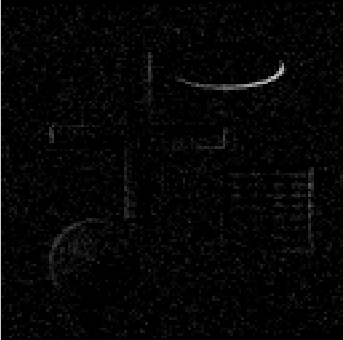
images for a 2 degree rotation are shown below for the two algorithms (along with the original
images for comparison).
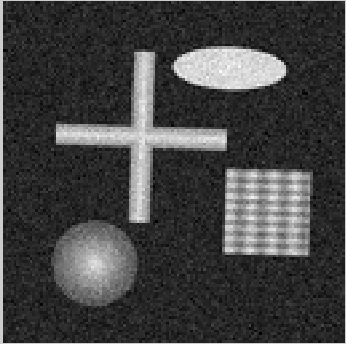
Unrotated image (Im0)
Rotated 2 degrees (Im1)
Rigid body transformation (Im0-Mr*Im1)
Affine transformation (Im0-Ma*Im1)
The rigid-body transformation does a good job correcting for the
rotation, showing essentially no features of the shapes phantom in the
difference image. The affine transformation clearly has not corrected
for the rotation, as the difference image shows prominent features of
the rotation.