Results
Image Translation
When the only motion is a small translation, both the rigid body and affine
transformations accurately find the applied translation on either
phantom. The figure below shows the performance of the algorithms on
the shape phantom where the motion is an equal shift along x and y
(tx=ty).
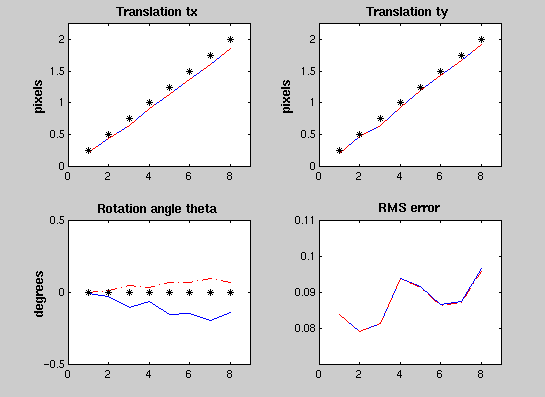

Algorithm performance on small translations (tx,ty<=2 pixels). Plots show the translation and
rotation parameters found by the rigid body and affine algorithms, as
well as the actual applied translation. The x-axis is an image index,
with the amount of translation increasing with increasing
index. The RMSE of the motion estimate is within the level of the
applied additive noise (stdev=0.1).
Similar results were found when shifts were applied only along a
single axis. In addition to the data shown above, large shifts of 4-12 pixels were
applied to both phantoms.
The accuracy of both the affine and rigid body methods degrades rapidly as the
shift exceeds 2 pixels. This degradation likely reflects the fact that the calculated
derivative information is localized to a few pixels. Both methods also perform
reasonably well in finding a small translation in the presence of
a rotation (i.e.- within 0.3 pixels of the actual value even with a rotation
of 2 degrees).