Experiments
Test Phantoms
The rigid body and affine algorithms discussed above were tested
using two simuation phantoms. The first contains a series of shapes
intended to cover a wide range of intensities and frequencies. The
second, the Shepp-Logan phantom originally developed for CT (see Shepp
et al), is a standard test phantom meant to mimic the anatomy of the
brain. Both phantoms and their fourier transforms are shown
below.
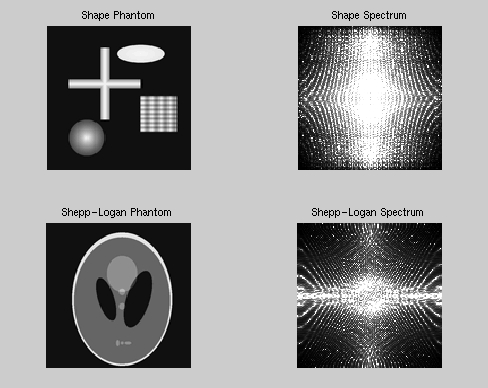
The two test phantoms used in
this study. Note that the shape phantom
uses much more of the
dynamic frequency range than the Shepp-Logan phantom.
Motions were simulated by computing the grid coordinates of a given
combination of shear, rotations and translations. The phantom
functions were then sampled using this grid.
Object motion as implemented above has the undesired effect of
aliasing small movements to sharp changes in intensity. A small
movement that happens to cross into an object can cause a pixel have a
large, sudden change in intensity. This process does not occur in MR
images, where pixels represent an average signal from a volume of
tissue. To avoid these sudden jumps in intensity, the images were
first sampled on a high resolution version of the desired grid. This
high resolution image was then low-pass filtered to the bandwidth of
the desired resolution and then resampled at the desired rate. Small
movements therefore tend to cause gradual changes intensity rather
than sudden jumps.