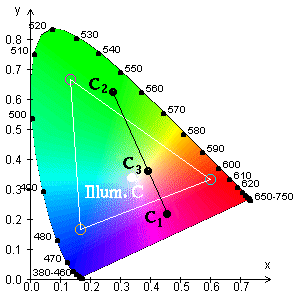
In order to characterize the color settings in Adobe Illustrator we measured the colors on a calibrated monitor using a chromameter then compared these to printouts of the colors by measurements made with a spectroradiometer. We used a Dell 15" monitor and a Hewlett Packard Color LaserJet 4500-PS printer. In mapping colors from the monitor to a printer, Adobe essentially has to convert the RGB (red, green, blue) phosphor-defined color space to the CMYK (cyan, magenta, yellow, black) ink-defined color space. In general the RGB gamut is much larger than the CMYK gamut so colors can be lost in the printing process if care isn’t taken to maintain color fidelity by shrinking the monitor’s gamut to that of the printer. The RGB color gamut can only display approximately 70% of the colors which can be perceived. The CMYK color gamut is much smaller, reproducing about 20% of perceivable colors. This is shown in the following image from Nan Schaller of Rochester Institute of Technology's website:
Adobe Illustrator has several parameters that can be varied in the color settings menu. These include: monitor type, engine, printer, and intents. We loaded our own calibrations into the monitor setting, left the intents setting at its default value and varied the printer and engine parameters. There were two possible engines to use – the Adobe Color Management System (CMS), and the Kodak Digital Science ICC CMS which was installed with Windows NT. We chose to measure three printer settings: Adobe Illustrator Default Printer, Hewlett-Packard Laser Jet PS, and Kodak DS 1000 PS Clear Film. In addition to these settings, Adobe also allows the option of "simulate print colors" in order to allow the user to see what the colors displayed on the monitor will look like when printed on a specific printer.
For our first experiment, we used a Minolta Chromameter
II to measure the xyY values of red, green, blue, cyan, magenta, yellow,
black, and white color swatches. We calibrated our monitor using the Adobe
Gamma utility. This program uses subjective observations made by the observer
to determine the whitepoint and gamma of the monitor. The file created
by the Adobe Gamma utility was saved and then loaded into Adobe Illustrator
as the input source. We measured the xyY values of these colors for all
the combinations of either engine, the three printers. In addition we measured
all these combinations for both the "simulate print colors" option clicked
and not clicked. The color swatches used are shown below:


Next we printed out these color swatches for the various combinations of engines and printer settings. We then measured the reflectance spectra of the printed colors using a spectroradiometer. This instrument measures the reflected spectrum from a known illuminant.
Finally we measured the white points of the monitor and the illuminant used with the spectroradiometer. We converted our xyY values for the monitor to LAB space. In LAB space Euclidean distances between points are linearly related so we calculated the differences between all our points in LAB space. We used the illuminant white point to convert the measured reflectance spectra to the spectra that would have been seen by a D65 light source. We chose the D65 light source because we assume the printer calibrates its measurements for daylight illumination. We then converted these values into LAB space. In this space we were finally able to compare the differences between all of our data sets.
As a second experiment we examined a feature in the color menu of Illustrator. In this menu there is the option to convert colors from RGB to CMYK and vice versa. In order to test this setting we first created RGB color swatches and converted them to CMYK space. We measured the xyY values on the monitor both before and after the conversion and printed out the converted swatches. We then measured the reflectance spectra of the printouts. Next we created CMYK swatches and converted them to RGB space and performed the same measurements. Again we converted the values to LAB space and measured their Euclidean distances.