The Super-Resolution Algorithm
This algorithm was first described in Irani and Peleg, 1990.
Given several images of a scene, together they potentially contain more information than any single one. Detail, that is lost due to decimation (the quantization process) and blur (optical and sensor characteristics), could be recovered. In a sense, one can think of such a resolution enhancement procedure as a process of intelligent image fusion, that recovers most of the original information.
Simply increasing the number of pixels, interpolating and averaging over multiple frames, often improves the quality and is typically used as a starting point. To go beyond that, knowledge of the imaging process and the viewing geometry is necessary. The further, to simulate the imaging process and the latter to match the various frames accordingly. If the camera or sensor geometry (viewing position, angle, distortion etc.) is known, then the geometric transformations can be directly incorporated in the imaging and reconstruction process. If the geometry is not known , i.e. multiple overlapping frames of unknown origin, then the images have to be registered. More on Image Registration here.
So how is it done ?
The principle idea is to simulate the image formation process, to generate
a set of low resolution images that resemble the original images. The simulated
images are generated from an initial high resolution image (an initial
estimate, based typically on an average). By comparing the generated images
with the originals one can iteratively adjust the high resolution image
to successively minimize the difference between the original and simulated
low resolution image.
Imaging Model, more precisely and in detail:
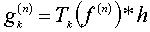
We start with a set of low resolution images {gk}. There are k original images.
where (arrow) denotes a down sampling operator by a factor of s and * is the convolution operator.
The goal is now to construct a higher resolution image f', which
approximates f as accurately as possible and surpasses the visual
quality of the observed images in {gk}. It is assumed
that the acceleration of the camera is negligible.
Starting with an initial guess f(0) for the high resolution
image, the imaging process is simulated to obtain a set of low resolution
images {gk(0)} corresponding to the observed
input images gk. If f(0) were the correct
high resolution image, then the simulated images {gk}
should be identical to the observed images. The difference images (gk
- gk(n)) are used to improve the initial guess
by "back projecting" each value in the difference images onto its receptive
field in f(0), yielding an improved high resolution image
f(1). This process is repeated iteratively to minimize the
remaining error.
This iterative update scheme of the high resolution image can be expressed by:
where K is the number of low resolution images (arrow) an upsampling operator by a factor s and p is a back projection kernel determined by h and Tk . Taking the average of all discrepancies has the effect of reducing noise.
Deblurring
Without up- and down sampling the algorithm has the effect of deblurring:
In this case the imaging process is expressed by:
And the restoration process becomes:
Choosing h and p:
An important part of the algorithm is the selection of the blurring operator h. The amount of blurring should approximate the actual properties of the imaging sensor (Point-Spread-Function).
Even more critical is the right choice of the backprojection operator p.
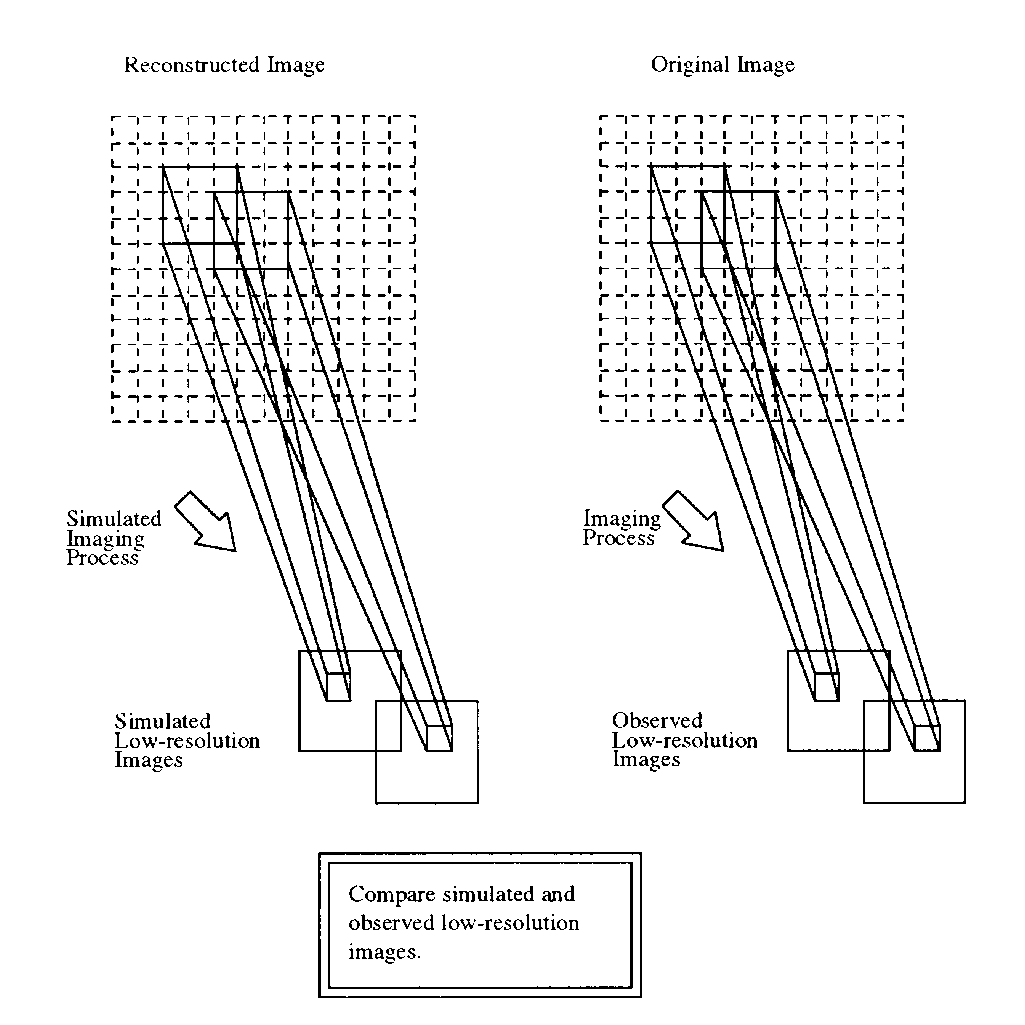
The diagram below explains the simulation process: Multiple pixels in
the high resolution image (those in the region of support of the blurring
operator) contribute to a single low resolution pixel. Since these areas
overlap, it is also the case that multiple pixels in the low resolution
image are influenced by the same high resolution pixel (some stronly and
others weakly). The backprojection operator collects these contributions
in a convolution operation and when applied iteratively has a de-blurring
effect.
Related work
Above described method can also be applied to color images, for example to multiple frames of a Video sequence. Due to the specific color perception of the human visual system, it is usually sufficient to apply the enhancement to the Y-component (luminance) and use simple averaging for the chrominance components.
Cheeseman et al have developed a statistical
method, namely a form of Bayesian estimation, assuming pixel neighbor correlation,
to improve on the Super Resolution algorithm. The Bayesian approach shows
dramatic resolution enhancement for images of the Martian surface gathered
by the Viking Orbiter.