Yu Kee Lim, Psych 221
In Conclusion
Final Comments
All in all, although the improvements are significant, remember that the test images used were very extreme. The luminance test image was raised in brightness as much as possible. Similarly, the contrast masking test images had extreme regularity or extreme uncorrelated noise. Real images would not contain such extremes and the benefits from this would then be not as great. It took quite a bit of experimentation to figure exactly how to bring out the advantages DCTune has over the standard jpeg compression.
To illustrate this, below are two lena images without any modifications, compressed by the standard jpeg algorithm and the DCTune respectively. Here is the link to the original pgm file.
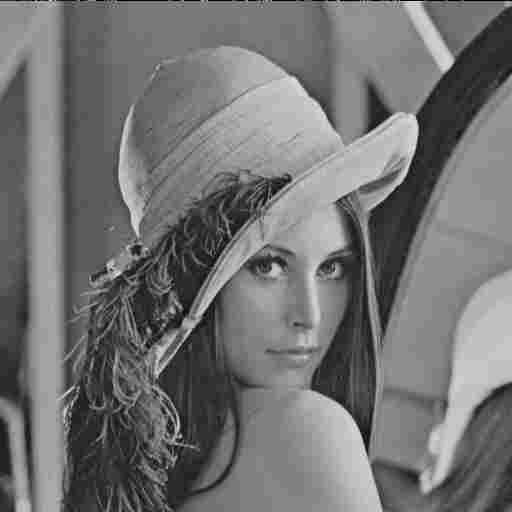
Standard JPEG compression, 9.643
kbytes
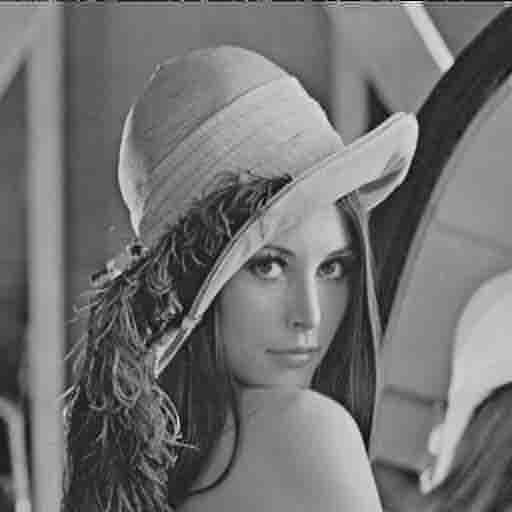
DCTune JPEG compression, 9.511
kbytes
It can be observed that the DCTune compressed one is of higher quality. However, the improvement is not by very much and not as significant as compared to the results from the previous two pages.
Conclusion
In conclusion, DCTune does indeed perform better than the standard JPEG compression algorithm. Although my demonstrations have to show that for same amount of compression, the image quality is better, this also means that for the same desired quality, the amount of compression will be higher. The effect from luminance masking though, does not seem as significant as that due to contrast masking.
However, DCTune algorithm is slow. The standard JPEG compression algorithm run almost instantaneously, while the DCTune one takes a quite a few seconds, depending on the image size and amount of compression. This is because DCTune has to reiterate through the images a number of times until the optimal quantization matrix is achieved.
In summary, DCTune does perform better compression for the same image quality but that comes with the cost of slower processing. At this point, it is probably not worth using it instead of the standard jpeg compression, mainly because of it's very processing time is very significant, unless the extra compression is needed. Nonetheless, it does proof that the theory does work in reality. Considering that the standard jpeg compression has been near-perfected over time, it is possible that further fine-tuning of the DCTune alorithm will improve its performance and its processing speed.


