Yu Kee Lim, Psych 221
Effect of Luminance Masking
Luminace Masking
First, to illustrate the effect of luminance masking, here is a sequence of pictures.
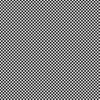



Each of these images have the same amplitudes but with different mean, the lowest on the left. As can be seen, the pattern is more noticeable towards the left. When the average brightness is higher, the same amount of regional change amounts to a lower contrast as compared to a lower average brightness. Thus the same variation in a bright region would be less visible than in a darker region.
It works out in this algorithm thus. For a region with higher luminance, quantization of, say, value 223 to 200 would be less noticeable that quantization of value 123 to 100, even though the quantization error in both are the same, 23. Therefore, a larger amount of quantization will be possible in brighter regions, without loss of significant data.
One thing about the DCTune program is that it provides a measurement of the quality of the compressed image which is different from the measurement that standard JPEG compression uses. Thus it is impossible to compress an image, using the two different programs, to the same quality and then compare which performed greater compression, since there is no concept of same quality between the two. Thus what I did was to used the two programs to compress in two different ways into the same size files before comparing their quality. A compressed image with better quality would have had better compression with same quality.
The image I used for testing is based on the popular Lena image. What I did was to make two quarters of the image brighter than the other two. I had to scale the original image first though to ensure that when I increased the luminance at those regions, the image values do not get out of bound. Here is the link to the original pgm file.
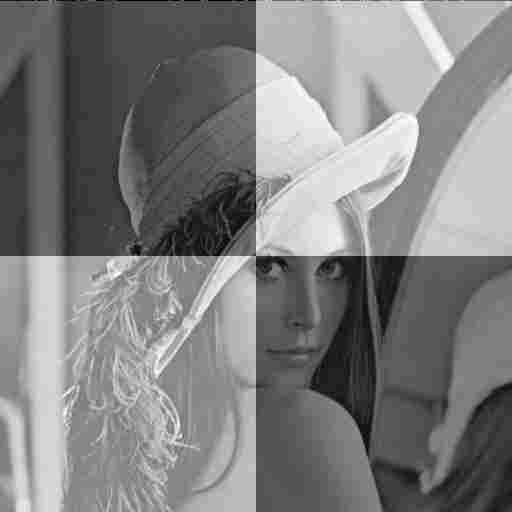
Standard JPEG compression, 8.045
kbytes

DCTune JPEG compression, 7.918
kbytes
Upon close examination, it can be observed that the DCTune image is of slightly better quality. One region this can be seen is the face and shoulder. The DCTune image is definitely smoother in this region, which means more levels of quantization to have less quantization errors. This can also be observed in the background of the darker regions. Moreover, the lighter regions do not seem to suffer any deteriotion except for the bunch of feathers in the lower left quarter. The presence of blocks are somewhat more apparent in the DCTune image than in the standard one.
Another thing to look at the compression without the brighter regions.

DCTune JPEG compression, 9.606
kbytes
This was DCTune compressed with the same perceptual error of 4.5, the measurement used by DCTune. Note that quality in the dark regions are similar and that the file is smaller for the image with the bright regions added. This demonstrates the compression is improved because of those regions with higher luminance.
All in all, these demonstrate that improvement DCTune has over standard JPEG compression when taking into account the luminance variation across an image.


