Audio-Optical Illusions
Results
How do you quantize totally subjective data?
The true effectiveness of a given Audio-Optical Illusion can be judged solely on feedback received by viewers. These viewers are sometimes biased, misguided, or mischievous. Some viewers are physically unable to give a valid response for reasons of color blindness, extremely poor vision, or lack of sterio vision. The point is that any set of data collected from subjects concerning the effectiveness of a given optical illusion must be taken with a grain of salt.
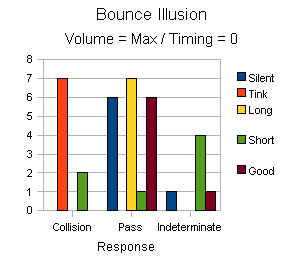
Now that the legal stuff is out of the way, lets dig into what we learned. The most interesting (and probably most formally studied) is of course the bounce illusion. Below are some graphs depicting the effectiveness of the bounce illusion over a group of not so randomly picked subjects:
Bounce Illusion
Here we see the results of administering the Bounce Illusion to seven subjectively selected subjects. For this test the audio was triggered right at the point where the two bars cross and the volume (as with all tests) was set to maximum. The viewer was first presented the illusion in silence to “dial in” the illusion. All but one viewer agreed that the bars appeared to “pass” each other in silence. One viewer insisted that the illusion was not consistent.
Definitions:
Silent = No tone during test
Tink = A sharp “Tink” sound
Long Swoosh = A drawn out “Swooshing” sound
Short Swoosh = An abrupt and harsh “Swhoosh” sound
Good Swoosh = A “Swoosh” sound that was likely to -NOT- produce a bounce
Before the test I expected that all viewers would see a pass in silence, a bounce on tink, and a pass on “Good Swoosh”. For the most part this was the case. Big Swoosh was really just a poor sound so I expected it to behave the same as silence. Short Swoosh was intended to be the calibrator for the experiment. Short Swoosh is a sound that is abrupt enough that it can be registered as either a Bounce or a Pass. Note that most people did find that sound to be indeterminate.
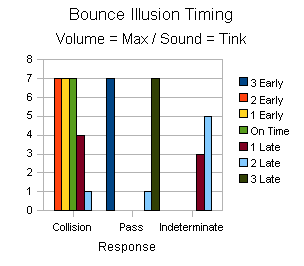
The
next step was to start playing with the timing of the signals. Each
sound was played early and late by up to 3 bars. The expectation was
that as a sound moves away from “center” its ability to
trigger a “bounce” response was reduced.
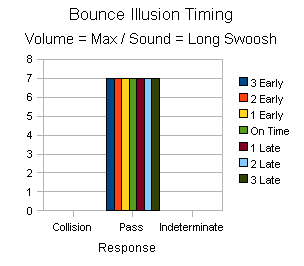
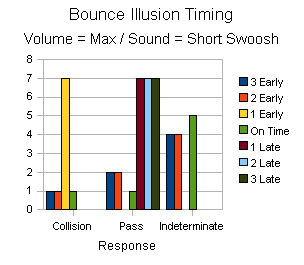
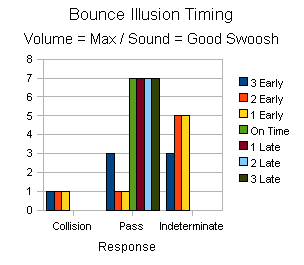
Two interesting things crop up in this data. One is that playing the sound 1 or 2 bars early seems to not effect the illusion. People are willing to accept the sound coming slightly early. This is counter intuitive since in real life you will always see an action occur before you will hear that sound. In any event once the sound was played 3 bars early the illusion broke and no one could see it. Similarly playing the illusion 3 bars late broke the illusion for everyone. Results were varied when the sound was played just after the collision. It seems that if someone was expecting to see a bounce they would and if they were expecting a pass they would see that. On subsequent tests the results started to be come more indeterminate when the sound was played 1 or 2 bars after the collision.
As a control each viewer was shown the standard 0 timing Tink bounce between different timing runs so that there would not be a collective result. The user did not know when the timing was going to be applied.
Here are the results for varying the timing with the other sounds
|
|
|
|
These results are confusing. If you examine the plots for Short Swoosh you will see a very strong response at 1 bar early. This leads me to believe that it is the timing of the signal (and not the content of the sound) that really drives the response. Even though the sound was a “passing” sound all of the viewers reported seeing a bounce when the Short Swoosh was played 1 bar early. From this you would expect to see a similar correlation with Long Swoosh and Good Swoosh. I can write Long Swoosh off as a signal that is “too long” but Good Swoosh should have returned similar results. Contrarily for early timing on Good Swoosh most people experienced and indeterminate illusion. Perhaps there is a struggle between the natural response and the logic of the brain.
Multi-Bounce Illusion
I did not collect any data on this illusion since the inconsistency of the graphics rendering caused too many anomaly's.
Flying Ball(s)
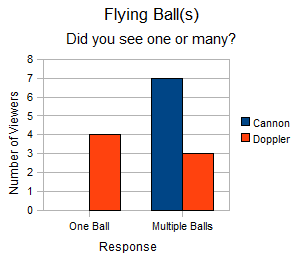
This
illusion was a big disappointment for me. I really just did not have
time to perfect the illusion before presenting it. I had a vision of
the Doppler effect including a surround sound system and I pictured
the timing being better. I really did not have a good Doppler
example and the timing was not totally convincing. I wanted to be
able to present the two Illusions and have everyone report multiple
balls for the cannon shots and only one ball for the Doppler effect.
Apparently people were not so impressed with my Doppler Illusion.
With work I think this illusion could pan out.
Assumption Illusion
Ok, bear with me while I turn up the subjective volume a few more notches. I had trouble finding a way to quantize this illusion so what I did was break the results down into two categories: Those who were able to identify the illusion BEFORE it was completely uncovered and those who could not. I only wanted to use one picture and I was obviously not a good contenstant so I broke the group into two. Half of the people were subjected to the Hint and half were not. Here is how it turned out:
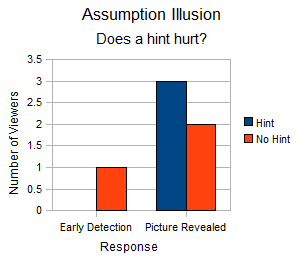
I dont know if this graph really means anything. It does show that one person detected what the image was before it was totally revealed (when not given a hint) but I did not run enough tests over enough people. My suspicion is that with a more scientific approach correlations could be made.
Voice Throwing
This test was by far the most disappointing of all. I know that the illusion works but I just couldnt get it to take with this test setup. I will try it again on presentation day with a larger screen and see if it works.