Method Overview
Characterization
Characterization
of the non-uniformities was conducted in two ways. The goal was to determine
the extent of colour distortion caused by lenses, and to determine the
contribution of the different factors to the distortion.
- ISET was used, along with a
wavelength-dependent aberrated lens model, to
study the effect of the wavelength-dependent properties of the lens on
image colouration.
- Custom code was developed that
performs position and wavelength dependent Gaussian blurring and intensity
loss. The code was used to see if colour changes could be modelled.
For the
purposes of the studies, two images were used. First, we used the Macbeth
colour chart (see figure 1). This image is appropriate because the colours are
well-defined and ISET can find the ideal colour balancing matrix to rectify
errors in the colours for this image. Second, we used a uniform image under D65
illumination (figure 2). For some purposes, this image was more appropriate
because the Macbeth colour chart would exhibit some colour blending at the
colour boundaries
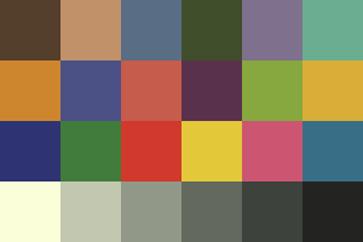
Figure 1: Macbeth
Colour Chart used to detect colour distortion

Figure 2: Uniform
scene (D65 illumination)
Compensation Implementation
Images
were generated by the custom code developed for performing position and
wavelength dependent Gaussian blurring and intensity loss. These images with non-uniform chromatic
aberrations were then used as input for investigating the Gray World colour
balancing variants. The colour balancing
algorithms presented are developed under generic Matlab.