Effect of Wavelength and Position-Dependent Blurring and Photon Loss
Experiment
1: Blurring-only
Using
our custom-developed Gaussian blurring code, we repeated a portion of the
previous experiment in order to determine how much of the colour distortion is
due to the blurring effect. In this portion of the study, there was no photon
loss. The model used is summarized in the table below.
|
Distortion Type |
Comments |
|
wavelength-dependent
blurring |
blur
factor proportional to: abs(wavelength
– 540) No blurring for 540 nm light; heavy
blurring for 400 and 700 nm lights |
|
position-dependent
blurring |
blur
factor proportional to: |
|
wavelength-dependent
photon loss |
none |
|
position-dependent
photon loss |
none |
Applying
this model to the macbeth and uniform
images yielded the following images:
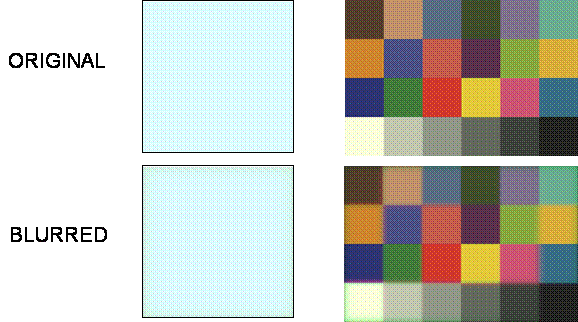
Figure 1: Gaussian blur filter with no
photon loss applied to the uniform and macbeth
images.
The
uniform image showed no change. This is expected because while one pixel will
blur into its neighbours, it will also receive some photons from its
neighbours. The overall effect is that there is no colour distortion of the
image.
The macbeth image showed some
distortion, as can be seen as the blending of colours at the colour boundaries.
As already discussed, this colour blending is not a distortion that colour
balancing is responsible for correcting. The real question is if any of the colour squares changed colours as a whole. The following SPD
is sampled from the centre of the white square in the macbeth image. The SPD shows us that there is no
colour distortion that is caused by blurring. The only distortion caused by
blurring is the boundary colour blending.
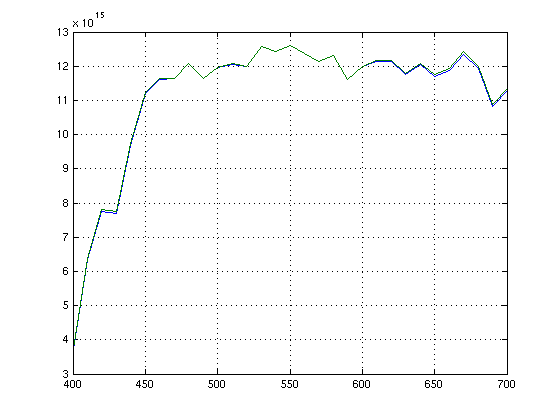
Figure 2: SPD of white
square in macbeth scene. There are two lines
shown, the original SPD and the SPD from the blurred image. The lines overlap,
so distinguishing them is difficult.
The
results of this experiment simply confirm the fact that blurring in its own
cannot cause a fundamental colour change – one that can be corrected by a
colour balancing matrix.
Experiment 2: Blurring and photon loss
In this
experiment, the photon loss effect caused by the lens was added to the
custom-developed code. The resulting distortion model used is shown in table
below.
|
Distortion Type |
Comments |
|
wavelength-dependent
blurring |
blur
factor proportional to: abs(wavelength
– 540) No blurring for 540 nm light; heavy
blurring for 400 and 700 nm lights |
|
position-dependent
blurring |
blur
factor proportional to: |
|
wavelength-dependent
photon loss |
photon
loss factor proportional to: abs(wavelength
– 540) No
loss for 540 nm light; heavy loss for 400 and 700 nm lights |
|
position-dependent
photon loss |
photon
loss factor proportional to: |
Using
this model yielded the following resulting images.

Figure 3: Uniform image with photon loss.
Image shows colouration changes. True colour is at image centre. Colour gets
greener as a function of radius.
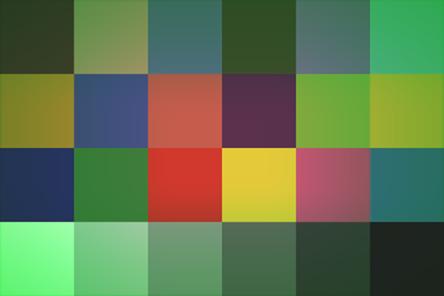
Figure 4: Macbeth image with photon loss.
Image shows significant colour distortion. Distortion is limited at image
centre, but colours at the periphery show greenish colourations.
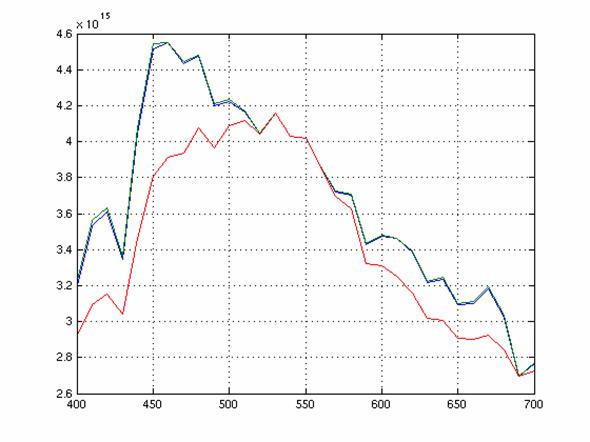
Figure 5: SPD of uniform image. Blue line
is sampled near image centre. Red line is sampled near image periphery. Change
in SPD envelope suggests colour distortion.
The results above show that wavelength-dependent
photon loss causes colour distortion. Normally this distortion can be corrected
with a single colour balancing matrix (see figure 6 and caption), but since the
effect is also position dependent, a unique matrix is required for each pixel.


Figure 6: Wavelength-Dependent Imager Aberrations as a Colour Balancing
Problem. Balancing for the
illuminant is a well-known colour balancing problem,
and can be rectified with a simple 3x3 colour-balancing
matrix. Although the problem of wavelength-dependent imager aberrations is
completely distinct from the illuminant problem, the two scenarios are
analogous – they both distort the image in a similar fashion. Using this
result, we can conclude that colour balancing is the
correct approach in dealing with wavelength-dependent intensity scaling of the
imager.