Class Project
EE362/PSYCH221: Applied Vision and Imaging Systems (Winter Quarter 2005-2006)
Title
Image-Based Rendering using Disparity Compensated Interpolation
Submitted by
Aditya Mavlankar
Introduction:
Virtual view synthesis refers to the generation
of a view of a scene from an arbitrary or novel view-point. Image-based
rendering (IBR) techniques generate a novel view from a set of available images
or key views. Unlike traditional three-dimensional (3-D) computer graphics, in
which 3-D geometry of the scene is known, IBR techniques render novel views
directly from input images. Figure 1 illustrates this idea. Camera number 1 and
camera number 2 are real cameras that capture the same scene from different
view-points. Also shown is a virtual camera placed at a view-point which is
between the two real cameras. The goal is to render a novel view observed by
this virtual camera.
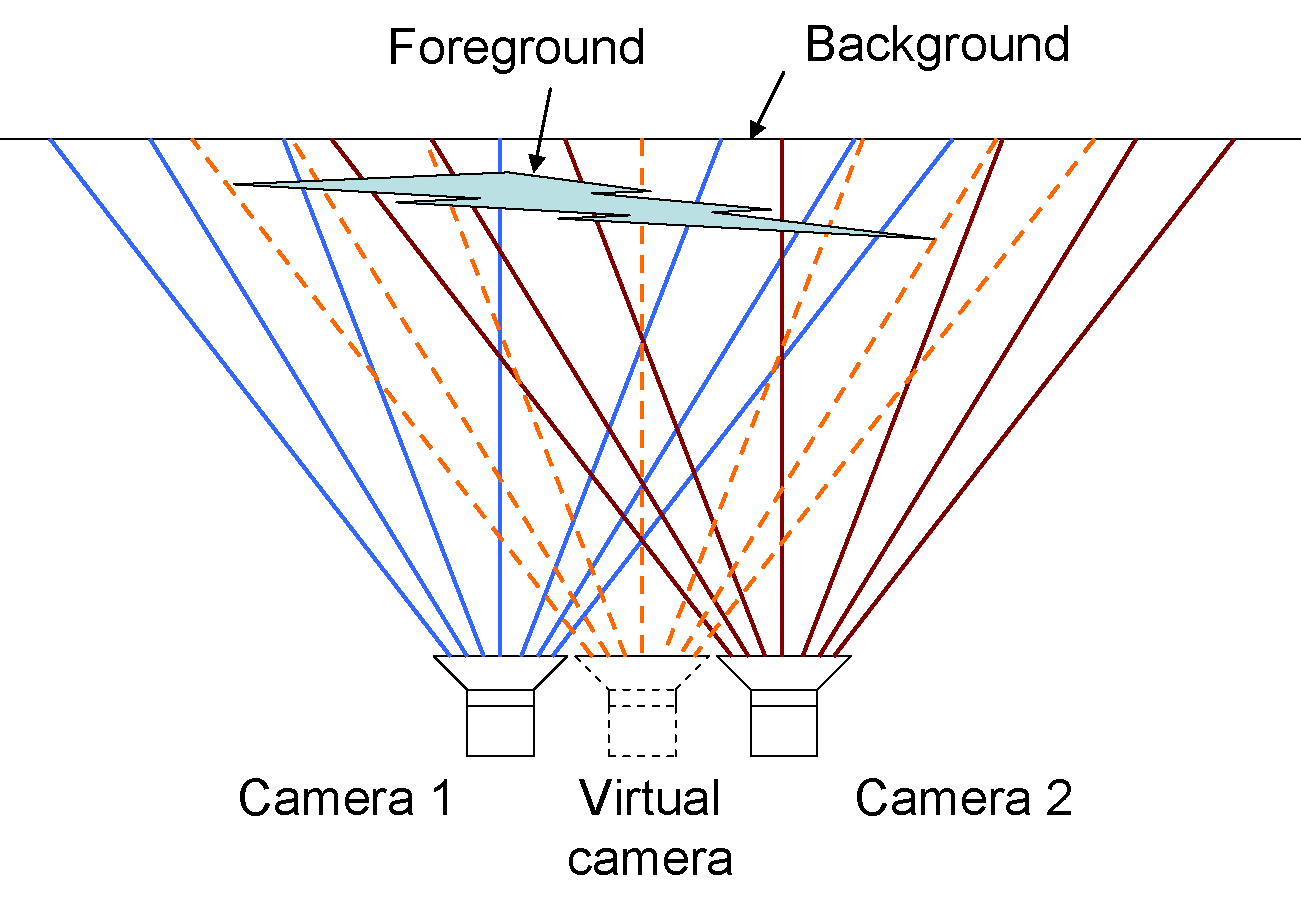
Figure 1: Virtual view synthesis.
A survey of IBR techniques is presented in [1].
This survey classifies IBR techniques into three categories according to how
much geometric information is used:
1) Rendering with explicit geometry
(either with approximate or accurate geometry).
2) Rendering with implicit geometry
(i.e., correspondence).
3) Rendering without geometry.
Rendering with explicit geometry:
This category is represented by techniques such
as 3-D warping, layered depth image (LDI) rendering, and view-dependent texture
mapping. 3-D warping [2] assumes that the depth information is available for
every point in one or more images. LDI [3] is an improvement over 3-D warping
since it treats the disocclusion artifacts in 3-D
warping. LDI, however, assumes the knowledge of what is behind the visible
surface. Texture maps can be generated by applying computer vision techniques
to captured images. View-dependent texture mapping [4] blends the textures from
different view-points after warping them all first to a common surface.
Rendering with implicit geometry:
View interpolation [5] and view morphing [6]
are the representatives of this category. Methods in this category rely on
positional correspondences across a small number of images to render new views.
The positional correspondences are typically generated from a sparse set of
correspondences (matching points) input by the user. Although geometry is not
directly available, 3-D information is computed using the usual projection
calculations.
Rendering without geometry:
Light field rendering [7] and lumigraph systems [8] are the main techniques in this
category. These techniques do not rely on any geometric information, but they
rely on oversampling to counter undesirable aliasing
effects in output display.
Goal:
The purpose of this project is to come up with
a rendering technique which requires no depth information, no correspondence
input and works well when the disparity between two views captured by two
adjacent cameras is not too high, i.e., the two key images depict the same
objects from slightly different view-points. Also it would be good if the
computational complexity is bounded by the image resolution (spatial size of
the image), rather than the scene complexity. The view-point for the novel view
can be anywhere on the line joining the two camera centers.
The IBR technique would then be used to
generate a video of view-point traversal in a static natural scene. The effect
of inserting novel views on the viewing experience would be observed. How many
intermediate views are required for a smooth traversal? How sensitive are we to
the quality of these intermediate novel views? Can we tolerate the artifacts in
the novel views produced by our proposed algorithm?
(One famous example of view-point traversal is
from the
References:
[1] H.-Y. Shum, S. B. Kang and S. -C. Chan,
"Survey of image-based representations and compression techniques," IEEE
Transactions on Circuits and Systems for Video Technology, Vol. 13, No. 11, pp
1020-1037, Nov. 2003.
[2] L. McMillan, "An image-based
approach to three-dimensional computer graphics," Ph.D. dissertation, Dept. Comput. Sci., Univ.
[3] J. Schade,
[4] P. E. Debevec, C.
J. Taylor and J. Malik, "Modeling and rendering
architecture from photographs: A hybrid geometry- and image-based approach,"
Proc. ACM Annual Computer Graphics Conf., pp. 11-20, Aug. 1996.
[5] S. Chen and L. Williams, "View
interpolation for image synthesis," Proc. ACM Annual Computer Graphics Conf.,
pp. 279-288, Aug. 1993.
[6] S. M. Seitz and C. M. Dyer, "View
morphing," Proc. ACM Annual Computer Graphics Conf., pp. 21-30, New Orleans,
LA, Aug. 1996.
[7] M. Levoy and P. Hanrahan, "Light field rendering," Proc. ACM Annual
Computer Graphics Conf., pp. 31-42, New Orleans, LA, Aug. 1996.
[8] S. J. Gortler, R.
Grzeszczuk, R. Szeliski,
and M. F. Cohen, "The lumigraph," Proc. ACM Annual
Computer Graphics Conf., pp. 43-54,