Introduction
In recent history, improvements in device technology have given rise to smaller handheld digital cameras. With the desire for miniaturization come technical difficulties with the optical elements of the system. Two of these challenges for the optical system, distortion and light falloff, are investigated in this project. Distortion is manifested as a deformation of the image, and light falloff, or vignetting, is a reduction in the light intensity toward the corners of an image. Short focal length can have a severe effect on both these metrics.
Distortion becomes a problem at short focal length. The push to smaller cameras and shorter focal lengths contribute to the problem with optical distortion. The two main types of distortion are presented in the illustration below. Barrel distortion is a bowing out of the picture image whereas pincushion distortion is a curving in of the image.
Compact digital cameras typically have a wide angle lens (focal length < 35 mm), which allows for a large field of view, but at the same time, suffers more barrel distortion. The Canon SD500 has a focal length between 7.7 – 23.1 mm, while the Canon S50 has a focal length between 7.1 and 21.3 mm, which are both considered wide angle lens.
Undistorted
Image Barrel Distortion Pincushion Distortion
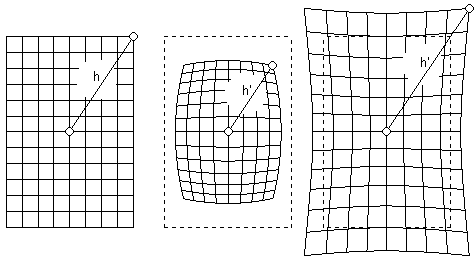
Image from Paul Van Walree
Vignetting, or light fall off, also becomes a problem with short focal length
lenses. This is due to the cos4 law of light falloff as it is known in the camera world.
There are 4 reasons why the light falls off at the camera edges, and all are functions of the cosine of the angle:
- The light has to travel a longer distance from the center of the lens to the corner of the image array.
- Light intensity falls off as the square of the distance. Light at twice the distance is spread across four times the area.
- Angle of light to the sensor. The light hits the sensor at a grazing angle which is not optimal for CCD absorption.
- Angle through the aperture lens affects the amount of light that passes through it. Straight on, light passes through the whole aperture. At an angle, the light only sees an elliptical sub-aperture of the lens. For short focal lengths, this angle can grow very large and is problematic.
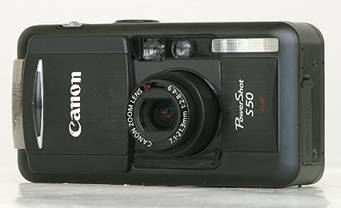
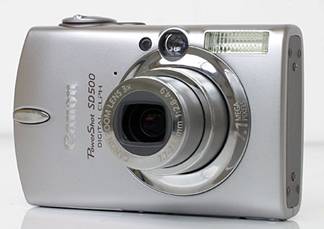
There is a variety of digital cameras available in the market, often with seemingly similar specs. For this project, the Canon PowerShot SD500 and Canon PowerShot S50 were compared.
The Canon SD500 is designed with 7 megapixels (larger CCD sensor) in a smaller body, while the Canon S50 is designed with 5 megapixels in a larger, bulkier body. Extra pixels are supposed to produce sharper, more detailed images. But on the other hand, a larger body allows for a larger lens and more functionality. Another difference is the new Dig!c II image processor in the SD 500, that is designed for improved processing speed and image quality over the image processing in the S50.
There are pros and cons between the two cameras, which is the reason for our investigation. Our comparisons are done on the end image, after all the photo processing has been completed, since as a user, we only care about the image that is loaded onto the compter.
Below are images of the two cameras (top – S50, bottom – SD500):
Back to Table of Contents.