Project Introduction
This project deals with the two deeply related fields of steganography and watermarking
and its application to the field of imaging and vision science.
Steganography is at its heart hiding information inside other media. The course dealt
with vision and image systems and in keeping with that spirit this project restricts
the scope of its work to the fields covered by the course
Prima facie, steganography might appear esoteric in terms of usage: covert communications ,
neat math and so on. However the related field of watermarking is very much grouned in
the present and infact one could say omnipresent in todays world.
The notion of watermarking is the same as steganography except with the added requirement of robustness
This makes it a crucial link in the realms of authentication, copyright enforcement , digital rights management - the
new concepts
The veritable explosion of usage of images and video due to the internet has lead to watermarking being central
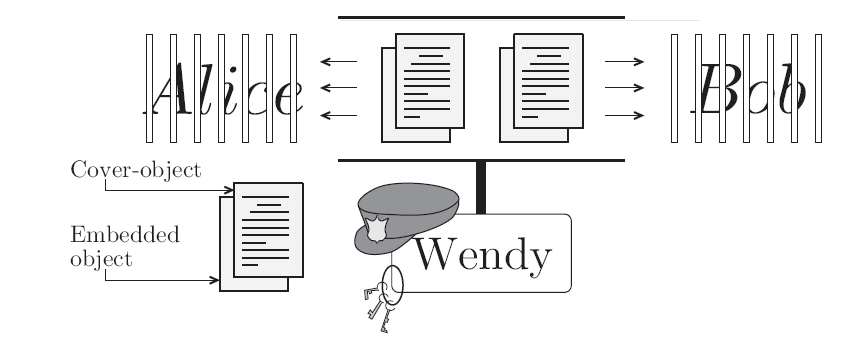
Both steganography and watermarking can be thought of in terms of the prisoners problem[1]
The “prisoners problem” describes Alice and Bob arrested for some crime and thrown in different cells. They
want to develop an escape plan but their only means of communication is watched over by a warden (who
can choose an active or passive role). The problem of Alice and Bob communicating without the "passive"
warden not knowing that they are exchanging secret messages is the principle of steganography. If the warden
were "active" and maliciously or otherwise tampers with the communication then it embodies the principle
of watermarking. The below figure (attributed to [3]) conveys the overall picture:
Motivation
The question of why this topic in a course on "Applied Vision and Image Systems" must be answered. It is my
opinion that this project is high in relevance as the whole fields of steganography and watermarking rely
heavily on the fundamental concepts put forward in the course namely visual acuity and
exploiting statistical properties of images to better gain. An added mention to the intrinsic
advantages of images & videos for information hiding are immense given the volume of data involved and the amount
of images & videos which gets exchanged or shown due to the internet.
In short, the topic is highly interesting, cross-disciplinary yet very relevant to the course (and suits my
CS background). (The coolness factor of hiding information inside other sources with little visual
is not to be discounted...)
The following pages go through the details of current prevalent techniques to carry out steganography and
watermarking. The implementation of said techniques wherever possible has also been carried out and morefully
described in the section titled source listing.