|
|
|
|
Cathode ray tube
|
|
|
|
|
|
|
|
|
|
|
|
|
|
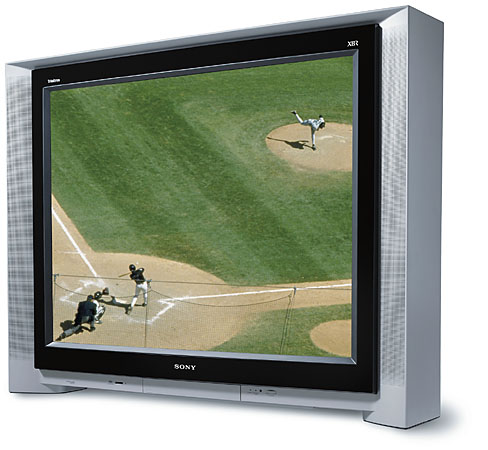
In a CRT an electron beam hits a phospor screen exciting it to emit a visible photon. The electron beam is generated in an electron gun, and its intensity is controlled usig a grid on which a voltage is applied. Then it is scanned all around the screen, exciting the different pixels.
The rate of emission of electrons from a heated metal is given by the Richardson-Dushman equation, i = AT2e-b/T A/cm2, where T is temperature in K, and A and b are constants . For tungsten, A = 60 and b = 52,400K. (For oxide cathode, which is used in most CRT, A=0.01, b = 11,600) The emission increases rapidly with temperature due to the exponential factor in the R-D equation. A thermal cathode can emit a lot of electrons, far more than required normally, most simply return to the cathode.
|
|
|
|
Gamma = 2.5
|
|
|
|
|
|
|
|
|
|
|
|
|
|
If you do a Google search about, you will find this: "All CRT displays have a power-law transfer characteristic with a gamma of about 2.5. This is due to the physical processes involved in controlling the electron beam in the electron gun, and has nothing to do with the phosphor." Do you believe this? I do, because Google is one of the only dotcom survivor, so it cannot be wrong.
The electrons emitted by the thermal cathode form a negative space charge region above the cathode. In equilibrium, the rate of emission is equal to the rate of return if no electron is sucked away by anode. When there is an anode, the amount of this current is given by I = A V3/2 for a flat cathode, where V is the voltage from anode to cathode. This is called the Langmuir-Child law. As I mentioned above, the freaking cathode emits so many electrons that there are always enough electrons available to satisfy Langmuir-Child. And the energy of the electron is I *V = A V5/2. We also know that the fluorescence of the phosphor is more or less linear in the deposited energy. so the light intensity emitted will have a gamma of 2.5.
|
|