|
|
|
|
First analysis
|
|
|
|
|
|
|
|
|
|
|
|
|
|
Simple inspection of the preliminary results renders the following facts:
- It was imposible to measure the lower intensities SPDs of the CRTs. Meanwhile those of the LCDs were obtainable.
This is due to the fact that in the CRT the low values just diminish the intensity of the electron beam, up to completelly blanking it. In the case of the LCDs the off state does not completelly block the backlight.
- In both CRT and LCD displays the three primaries are independent.
This is obvious in a LCD, and in the case of the CRT this implies that the three electron beams do not interact with each other.
- CRT spectral response keeps the same shape regardless of the intensity of the image. Its value, nevertheless is not linear with RGB digital value, but follows an exponential growth with gamma being the exponent.
On the other hand, LCD spectral response does not keep a common shape for all intensities.
- The gamma results for the CRTs complies with the theory, but that of LCDs should, in theory be linear. They have a gamma of around 3, that could be due to some software driver that tries to emulate the behaviour of the more established CRTs. This would be motivated by the actual standards like JPEG, that are being programmed to show comparable images in CRTs.
As will be seen later, plasma TVs have a gamma of approximatelly 1, which acounts for the fact that they are not used primarely as a computer monitor, but as a broadcasting TV, which need not comply with the actual computer standards.
|
|
|
|
HP old crt analysis
|
|
|
|
|
|
|
|
|
|
|
|
|
|
The linearity results of the HP CRT monitor show a very interesting result. Namely, the fact that the response is linear on the three separate phosphors, but not exactly for the case of the white stimulus. Although the gamma curves were the same for the three primaries, the green component was not completelly linear, such that:
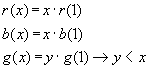
The first hipothesis was some kind of higher wear out on the green phosphor, that had caused a lowering in its efficiency.
The second posibility was that the green electron gun electronics had suffered some kind of miscalibration with respect to the other two guns. This hypothesis was proven rigth by the gamma results, that show a different behaviour for the green stimulus.
|
|
|
|
Plasma TV analysis
|
|
|
|
|
|
|
|
|
|
|
|
|
|
The phosphors used in the plasma TV measured were reasonably different to those that appear in conventional CRT screens. The primaries spikes are narrower, even the smooth blue. This was expected from the fact that Plasma TV phosphors are tuned to respond to UV excitation.
The spikyness and little overlap of the primaries SPD show a better performance in color display for Plasma TVs.
Also, from the XYZ chromaticity graphs the primaries are further apart so a wider range of colors can be displayed. Their position does not depend on the stimulus intensity, so this range is attainable for a wider range of brightnesses. CRT xy values are also plotted for comparision. LCD xy values decay very rapidly with brightness, and even in the highest one, the range was smaller.
As expected from its working principle, the primary cells are independent to one another, and they are perfectly linear in their response. The time multiplexing nature of their behaviour explains this fact.
As a conclusion, Plasma TVs are more linear than CRTs, and their spectral power densities are purer, but their gamma does not make them appropiate to be used as computer monitors. Still they are excellent choices for broadcasting TVs, if the buyer is willing to burn all that money.
|
|