Inkjet Printer Development
History
Over the course of the 1990's, home inkjet printing saw a remarkable growth,
both in terms of unit sales and in terms of capability. The first
commercial inkjet products were relaeased in the late 1980's. The
Canon BJ80 was a black only, 360 DPI product when it debuted in 1985.
In the United States, the original Hewlett-Packard DeskJet made it's debut
in 1988 as a $1000 alternative to more expensive laser printers.
These early inkjets offered significantly better resoution and much quieter
operation than the leading printer technology of the time, dot matrix.
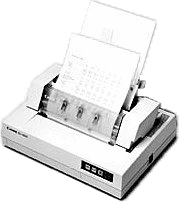
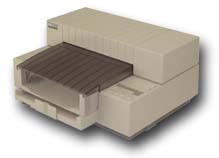
Two Early Inkjet Printers -- The Canon BJ80 and the DeskJet 500
Around 1995, Epson, Canon, and Hewlett-Packard were all competing for
market share in the now sizable inkjet printer market. Each also
shifted it's focus to color printer offerings, using separate cyan, magenta,
and yellow inks to produce color documents. The method of conbining
these subtractive color inks to produce color combinations is similar to
the process used for years in the trade print industry, though the job-to-job
flexibility of producing digital images offered new challenges and opportunities
for composing and combining these colors to produce images. The bonus
of color capability at a sub-$500 price made inkjet products an even more
attractive aternative to black-and-white laser printers. About this
time, world wide web made access to color images easier and easier, and
digital scaners started to find their way home. Soon, customers started
to value not just the ability to print in color, but to demand the best
print quality they could get from these images. In 1996, Epson offered
a 1440x720 DPI color printer, touting similar improved resolution across
it's product line, while most of thier compeditors were still offering
300 DPI or 600 DPI products. With digital photography right around
the corner, the battle for inkjet photo quality was underway.
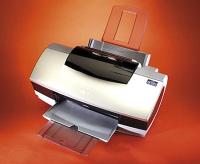
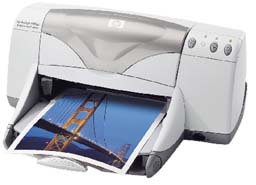
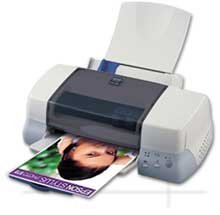
Recent photo-quality inkjet offerings: The Canon BJ Photo S900, HP
Deskjet 990cxi, and the Epson Stylus Photo 870
Current Trends
Currently, most inkjet products touting high quality photo reproduction
are capable of at least 1200 DPI resolution. Hewlett-Packard, Canon,
Epson, and Lexmark all offer printers that retail for less than $200 that
offer this resolution, though all also offer higher priced models with
extra capabilities and features. In many cases, a resoultion level
much beyond 600 DPI makes effective halftoning almost trivial. However,
extremely light shades still offer areas where sparse patterns of dots
are still potentially visible. Also, with higher resolutions come
larger data files, and thus the speed of a printer's ability to convert
raw image information into effective output becomes an important focus
for design. Several companies have tried to find ways to offer exceptional
photo performance at lower resolutions without requiring extrodinary printing
or processing times, many times offering very compeditive image quality
at 600 DPI resolutions.
More than DPI -- Varying Intensity Levels
In addition to trying to sway consumers with better resolution claims,
most printer manufacturers have investigated other ways to achieve excellent
image reproduction. Hewlett-Packard has also used alternatives to
multiple inks such as it's PhotoRet
system to vary ink intensity by combining multiple drops per pixel to achieve
different color intensity levels, while Epson offers drop-size varaition
on some of it's models. Multi-level halftoning techniques are also
relevant to 6 ink printers, where a separate intensity of cyan and magenta
ink is used. Such printers are currently recognized to offer exceptional
performance on images, and by examining the benefits of multiple levels
in halftoning, it's not hard to see why.
Continue to Halftoning Basics
Return to Index