[Home]

Camera Pictures of Image Series


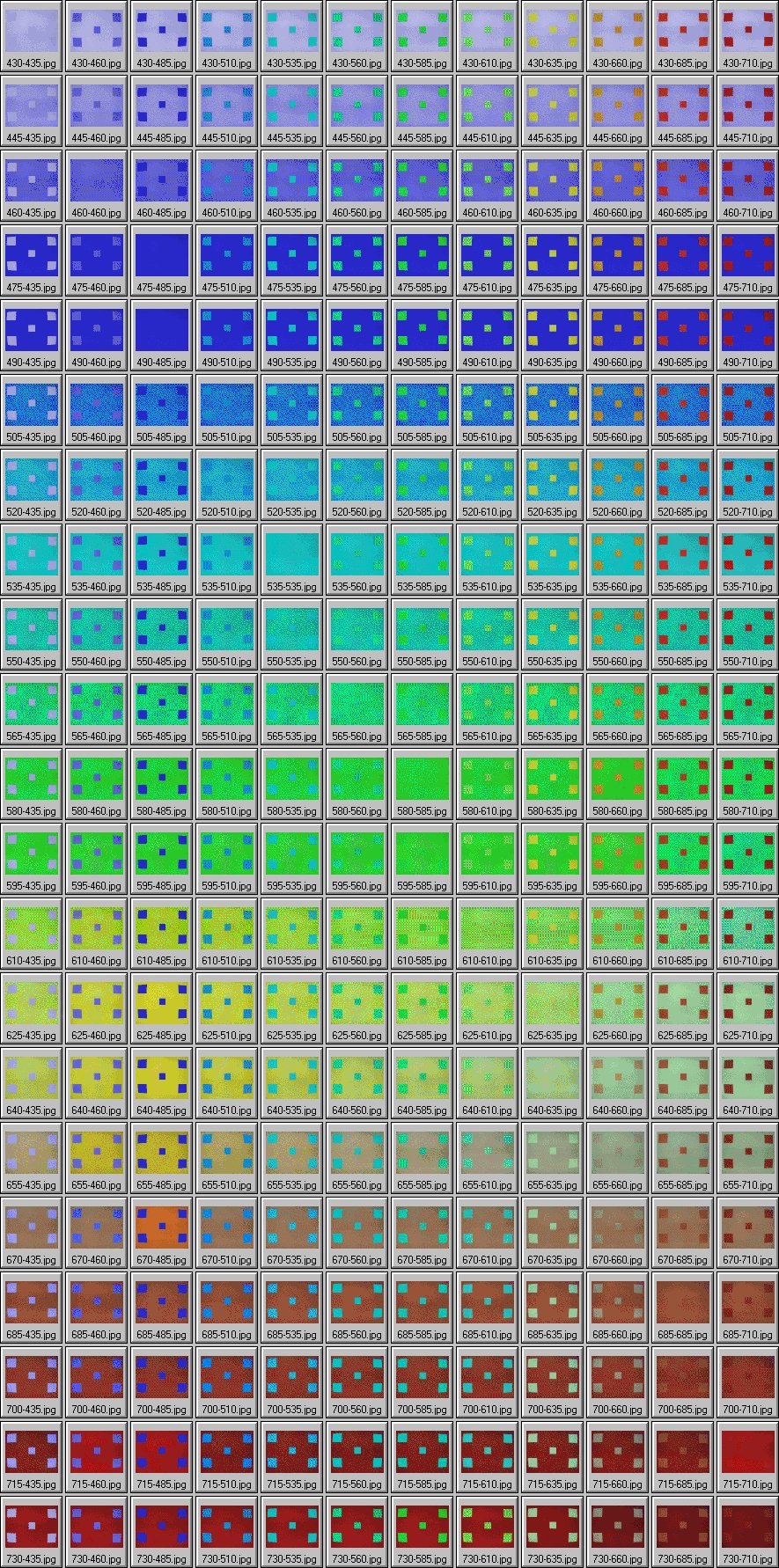
The generated images with the monitor gamma correction were then displayed on the monitor and shoot by the camera.

Taking a picture with camera is not a simple task. The monitor has a refresh rate which the camera will pick up. This causes a bar across of the screen to be displayed lighter than the rest of the screen as that portion of the screen is refreshed. To correct for this problem the camera's exposure time must be decreased so that the screen refreshes a couple times while the aperature is open. For a monitor refresh rate of 85 Hz, the refresh problem can be avoided with an exposure time of 6 EV.

Increasing the time the aperature is open lets more light into the camera over that period of time. This causes the final image to be too bring. To correct for this, a decreased aperature size must be used. This limits the amount of light that is let into the camera decreasing the brightness of the images. The problem is that the aperature size has only two levels, F2.8 (wide open) and F5.6 (decreased aperature). The F5.6 level does not decrease the brighness sufficiently. This means that the exposure time can not be set to 6 EV at monitor light levels. Decreasing the exposure time to 10 EV results in the best tradeoff between brightness and refresh artifacts.

The two sets of images that were shoot contain 264 images. These images were shoot at a resolution of 1280x1024 and saved in JPEG format. This was the only step in the project which introduced compression into the image flow. It was impractical to store these images in the uncompressed TIFF format because this would require 1.8 GB of storage space in the camera.

Images without a center target:

Images with a center target:

trek@alumni.stanford.edu
lihui@leland.stanford.edu