Color Correction Project: PART II
By Firas Hamze
(Part I- Calibration and correction using digital camera
here.)
Color Calibration Experiments with the HP Scanjet Scanner:
The Scanner Imaging Process:
The scanner produces digital images in a similar way
that a digital camera does. A illuminating light is shone onto an object
with a characteristic reflectance profile (different quantities at different
wavelengths are bounced back.) A mosiac of sensors recieve the reflected
light and respond linearly to the intensity. Scanners, however, perform
a gamma-correction process whose purpose is to straighten the nonlinear
relation between CRT intensities and frame buffer values that would otherwise
warp the color appearance.
Calibration:
A scanned image, however, may not closely resemble the
original when displayed on a monitor. Color-calibration systems attempt
to resolve these discrepancies. Percieved colors are often described in
terms of their xyz values, the relative quantities of given primary lights
used by a person to match a color stimulus. Thus, perceptual correspondence
between the original image and the scanned, displayed image is achieved
if the xyz values are concurrent. In the experiments described here, we
attempt to find an agreement between the original image xyz values and
the xyz values of the scanned image.
Experimental Procedure:
The first step was to scan a color source; we used the
Macbeth
Color Checker, displayed in Figure 1.
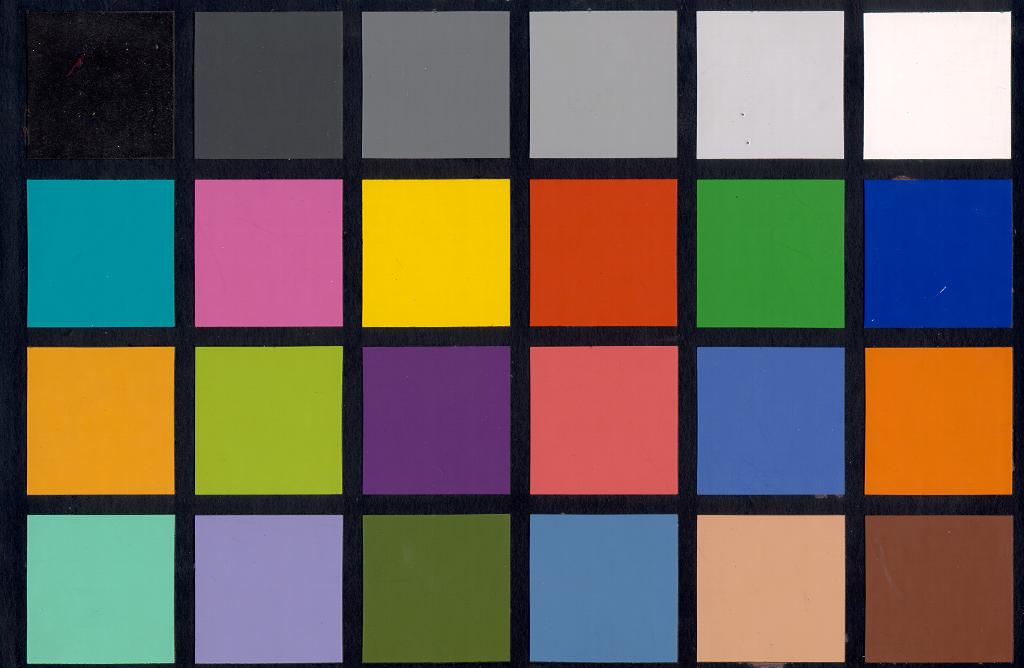
Figure 1:
The Macbeth Color Checker used to get color data.
-
Extract patch reflectance values and compute xyz:
In order to obtain its xyz values, the spectral reflectances
of the surfaces must be known. This was done as follows: the white patch
of the checker was assumed to represent the spectral distribution of the
tungsten light source. This light was divided away at each wavelength (since
the reflection is linear) to leave us with the reflectances. This is shown
pictorially in Figure 2. The xyz relation is the xyz color matching function
multiplied by the spectral radiance of the surface under the scanner light.
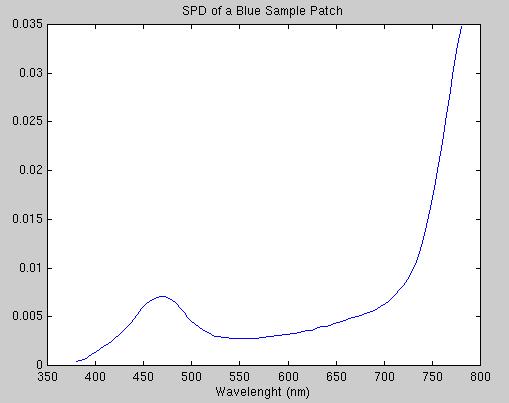
Figure 2(a): The spectral power distribution of the blue patch
shown in 2(d) subject to the light shown in 2(b).
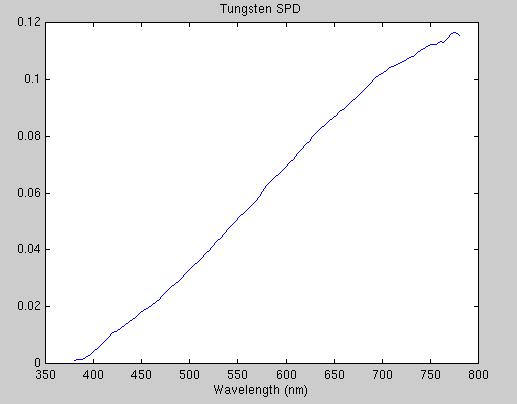
Figure 2(b): Spectral power distribution of the tungsten light
source used to get the xyz data of the patches.
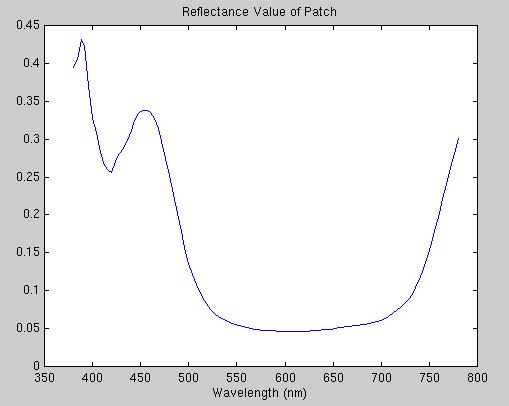
Figure 2(c): Reflectance profile of the blue patch shown in
(d).
Figure 2(d)
We ran into several practical difficulies in obtaining
the spectrum of the scanner light, so the assumption was made that standard
D65 white light is used. The spectrum of this light is shown in Figure
3.
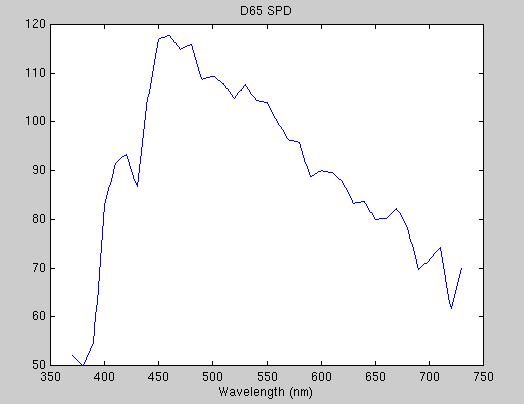
Figure 3: Power distribution of white light.
-
Compensate for gamma correction in the scanner:
The scanner, however, performed gamma-correction on
the light, so that the presumably linear reponse of the sensors was skewed.
This effect is shown in Figure 4, where the mean RGB values for the gray
test patches is plotted against the intensity of the patches as measured
by the luminance component of the spectroradiometer with the light source
removed. The gamma factor was computed by finding the parameter that made
the logarithmic relation derived from the gamma function be the best fitting
line to the data (see the code for details.)
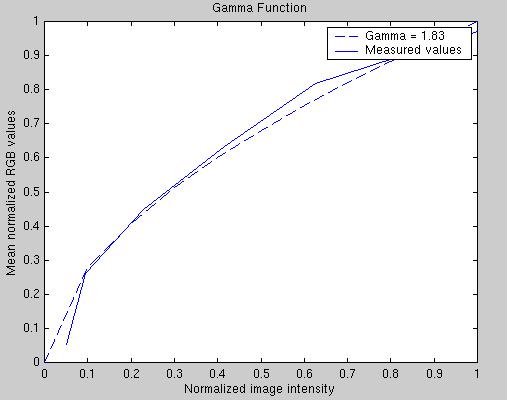
Figure 4: The gamma function. Solid line is the plot of measured
data, the dotted line is that of our best-fitting value of gamma = 1.83.
-
Fit to first- and second-order linear models:
We searched for a relation between the RGB and the xyz
values using both a first- and second-order model described in the section
on camera calibration.
Each test patch's RGB values were normalized to the range [0,1] and transformed
by the inverse of the gamma relation described above. Thus, we obtain the
RGB values that for the given light intensity
would have resulted.
We now have a linear relation between the intensity and the value of the
RGB. The patch xyz values are, as stated earlier, calculated from the radiometric
data and the presumed light source.
It remains to compute a matrix that transforms from
the RGB to the xyz values. 12 of the 24 Macbeth color patches were used
as data to determine the matrix, and the remaining 12 were used to test
it. The data patches were gamma-corrected and the matrix solving the relation
A(rgb) = (xyz) was solved using the known xyz values, and the matrices
from the 2 methods were applied to the test patches and the xyz values
were compared.
Conclusion:
Unlike those relatively successful results of the camera
calibration, the scanner did not seem to be tractable by our model. The
actual xyz values of the test patches are shown below:
xyz =
0.3883 0.1806
0.3319 0.1119 0.3511
0.4683 0.1225 0.4025
0.2153 0.1132 0.2798
0.3659
0.3134 0.1712
0.2266 0.0862 0.4508
0.4387 0.1066 0.3780
0.2274 0.1465 0.2662
0.4929
0.0638 0.4593
0.1671 0.1950 0.1272
0.0908 0.0669 0.2788
0.4254 0.0776 0.4891
0.5380
and the first-order model-predicted
values are:
xyz =
0.5552 1.4108
0.6246 0.3804 0.3162
1.3409 0.7482 0.7298
0.0636 -0.4542 1.4210 0.3061
0.4389 0.4101
0.4300 0.2138 0.2589
0.7208 0.3189 0.6474
0.0668 0.2721 0.4604
0.5073
0.4515 0.0772
0.5551 0.1115 0.2701
0.8538 0.0781 0.7438
0.0875 0.2735 0.2602
0.4493
and second-order values are:
xyz =
0.8229 0.3366
0.9697 0.7439 0.5614
2.2723 0.8255 1.0459
0.0892 -0.8363 0.7409 0.0236
0.5879 0.1557
0.2040 0.4472 0.4212 -0.4086
0.3161 0.5884 0.0907
2.2968 0.4936 1.7329
0.5397 0.3945
0.2260 0.2338 0.3858 -0.7411
0.1060 0.5722 0.1252
2.6730 0.6339 1.8827
The mean-square error in prediction for the first
order model was:
mse = 0.1817
and
mse = 0.6516
for the second-order model.
There are several reasons why this could occurr.
Most obviously, yet most probably, the error was caused by the fact that
the scanner light source was not D65. This would skew the actual
xyz values. Also, the measured gamma value (1.82) was not the same
as the gamma specified in the scanner program (2.23.) We attempted to experiment
with the effect of varying gamma on the xyz values; the change never made
the results substantially more accurate.
Appendix:
-
Code to compute the mean RGB values of a color patch: getRGB.m
-
Computes the value of gamma and plots it:
plotGamma.m
-
Performs the inverse gamma correction on the rgb:
gammaCorrect.m
-
Gives the linear transformation matrix(1st or 2nd order):
train.m
-
Runs the transformation over test data:
testt.m
-
Perform 1st order fitting:
o1fit.m
-
Perform 2nd order fitting:
o2fit.m
References:
See Part 1 on camera calibration.