Any finite two-dimensional image I is uniquely determined by its dipole histogram.
Any finite, discrete, two-dimensional image I comprising M+1 rows and N+1 columns can be constructed using only those of its 'short' dipoles; i.e. those dipoles (dy,dx) with |dy|<=ceil((M+1)/2) and |dx|<=ceil((N+1)/2).
Definition of Dipole Histogram:
D(dx,dy,a,b)=number of pairs [(x1,y1) (x2,y2)] such that
I(x1,y1)=a and I(x2,y2)=b and (x2,y2)-(x1,y1)=(dx,dy) where a,b are intensity values
Apparently D contains no locational information
Proof:
S(m,n)=sum D(m,n,a,b)*a; for a=0:L-1, b=0:L-1
L:intensity value
S(m,n)=sum D(m,n,a,b)*a=sum I(x,y)*I(x+m,y+n) for x=M-1-m, y=N-1-n
I(m,n)=S(m,n)-S(m-1,n)-S(m,n-1)+S(m-1,n-1);
By this algorithm, all I(m,n) can be generated
The second algorithm can also be easily shown by divide the whole image into four quadrants and use the D(m,n,a,b) for (|m|,|n|)<=ceil(M/2,N/2)
Actually the 2 reconstructions are equivalent. The first uses D(m,n,a,b), (m,n)=(0:M-1,0:N-1). The second one uses (|m|,|n|)<=ceil(M/2,N/2)
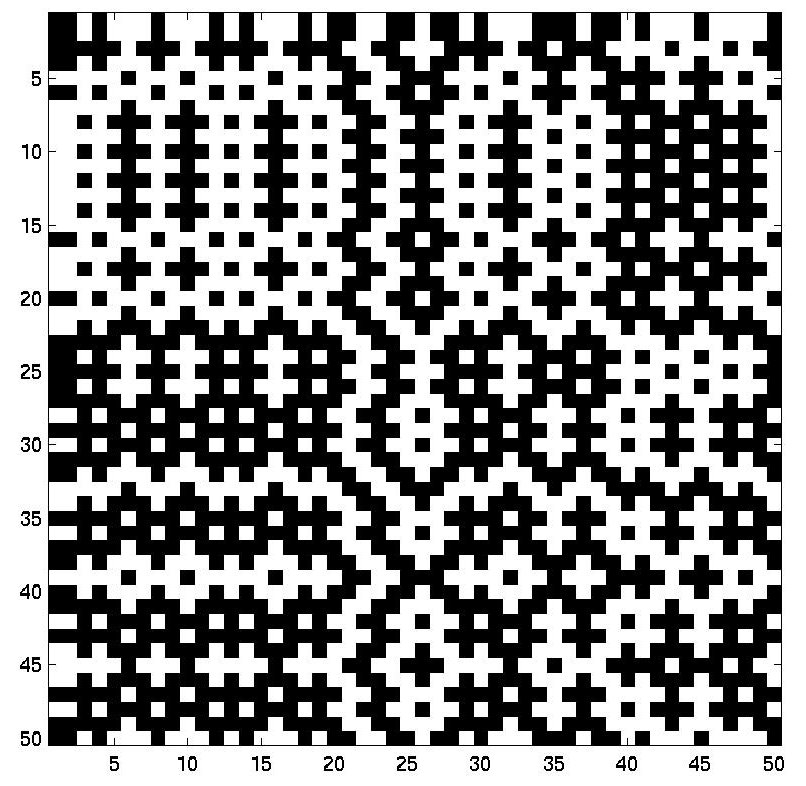
The two versions of Dipole Histogram Uniqueness Theorem are implemented as reconstr.m and reconstrHalf.m
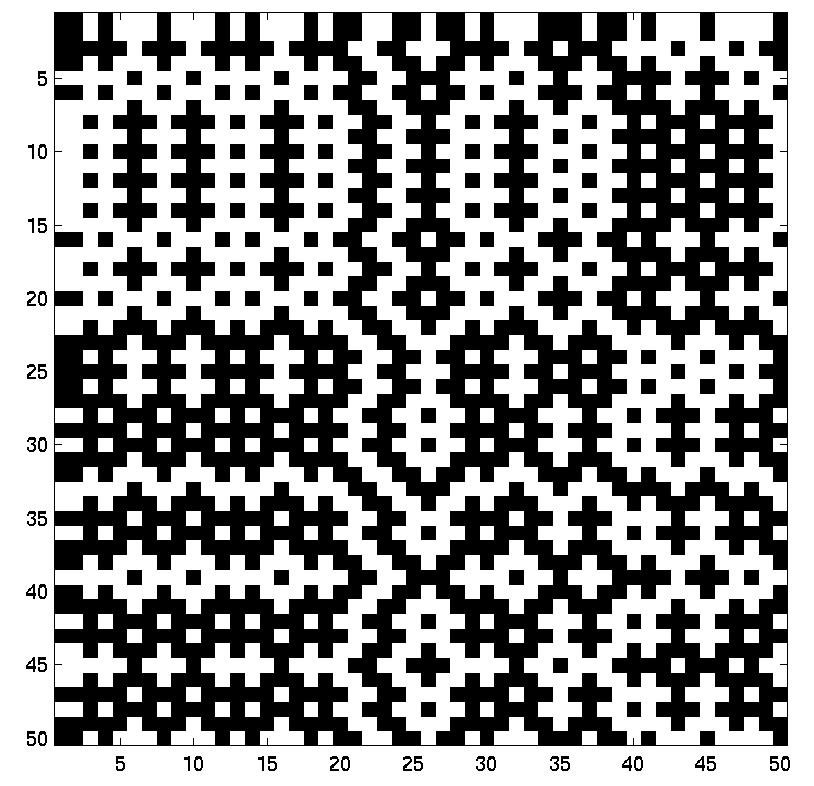
A coin-flip image has been chosen to show the correct reconstruction of the algorithm
 |
 |
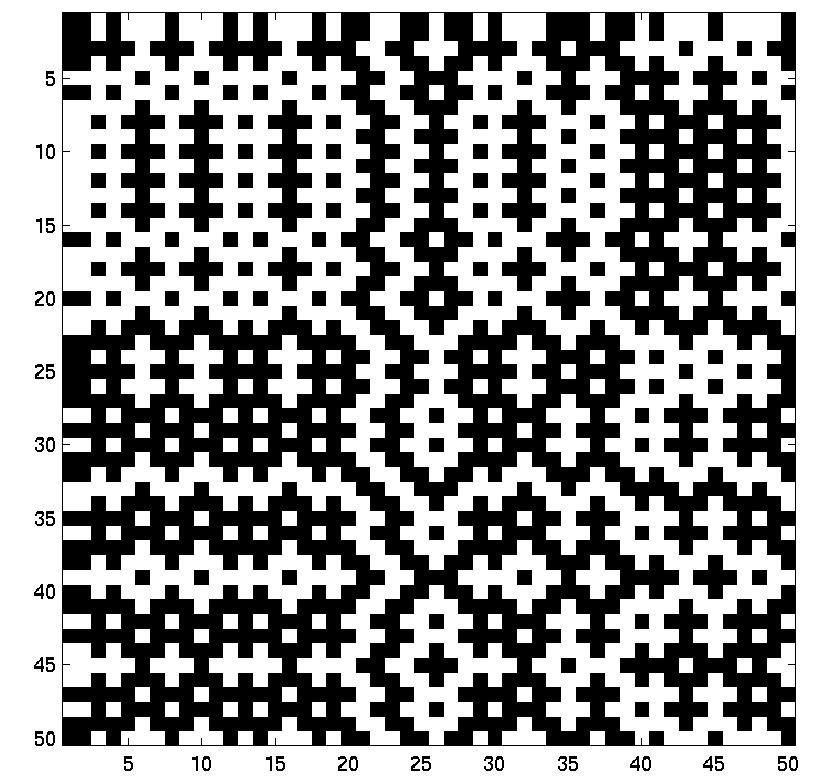 |
| Original | Reconstructed by dipole range 0:M-1 | Reconstructed by dipole -ceil(M/2):ceil(M/2) |
The reconstructed images have been examined by Matlab to be the same as the original.