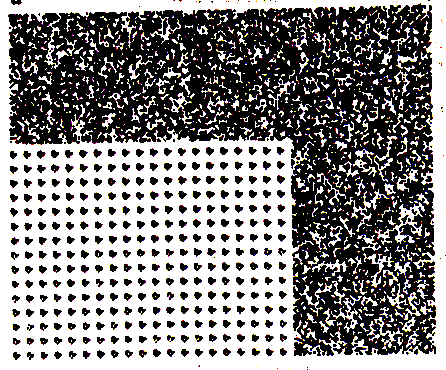
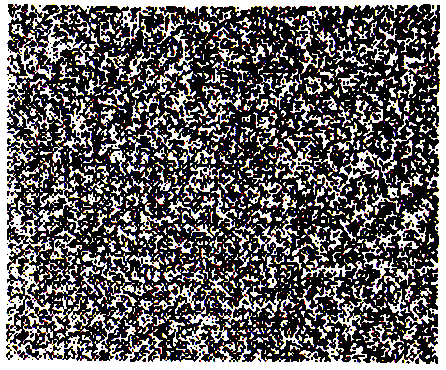
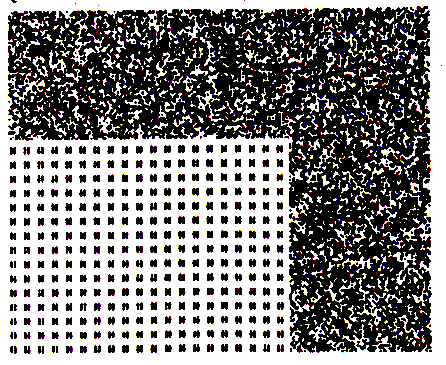
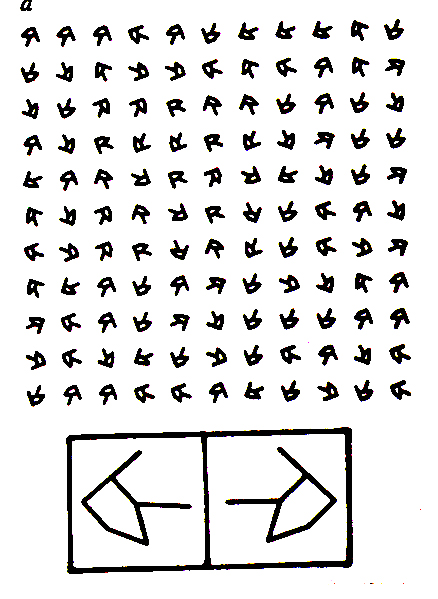
He used the odd and even textures as examples. He claimed that the odd and even textures have the same third-order statistics. Hence they must have the same second-order statistics. Since they can easily be seen as different( spontaneously discriminated), the Julesz Conjecture must be wrong.
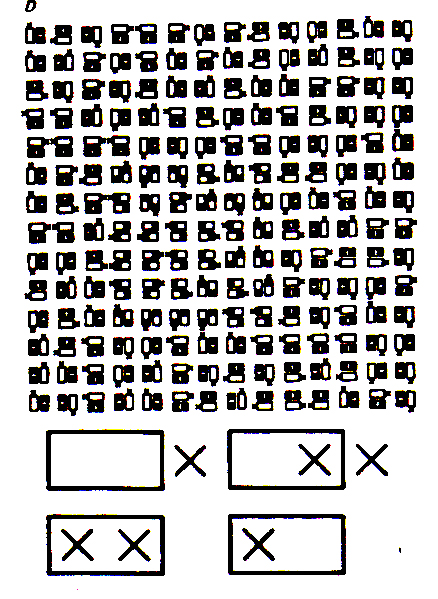
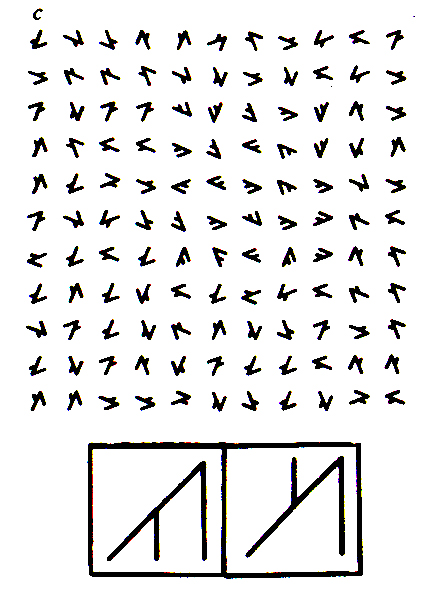
- Odd, even and coin-flip texture images
These are special cases for random square coloring
- Coin-flip texture image:
Each square is determined by a coin-flip process with probability P=0.5 - Odd texture image:
The row 0 and column 0 are generated by the fair coin-flip with P=0.5. The rest are generate by the following formula:
I(m,n)=I(m,0)+I(0,n)+I(0,0) (mod 2)
- Even texture image:
The row 0 and column 0 are generated by the fair coin-flip with P=0.5. The rest are generate by the following formula:
I(m,n)=I(m,0)+I(0,n)+I(0,0)+m*n (mod 2)
- Coin-flip texture image:
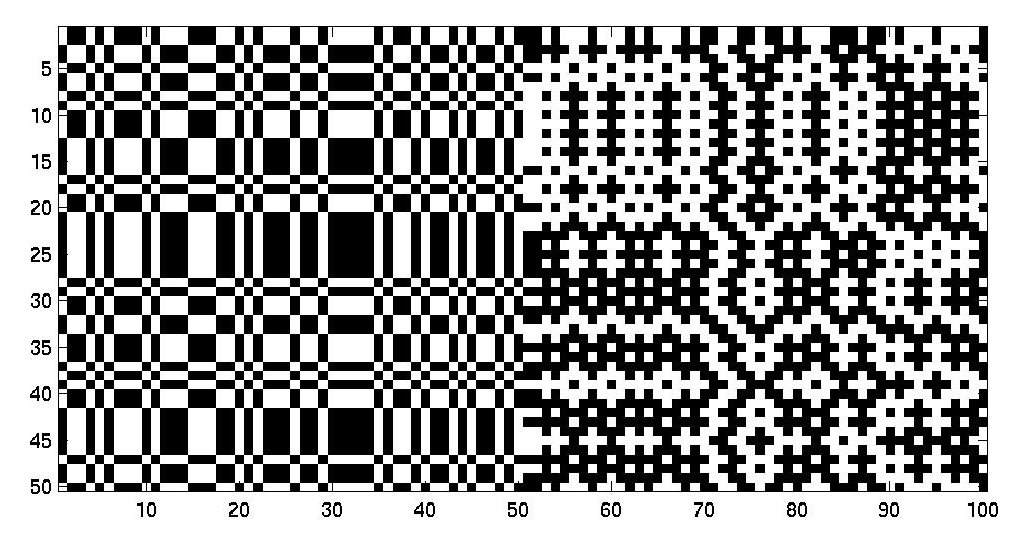 |
| Fig 1 (a) Even & Odd Textures |
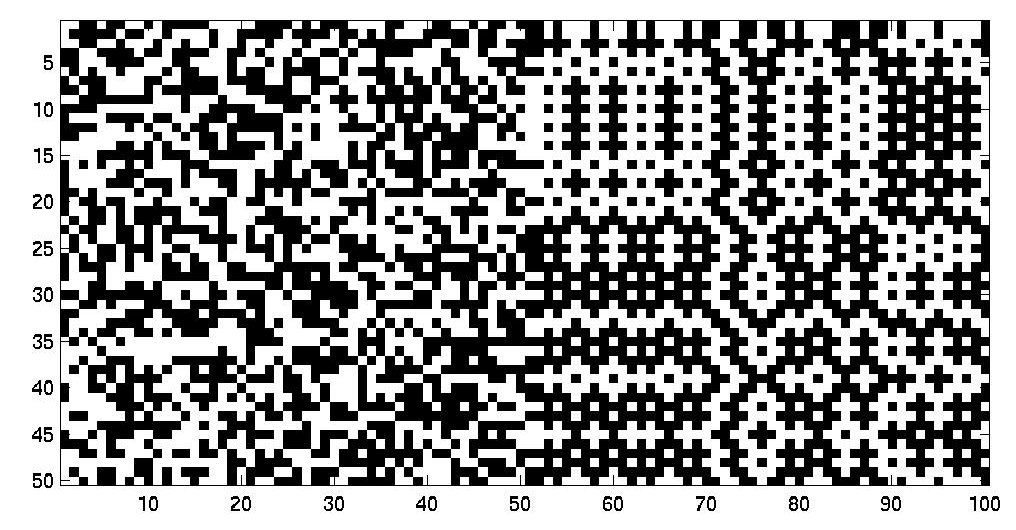 |
| Fig 1 (b) Coin & Odd Textures |
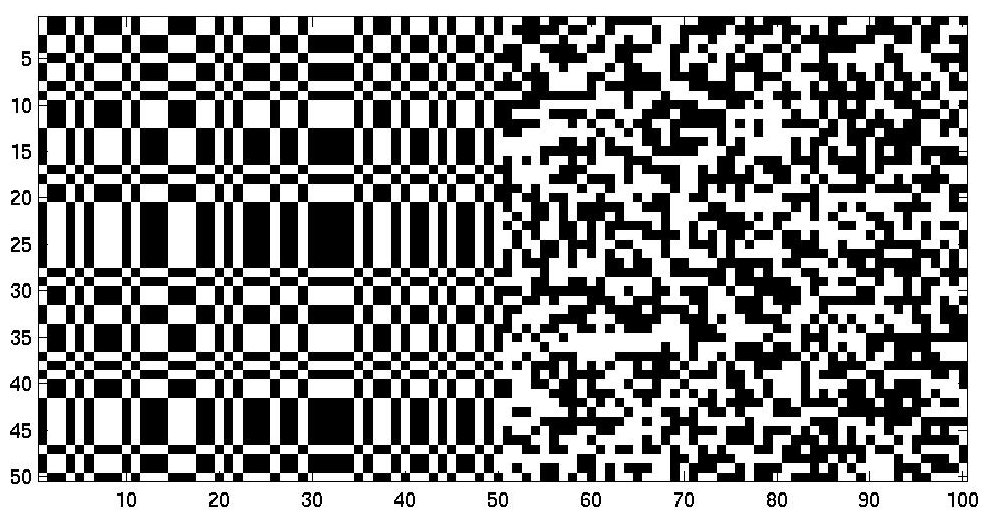 |
| Fig 1 (c) Even & Coin Textures |
Although his conjecture was proved to be wrong, Julesz still stated that texture images with the same second-order statistics, iso-second-order textures, are usually indiscriminable. He proposed a Modified Julesz Conjecture
The pre-attentive textural system cannot globally compute third- or higher-order statistics
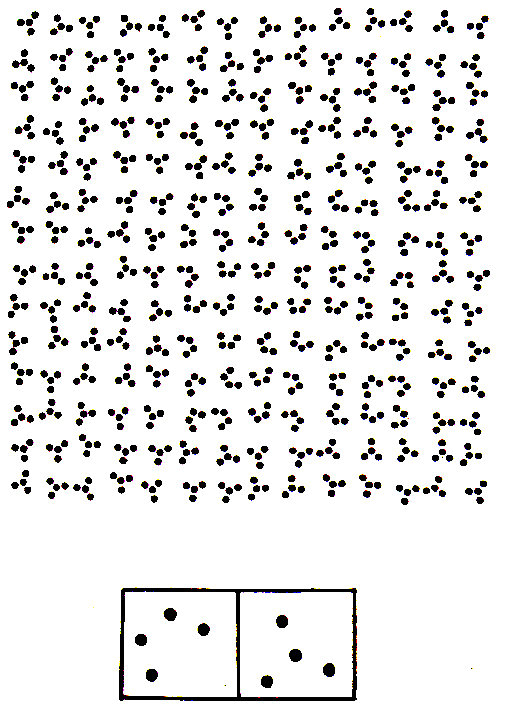
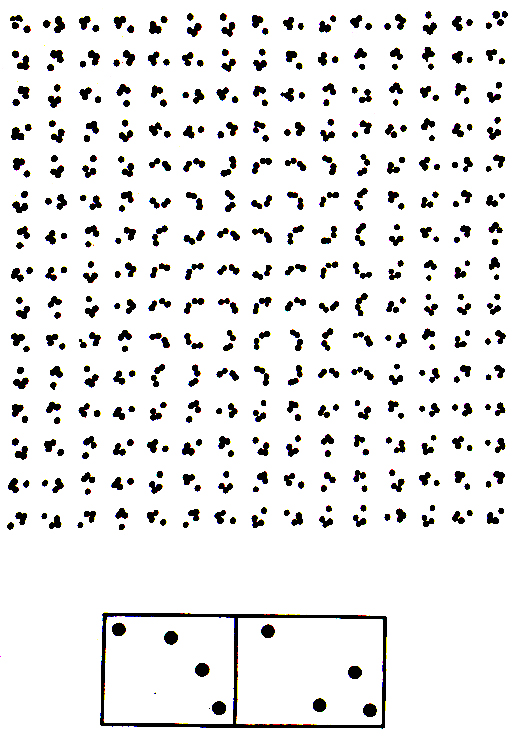
He and his co-workers adopted a four-disk method to generate isometric dual micropatterns. They claimed that these texture images will have identical second-order statistics if these micropatterns are randomly thrown.
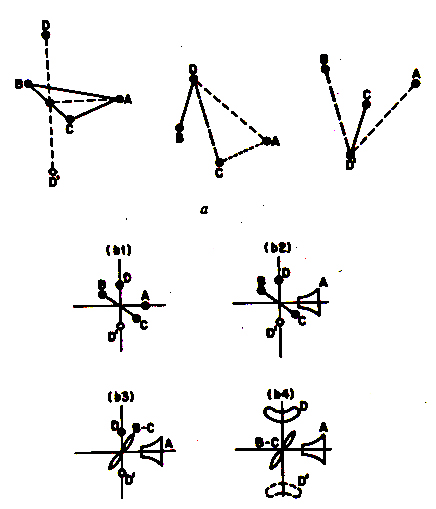 |
Julesz and his co-workers generated several pre-attentive indistinguishable texture pairs with identical second-order but different third- and higher-order statistics.
 |
 |
 |
| Micropatterns and mirrors | Dual micropatterns | Dual micropatterns |
Because iso-second-order statistics means identical autocorrelation functions and identical power spectrum, Julesz concluded that the pre-attentive visual system ignores the phase (position) spectrum that is so conspicuous when the elements are viewed by focal attention. This implies that
The operation of two visual system
The insensitivity of pre-attentive texture perception implies a parallel system.
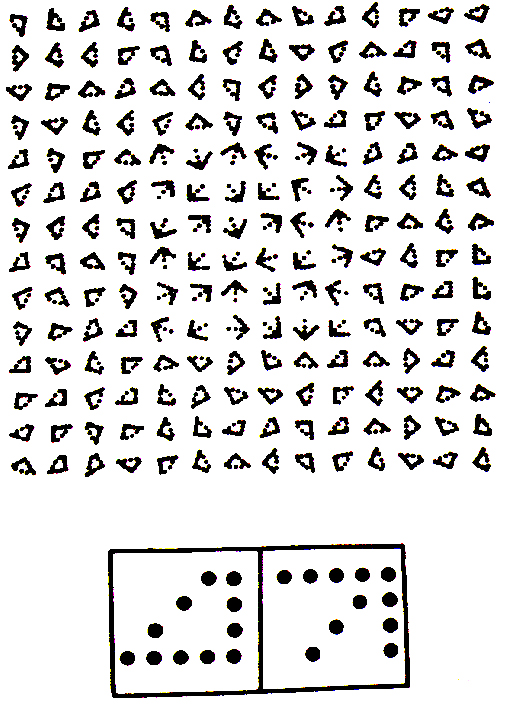
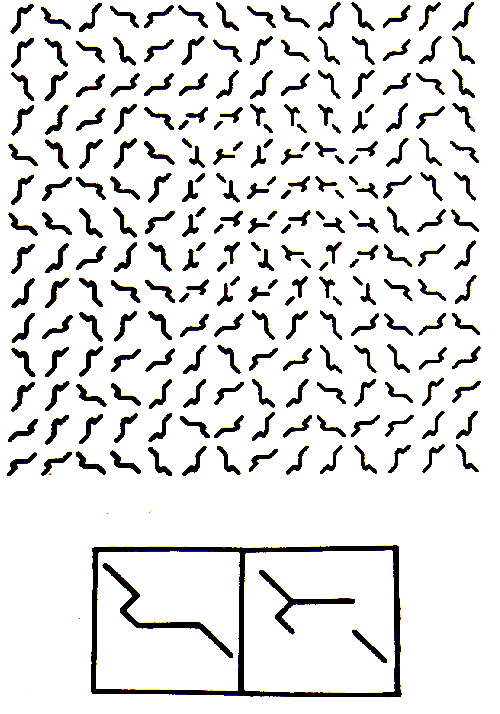
Julesz observed that many seemingly conspicuous features do not yield texture discrimination in the iso-second-order statistical constraint, so he thought those local features should be very special ones. They should be regarded as the basic elements of pre-attentive perception, and named texton.
 |
 |
| Just below threshould | Well above the threshold |
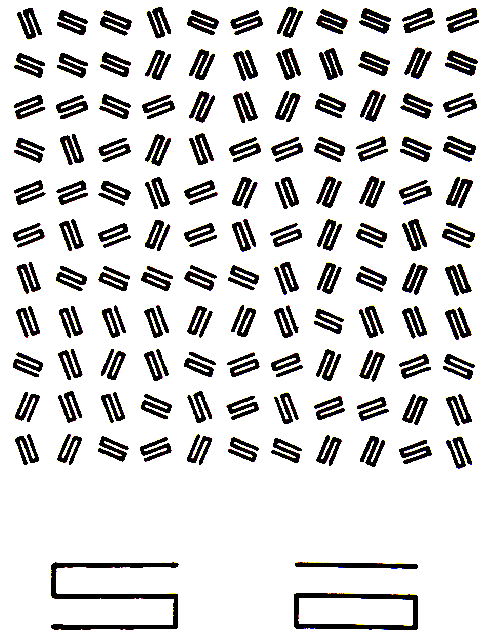
Several discriminable local conspicuous features were found: closure, corner, connectivity, granular
 |
 |
|
| Closure | Connectivity | Granularity |
Although the local features above make the above textures discriminable, Julesz didn't think they are all qualified to be the basic elements, textons. From his research, he concluded that he found only three kinds of textons