 |
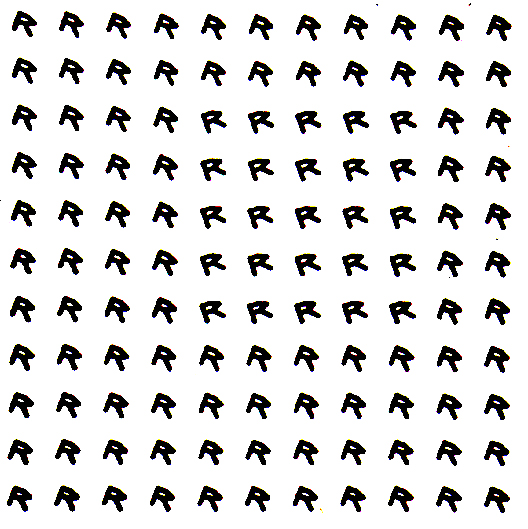 |
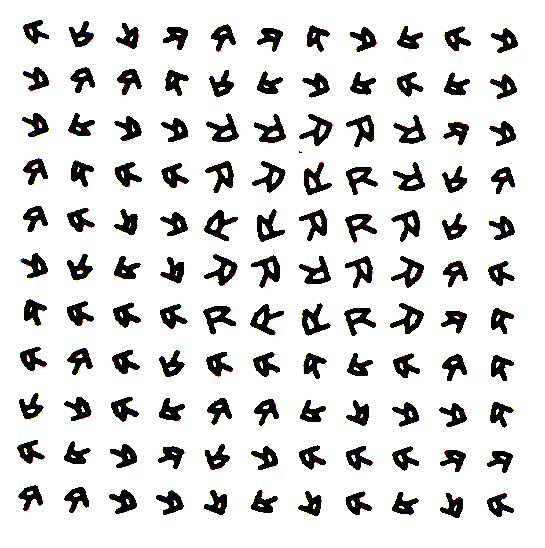
| Difference: size & first-order statistics | Difference: orientation & second-order statistics |
In the early stage of pre-attentive texture discrimination, researchers had a question. Is it the local or the global statistics difference that causes the discrimination ?
|
|
|
| Difference: size & first-order statistics | Difference: orientation & second-order statistics |
In a seminar paper in 1962, Julesz first brought out a question:
Can some pairs of distinct textures be instantly seen as different (spontaneously discriminated) while others can be distinguished only after careful scrutiny. He asked whether the perceptual dishotomy can be predicted on the basis of global image statistics corresponding to the joint probability distributions that characterize stationary stochastic processes.
A decade later, he and co-workers proposed a specific hypothesis know as the Julesz Conjecture:
Textures cannot be spontaneously discriminated if they have the same first-order and second-order statistics and differ only in their third-order or higher-order statistics.
Surviving for a about a decade, the conjecture was first proven wrong by Julesz's group themselves. After that many researchers have disproved this conjecture by other methods.
Understanding the limitation of the global statistics, Julesz proposed the local conspicuopus features, called texton as the basis of texture discrimination.
A similar higher-order relation was proposed and proved later. Triple Correlation Uniqueness theorem:
If two texture samples have identical third-order statistics, they must be physically identical images and thus visually nondiscriminable by definition.
Yellott discussed this theorem in his 93 paper and proposed his counter examples to Julesz conjecture.
Another similar measurement of the image's global statistics is Dipole Histogram.
At the first sight, a relational information like dipole histograms can be uniquely generated from the locational information, images. However the location information could possibly be lost during the process. In 2000, Chubb and Yellott proved that
Every discrete finite image is uniquely determined by its dipole histogram.
In this project, we are going to show Julesz's textons and implement Yellott and Chubb's algorithms and discuss the results.