The Goal of Image Enhancement
While a basic theorem of information theory states that no transformation
can increase the amount of some information, a transformation can improve
the match between the presentation of the information and the perceptual
characteristics of the user. Image enhancement seeks to achieve just this:
to improve the visual representation of an image to enhance its interpretabiliy
by the human viewer.
An Overview of Image Enhancing Techniques
Image enhancement techniques can be divided into two broad categories:
(1) Frequency domain methods and (2) spatial domain methods. Frequency
domain enhancement involves multiplying the Fourier Transform of the image
with a filter. The enhanced image is taken from the inverse Fourier Transform
of the result. The intuition behind choosing filters for this purpose is
fairly strong. You blur an image (and hence reduce sharp transitions
associated with noise) by reducing its high frequency components and you
sharpen an image by increasing its high frequency components. However,
these methods are less efficient to implement than their spatial domain
counterparts. In the spatial domain, the value of each pixel in the enhanced
image is the the result of performing some operation on the pixels in the
neighbourhood of the x-y coordinaties of the pixel. Neighbourhoods can
be as small as a single pixel (referred to as a grey scale transformation)
or as large as the whole image (global processing).
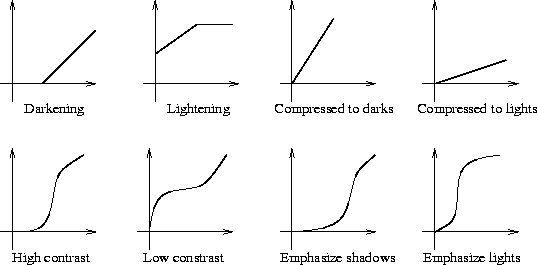
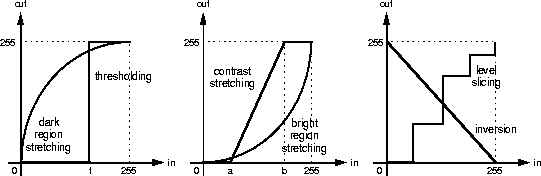
Examples of grey-scale transformations are shown below:
Enhancement of poorly-exposed Images
Image enhancement is an important branch of image processing, correcting image degradations that not even the most sophisticated cameras available today can prevent. In this study we will focus on the enhancement of poorly-exposed greyscale images to produce output images of acceptable tonal qualities.
How do we decide when an image is poorly-exposed and when the exposure is correct? While the exposure level depends on the desired effect, we can safely say that at the "correct" exposure, we want to record with greatest detail the subject of the image rather, not caring too much about the background. For good detail and to be visually pleasing, the subject must occupy the mid-tones
Several image enhancement techniques exist to enhance the tonal quality (restore the optimum brightness and contrast) of digital images both locally around a point or region and globally. These techniqes use the overall nature of the image at the local or global level (whether is is light or dark etc) and compensate by increasing/decreasing the intensity of pixel values (through histogram modification etc).
We will next proceed to demonstrate two of these techniques, namely
contrast stretching and histogram equalization. We will then discuss an
alternative global enhancement algorithm which differs from the traditional
techniques described above.
Contrast Stretching
The contrast of an image is the distribution of its dark and light pixels.
A low-contrast image exhibits small differences between its light and dark
pixel values. The histogram of a low-contrast image is narrow. However,
since the human eye is sensitive to contrast rather than absolute pixel
intensities, a perceptually-better image could be obtained by stretching
the histogram of an image so that the full dynamic range of the image is
filled.
Original (over-exposed) book image:
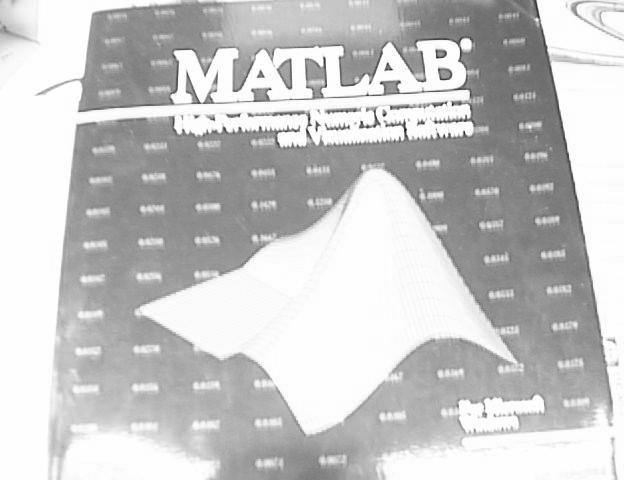
Using Matlab to perform the contrast-stretching:
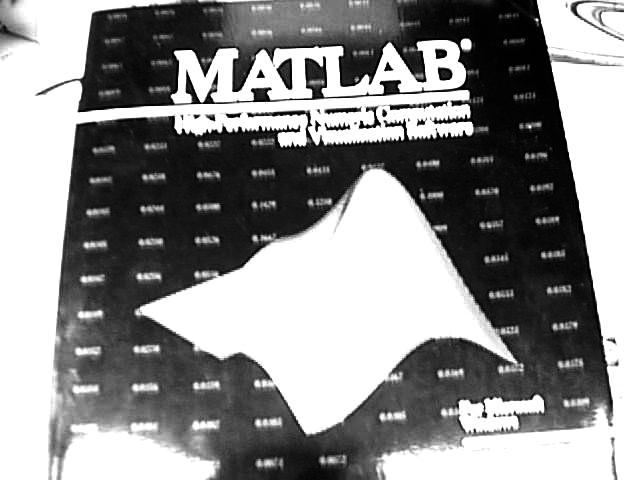
Notice how the contrast between the light and dark pixels is much greater
now.
Histogram Equalization
Histogram Equalization is a common technique for enhancing the appearance
of images. Consider an image that is predominantly bright such as the over-exposed
image of the Matlab book cover (greyscale) below. The histogram of the
image would be skewed towards the lower end of the grey scale and all the
image detail is compressed into the bright (high intensity) end of the
histogram. If we could 'stretch' out the histogram to produce a more uniformly
distributed histogram, the details of the image would be more clearly visible.
Original (over-exposed) book image:
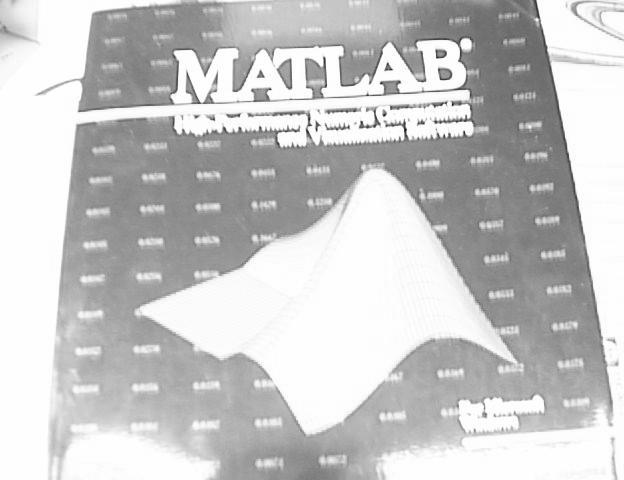
Using Matlab to perform the histogram equalization to 256 grey values, the "enhance" image below was obtained:
Histogram-equalized book image:
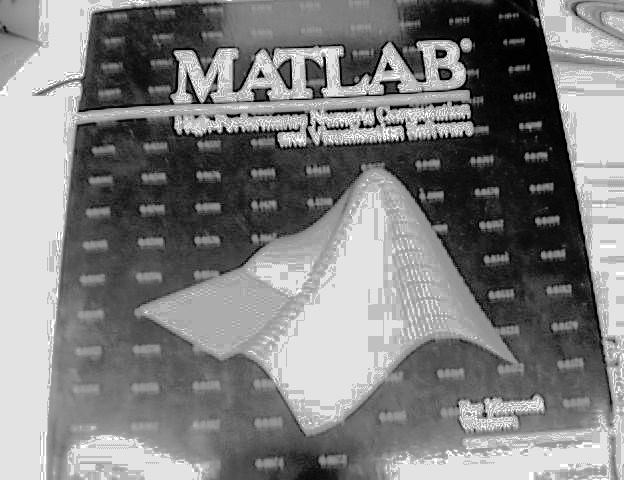
Notice that the finer details of the image are indeed more clearly visible
on the histogram-equalized image. However, while the histogram-equalized
image does have greater contrast, it suffers from false-contouring and
quite a bit of speckle noise.
The problem with grey-scale transformations
The major drawback of techniques like histogram equalization described above is that they are "blind" to the visual contents of the image. Consider an image with a dark background and a slightly underexposed subject. Histogram equalization would consider this image to be strongly underexposed and the "enhanced" image would have an unnecessary lightened subject and/or could reveal details in unwanted places (eg the background). Histogram equalization is a good example of processing information without much thought for asthetics. In the attempt to reveal more detail by moving extremes to midtones, enhanced images look gray, sacrificing the quality and contrast between blacks and whites.
So what if we were to remove this blindness handicap? In the next part
of this project, we study an automated global enhancement technique exposure
correction on digital images.
A Global Enhancement Algorithm For Exposure Correction
In this technique, an image is no longer summarily described by a histogram. Instead, we pay attention to the visual contents of the image. This results in a two-step process:
1. visual analysis
An attempt is made to identify regions in the image which are visually
more important to the viewer. These are the segments for which we would
want the greatest level of detail since they matter the most. The metrics
by which we judge the how "visually importantance" of a segment of an image
are: focus, contrast and texture. Simple statistical
measures are developed to evaluate these features.
2. enhancement
Now that we have the visually significant segments of the image have
been identified, we can proceed to enhance the image. Recall that our goal
is to reveal the most detail in the visually significant segments. This
is done by applying a gray-level transformation that maps the average intensity
of all the visually important segments to neutral gray. However, we would
like to keep the tonal variations in the extreme dark or extreme light
tones (which are assumed to be in the background and hence not important)
small i.e we don't want to reveal more detail than necessary in the background.
This is achieved by performing an exposure correction operation based on
the exposure-intensity curve of the camera.