MARC
(Methodology for Art Reproduction in Color)
The MARC system was built after the VASARI project completed, and uses much of the same technology, with a greater focus on printing out accurate results, since color images stored on the VASARI system could not easily be reproduced on paper with good color fidelity. MARC produced a catalog, Flemish Baroque Painting, Masterpieces of the Alte Pinakothek, Munchen, the first all-digital colorimetric art catalog. The catalog was produced in order to promote the methodology established during the project, with the hope that industry would be willing and able to commercialize it.
MARC vs. VASARI
System
The main difference from the VASARI system is that the MARC lighting subsystem is fixed, and does not move with the camera. This results in a slightly different gain characteristic in each tile. This is partly compensated for by performing a full-field calibration analysis to generate a 7x9 set of correction factors.
Analysis of printing tests showed that the 8 bits per channel (used commonly in TFF) often lead to contouring when printed. MARC uses a 12 bit A/D converter instead of an 8-bit, and set a standard of 10 bits of L and 11 bits for each a and b. The Eab color difference averages approximately 3 E, slightly less accurate than the VASARI system.
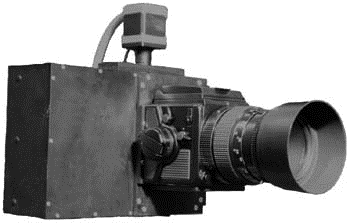
MARC also has a faster mechanical system, and can perform quick low-resolution scans for reference. The camera is mounted on a two-way motorised stage. To capture each frame, the sensor is moved by motors within a pixel separation distance of 11 by 17 um to 6 by 8 positions. The camera is then positioned across the 6 cm by 6 cm focal plane of the lens to 7 position horizontally and 9 positions vertically of 3k by 2k each. The result is a resolution of around 20k by 20k pixels.
Process
Like VASARI, MARC has overlap areas between tiles. These are examined to correct position, but have an additional use : they are examined for differences in brightness (due to different gain characteristics), and a correction factor is calculated for each tile.
The MARC Printing System
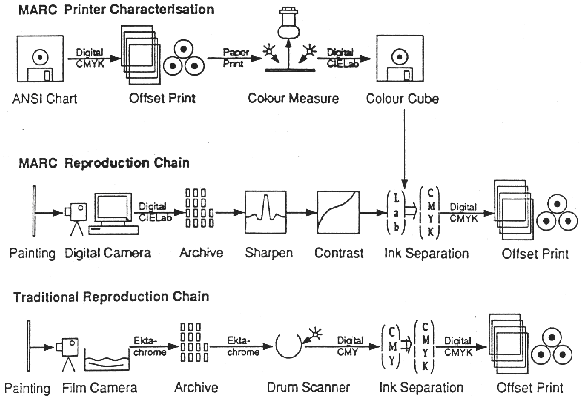
MARC generates a 3D look up table to convert the XYZ coordinates from the image to CMYK coordinates for printing. This is done by printing, using the target paper and ink, 140 color patches from the ANSI IT-S chart, and then measuring each patch. The press calibration package fits a set of third-order polynomials and inverts them to produce the lookup table. For colors outside of the specified gamut, an automatic mapping procedure is used. If the color is close to the edge, it is moved in. If it is far out of range, it is not used. The press operator prints a proof of each image for comparison of all subsequent images. The resulting MARC book has excellent color matching, particularly in the lighter paintings.
The entire MARC process, as compared to traditional art reproduction, is shown in the figure below.