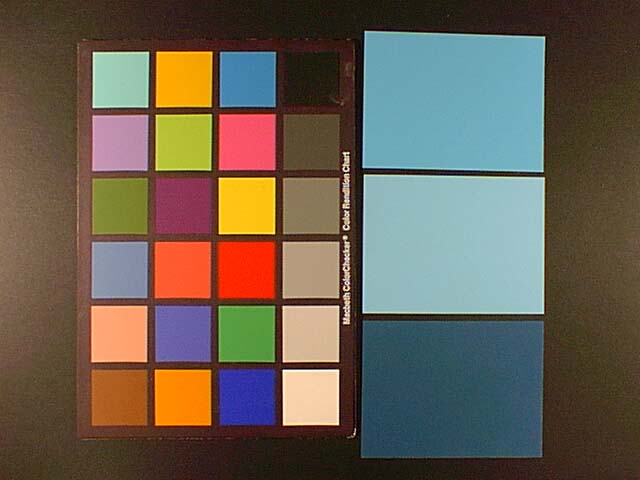
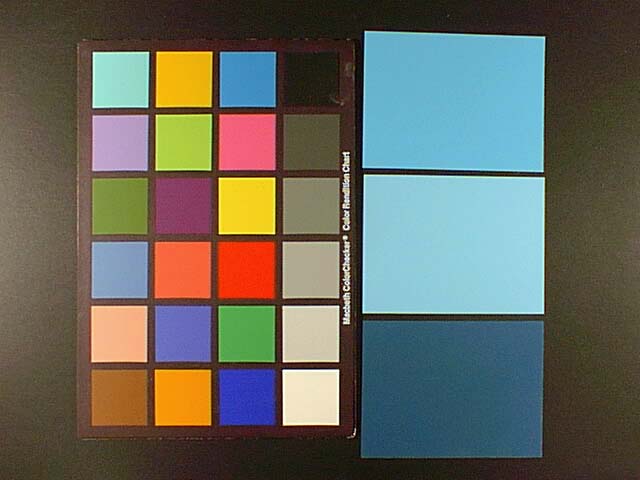
Initial attempts to photograph single color swatches with the Olympus camera ran in to some difficulties. It appeared in both the preview mode, and through some sample pictures that the image colors were being adjusted based on the overall colors in the field of view. While moving the samples around had no effect on this, adding one more color was sufficient to drastically change the appearance of the original swatch. It appeared that the camera was balancing the colors by averaging across the scene.
Please note that for this page, we'll refer to the camera's output (the initial photographs) as the "balanced" images and the data in which we've removed the camera balancing function will be referred to as the "unbalanced" images.
Although color balancing is generally desirable, the experimental set up had unusual features that caused problems. The camera was reading the intense illumination reflected back from the light table as ambient light. Also, there were only two colors, the matte black and the sample to be measured, that the camera could use for balancing. As a result, the colors of the swatches were severely distorted. With advice from Hareesh Kesavan, a Macbeth Color Checker was included in every image. It acted as a constant in every image, and remained in a standard location.
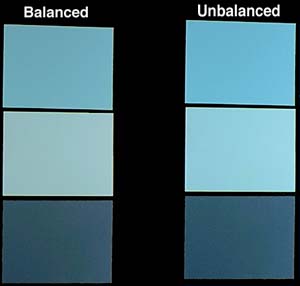
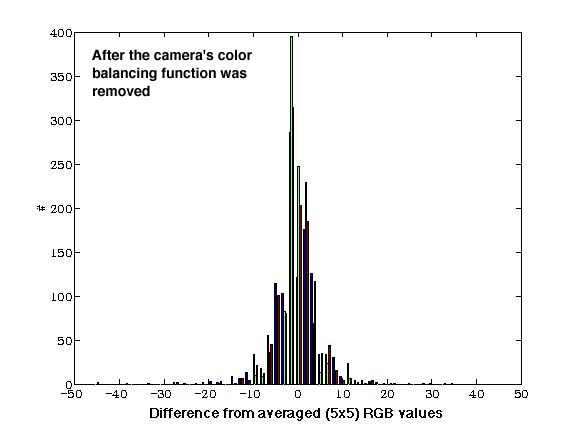
We were then capable of measuring the RGB values of the Macbeth Color Checker in the same manner as the color swatch measurements in every photo. The values for each square of the Macbeth were averaged over all the digital images taken. This averaged Macbeth chart was used as a benchmark to which each individual photo was compared. Using our assumption about the camera's need to balance over the entire field of vision, we were able to "unbalance" the images. In the following graphs one can see the difference that color balancing made. The graphs show the distribution of the samples showing errors, errors being the deviation of RGB values from the benchmark.
Image of Macbeth chart with swatches, balanced (ie no changes)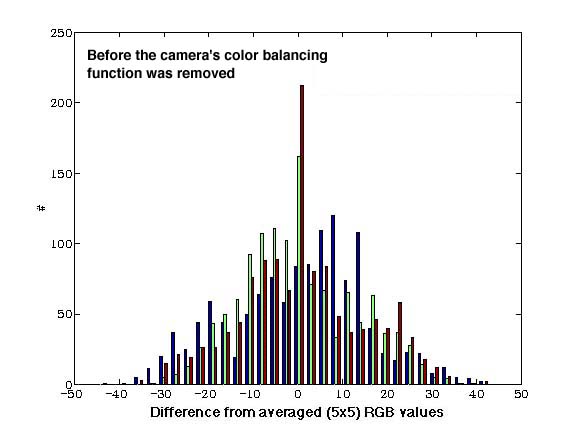
This next graph shows our "raw data", the same images with the color balancing backed out. The standard deviation is reduced by a factor of three, showing great improvement.
Image of Macbeth chart with swatches, unbalanced